THE nation’s capital market reached a historic high of RM4.3 trillion in 2025, reflecting a 3.2 per cent increase from RM4.2 trillion in 2024, supported by robust corporate bond issuance and continued inflows into fund management activities.
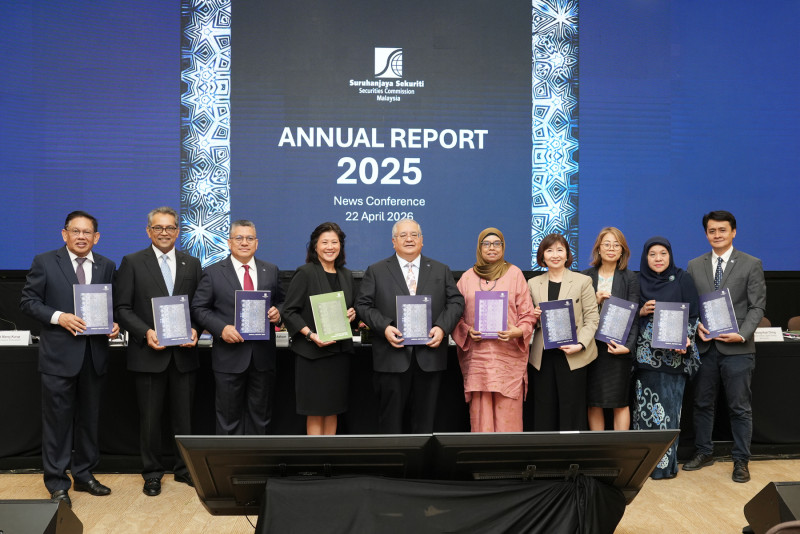
The milestone was announced in the Securities Commission Malaysia’s (SC) Annual Report 2025, alongside the Audit Oversight Board Annual Report 2025 and the Capital Market Stability Review 2025, all released on Wednesday.
The regulator said the stronger performance came despite a challenging global environment marked by geopolitical tensions and persistent trade frictions that weighed on investor sentiment and global financial markets.
However, average daily trading value in the Malaysian equity market fell 19.7 per cent to RM2.76 billion in 2025, compared to RM3.44 billion in 2024, reflecting more cautious participation amid heightened uncertainty.
SC chairman Datuk Mohammad Faiz Azmi said the results demonstrated the underlying strength and resilience of the domestic capital market.
“The 2025 results reflect the fundamental strength of the Malaysian capital market. By balancing market development while safeguarding market integrity, the SC continues to provide a stable, innovative environment for all stakeholders,” he said.
He added that the regulator remained alert to global risks arising from geopolitical instability, economic uncertainty and rapid technological change, but maintained a positive outlook for the sector.
Looking ahead, he said the Capital Market Masterplan 2026–2030 would play a key role in sustaining reforms and strengthening Malaysia’s competitiveness and investor protection framework.
“However, with the forward-looking Capital Market Masterplan 2026-2030 in place, the SC is optimistic that the Malaysian capital market will stay on course in delivering reforms, boosting market competitiveness and inclusiveness, strengthening governance frameworks and enhancing investor protection,” he said.
The report highlighted broad-based growth across key segments.
The Islamic capital market expanded 4.31 per cent to RM2.7 trillion, while assets under management rose 6.9 per cent to a record RM1.14 trillion, driven by improved fixed-income performance and higher asset valuations.
Total capital raised through the market surged 35.4 per cent to RM187.7 billion, while a record 60 initial public offerings were recorded in 2025, surpassing the 55 listings achieved in 2024.
Venture capital and private equity commitments also rose 21.66 per cent to RM30.05 billion, while alternative financing channels provided RM5.7 billion in funding to micro, small and medium enterprises as well as mid-tier companies.
Malaysia’s regional positioning improved further during the year, with the country recognised by the IFRS Foundation as one of the first ASEAN jurisdictions to adopt the International Sustainability Standards Board (ISSB) framework under the National Sustainability Reporting Framework.
The introduction of the Single-Family Office incentive scheme also attracted interest from regional investors, with nine conditional approvals issued, representing nearly RM670 million in indicative assets under management.
On enforcement, Mohammad Faiz said Malaysia achieved “Regular Follow-up” status under the Financial Action Task Force assessment, the highest possible rating, reflecting strong compliance standards.
In 2025, the regulator initiated 96 criminal charges against 16 individuals for securities law breaches, securing nine convictions with custodial sentences of up to three years and fines totalling RM13.1 million. Civil enforcement actions recovered RM11.14 million through disgorgement and penalties.
A further RM1.98 million was returned to 239 investors, while RM8.63 million was earmarked for 993 additional affected individuals. The SC also imposed 99 administrative sanctions amounting to RM8.28 million.
The Capital Market Stability Review 2025 found that Malaysia’s financial system remained stable despite external pressures, with no systemic risks identified.
It noted that equity and derivatives markets functioned in an orderly manner underpinned by strong risk management frameworks, while no corporate bond defaults were recorded. Listed companies continued to demonstrate resilient earnings performance.
Capital adequacy levels among intermediaries remained comfortably above regulatory requirements, while stress tests showed investment funds were able to withstand redemption shocks without relying on liquidity buffers.
Meanwhile, the Audit Oversight Board Annual Report 2025 reported that 41 audit firms and 397 individual auditors are currently registered under its supervision.
During the year, the board inspected 41 audit engagements conducted by 14 firms and engaged with 724 audit committees to reinforce governance standards and audit quality awareness.
It also contributed to international regulatory discussions on audit quality and ethics, providing Malaysian input to global standard-setting bodies.
Enforcement actions were taken against two audit firms and six auditors, resulting in penalties and prohibitions totalling RM423,750.
For the first time, the board also suspended an audit firm and two partners over serious audit quality concerns and failure to improve following previous inspections. - April 22, 2026