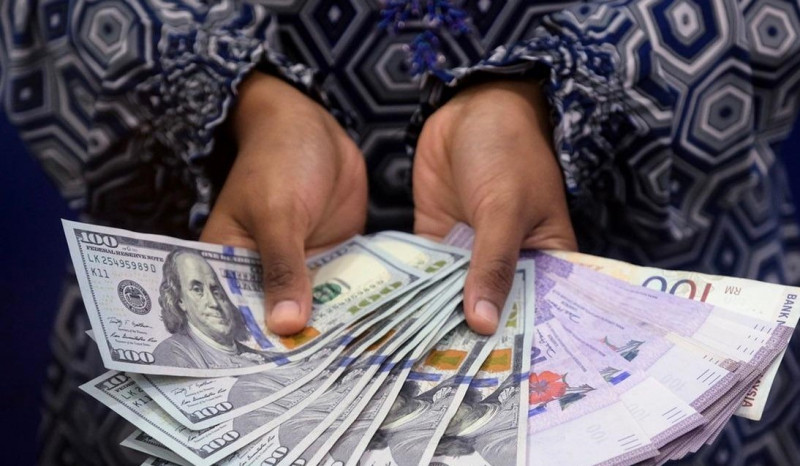
KUALA LUMPUR – The Malaysian ringgit is playing catch up to the US dollar as surging global interest in the greenback increases its demand and value tremendously.
The sharp increase in the US dollar has resulted in the ringgit depreciating 5.3% year-to-date (YTD) to RM4.3987 against the US dollar on Friday from RM4.1763 on January 1, 2022. The local note is expected to slide further following the decision by the US Federal Reserve to increase interest rates.
The declining value of ringgit against the US dollar have triggered alarm bells among economists, forcing the government to find ways to stabilise the exchange rate for the local note.
What the government faces today is similar to what it encountered during the 1998 Asian Financial Crisis (AFC) and 2008 Global Financial Crisis (GFC), which saw the ringgit plunge against the greenback.
The value of ringgit was at RM3.80 and RM3.46 against the US dollar respectively before measures were taken to stabilise the local note.
The striking difference was that the price of oil witnessed a slump at the end of 1998 and 2008, where its average price were at US$12.76 per barrel and US$96.94 per barrel respectively, compared to around US$106.61 per barrel today.
Hence, why has our local currency depreciated against the dollar when oil is trading higher than before?
The answer is that not only the ringgit faces pressure but also currencies of developed nations are facing it as well.
According to Bank Islam chief economist Mohd Afzanizam Abdul Rashid, there are various factors that influence the movement of a currency especially in terms of demand.
He said this could be either short term or structural in nature, such as something that is more permanent.
The economist said the short-term factors could come in the form of, among others, interest rate decisions by the major central banks such as the US Federal Reserve as well as other factors such as geopolitics like the war in Ukraine.
“During these uncertain times, demand for safe-haven currency namely the US dollar would be higher because the currency is deemed to be stable and liquid. This will happen all the time,” he said.
Besides the ringgit, he said the Singapore dollar also weakened 3.42% against the US dollar, the Thai baht depreciated 4.52%, the Indonesia rupiah eased 2.39%, the Taiwan dollar declined 7.15% and the Japanese yen went down 10.7% against the greenback YTD.
What could be done to minimise the impact?
Among the measures taken to mitigate the 1998 AFC were the pegging of the ringgit against the US dollar as well as the closing down of the overseas trade of the ringgit and the trade of Malaysian shares in Singapore to put an end to speculative activities in the currency and local market.
Measures were also taken to regulate capital flows, particularly short-term capital outflows by foreigners and local citizens.
During the 2008 GFC, the government had employed fiscal and monetary policy, stabilising the banking system and strengthening the economic outlook to stabilise the ringgit.
As a result, the banking system had sufficient capital to resolve the crisis and it was relatively difficult for Malaysian authorities to borrow from foreign banks.
Malaysia also adopted measures to deal with the crisis in the form of a fiscal stimulus package and an easing of monetary policy.
However, Afzanizam said the measures taken in 1999 and 2008 were not the best measures to be replicated to solve today’s problems.
“We have to understand that the effect of currency movement is always two-way. It can be a costly affair to importers as they have to pay more but exporters are benefitting from it since export prices become highly affordable from the foreign buyer point of view.
“I suppose the government should focus on managing economy by ensuring that growth will remain intact and can facilitate the business community to prosper and more quality and high-paying jobs will be created along the way,” he said.
He said by doing so, the local currency would align itself with the state of the economy and its prospects.
Besides that, Afzanizam said another crucial aspect is subsidies for the people to mitigate the rising inflation as well as prices of basic necessities.
“We admit that there are cases of misused subsidies but the reform needs to be halted at this juncture to avoid the situation from worsening.
“What we need is a roadmap and direct communication with businesses to ensure the people do not have to carry this burden on their shoulders,” he said.
Light at the end of the day
Regardless, rest assured that what the country faced today has been faced before and the government will take necessary measures to mitigate the impact on the people.
Among them would be the tightening of monetary policy by Bank Negara Malaysia as announced on Thursday and an increase of the minimum wage to RM1,500 from May 1, 2022 onwards.
Based on the announcement of the first quarter of 2022 (Q1 2022) GDP on Friday, which came in higher than expected due to the growth in domestic demand, namely consumption and investment, there are signs that the local economy is improving post-pandemic.
The further reopening of the economy has been instrumental in contributing to the domestic economy as households and businesses are free to engage in activities that could raise the GDP.
As the economy improves, more jobs are created, the supply chain resumes to normalcy, investments return and monetary and fiscal measures are taken, Malaysia will regain its footing and the ringgit will stabilise. – Bernama, May 15, 2022