HONG KONG – Hong Kong and Shanghai stocks saw big swings today following the previous day’s rout after Xi Jinping tightened his grip on power in China, while other Asian markets extended gains on hopes the Federal Reserve will slow down its pace of rate hikes.
Optimism about upcoming corporate earnings was also providing support, with Wall Street chalking up another strong day ahead of reports this week from big-name firms including Apple, Amazon and Microsoft.
Investors were keeping a wary eye on developments in China after Xi at the weekend was handed another five-year term as leader and gave top jobs to a number of loyalists who back his strict zero-Covid-19 strategy.
The policy of lockdowns and other strict measures has been a major cause of the country’s economic woes and the prospect of more upheaval has sent chills through trading floors.
The uncertainty resulted in a drop of more than 6% in Hong Kong yesterday, with tech firms – which have been hardest hit by Xi’s crackdown on a range of private-sector companies – taking the brunt of it.
And the selling spread to New York later in the day, with the Nasdaq Golden Dragon China Index of 65 Chinese stocks diving 14% – its biggest fall on record – wiping more than US$90 billion (RM426.7 billion) off their market value.
Alibaba, JD.com and Tencent all saw double-digit losses, matching the selling earlier in Hong Kong.
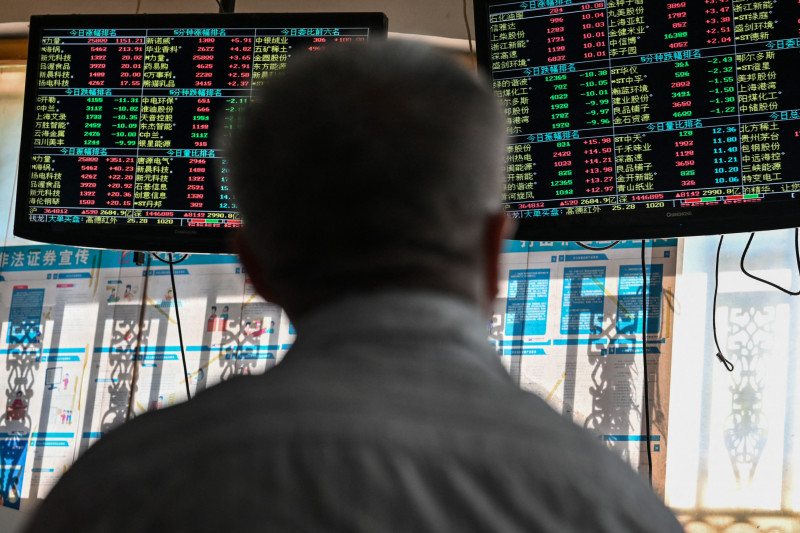
Any hopes for a bounce from bargain-buying today appeared to be short-lived with wild fluctuations in the city seeing the Hang Seng Index swing from gains to losses.
Shanghai struggled to get out of negative territory, while the onshore yuan sank to its weakest level since 2007 and the offshore yuan hit a record low.
“We’re certainly staying away from the Chinese market right now because the political scene is not favourable,” Laila Pence, of Pence Wealth Management, told Bloomberg TV.
“There’s a lot less risk in the US and just as much upside.”
The gloomy mood in China cast a shadow over an otherwise positive start to the week elsewhere as investors were cheered by a report suggesting the Fed could discuss at next week’s policy meeting the possibility of slowing down its pace of interest rate hikes.
The bank’s policy of ramping up borrowing costs to fight decades-high inflation has hammered global markets this year as investors worry that they will send the economy into recession.
“Investors are getting more confident that inflation will soften as the consumer rethinks massive purchases,” said Oanda’s Edward Moya.
“Fed rate hike expectations will remain volatile, but expectations are growing that a weaker economy will let the Fed pause their tightening after the February policy meeting.”
Tokyo, Sydney, Seoul, Singapore, Wellington, Manila and Jakarta all rose, though Taipei fell.
Focus is now on the release of earnings, with a sense of hope that the results will not be as bad as feared.
A fifth of S&P 500 companies have so far released their figures, with more than half beating expectations, according to Bloomberg News.
The yen hovered around 149 to the dollar after rallying Friday and yesterday, with speculation swirling that Japanese authorities had intervened to support the struggling currency.
However, there are expectations it will continue to drop owing to the divergence between the Bank of Japan’s ultra-loose monetary policy and the Fed’s tightening.
The pound was also sitting around US$1.13 as the choice of former chancellor Rishi Sunak as Britain’s next prime minister provided a sense of stability after weeks of uncertainty caused by former leader Liz Truss’ controversial debt-fuelled budget. – AFP, October 25, 2022