_receives_a_memento_from_Sabah_Credit_Corporation_Chairman_Datuk_Seri_Dr_Yee_Moh_Chai._Jason_Santos_pic._9_Nov_2023.jpeg)

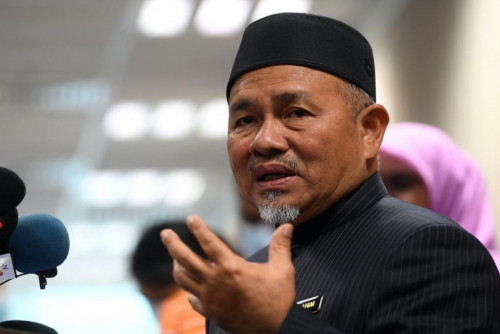
KOTA KINABALU – Sabah Finance Minister Datuk Seri Masidi Manjun has hinted to leaders of the state linked firm’s that are performing badly to voluntarily resign from their posts, saying that they should “know when is the time to stop.”
He said this in reference to the dismal performances of a couple of hundred state government-linked companies (GLCs) this year while pointing out that the state government only has two choices to deal with loss-making state firms.
“Only two things can happen – you change them or you close the company,” he said.
“We are already considering it (closing loss-making GLCs). I believe I have to set a deadline. But I think all of us are intelligent enough that there is nothing free in this world. Even the air is not free now, as it's very much polluted.
“Somehow, we are now purifying the air to make it breathable again… There’s no point doing the same things over and over again but expecting different results.
“It is the definition of insanity. If you have that in mind then you will know when is the time to stop,” he said, implying that the heads of such GLCs should resign voluntarily.
Masidi said this to reporters after launching Sabah’s super-app called Yono, owned by the Sabah Credit Corporation, at the Sabah International Convention Centre here yesterday.
Chief Minister Datuk Seri Hajiji Noor had recently expressed his disappointment over the dismal performance of the GLCs in the state, pointing out that their dividends and contributions have dropped 8.8% from the amount the government received last year.
Sabah has over 200 GLCs and statutory bodies, but just a little more than ten companies are meeting their commitments to the government.
Asked about the possibility of hundreds of locals losing their jobs if the GLCs are shut down, Masidi said the GLCs are not an extension of any government department as they had been established to make money for the government.
“The government is not running charitable organisations. You (GLCs) are supposed to make money to pay for their workers’ own salaries. If you expect the government to pay your salary, then it becomes a charity.
“So, my simple answer is that we do give opportunities to people to prove themselves, we know the challenges they have. But there is a limit to the charitable nature of the government… any government, for that matter,” he said.
Masidi also refuted accusations that GLCs are incurring losses due to political appointments, saying that companies can still make losses even when experts are leading them.
Speaking on the launch of the Yono super app, Masidi said there’s no need for other GLCs to develop their own apps unless there is a specific need for it.
He said that Sabah Credit Corporation is willing to accommodate other GLCs to provide their services through the application.
Towards this end, he also advised all GLCs not to compete against each other but instead focus on positive development in areas where they are currently strong. – The Vibes, November 10, 2023