
A NOT uncommon classical Chinese poem from the poetically opulent age of the Tang Dynasty is said to hover, with some sense of melancholy, over the annual Lunar New Year, the celebration signalling the arrival of spring.
Sometime in the 9th century, amidst a rebellion in China, the poet Cui Tu, makes his way home:
"The road to Ba is a long, long way
Still, I am making this fearful journey of ten thousand li
In the melting snow beneath the jagged mountains at night
A stranger in a strange land
Alone, gradually growing distant from family and friends
Becoming closer to my companions instead
How does one bear moving from place to place,
What will the New Year bring?"
A year ago, in the year 2020, in the numerologically ominous year of 4, travellers from various provinces of China began making preparations to return home to the landlocked, densely populated city of Wuhan in the Hubei province in Central China.
Early murmurings of a human-to-human transmitted virus resembling the perilous SARS had been discovered in a fish market. Earlier in December of the previous year a doctor at a Wuhan hospital who had been treating patients with SARS-like symptoms sent out messages of warning to fellow doctors. He was immediately ordered to “stop making false comments” and “spreading rumours” by the authorities.
Dr Li Wenliang was later to fall prey to the Coronavirus and hailed as a hero by the inhabitants of his native city. Just ahead of that Lunar New Year, President Xi Jinping ordered the lockdown of Wuhan, heralding a year of lockdowns everywhere that would bring the world to the complete close, from which it has yet to emerge.

But for a few crackpot reports of a sage here and seer there who had made some sort of prediction of an unknown “plague”, no geomancer, diviner or astrologer had predicted this age of the virus. Most had simply predicted the 2020 Year of the Metal Rat to be one of renewals and new beginnings. For all their mastery in the art of prediction, few appeared to possess, instead, the mastery of metaphor, allegory and parable in which so much of the classical art of astrology and astronomy was inspired. The Rat, after all, in the history of the Chinese zodiac was characterised as among most beguiling, deceptive, even duplicitous of the animal signs, and greeting its arrival would require equally astute powers of interpretation.
It is narrated that the Chinese zodiac was created by the Jade Emperor, the representation of the First God. Looking for 12 animals to serve as his personal guardians, the Jade Emperor dispatched an immortal being into the earthly realms to spread the message among the animals that the earlier one went through the Heavenly Gate, the better the rank one would have in his Order.
This began the great animal chase towards the Heavenly Gate. It was the Rat who set off earliest. Making his way to the Heavenly Gate he came across a river. Stalled there due to the rapid currents, his passage was long delayed. In the distance he saw a diligent ox, just about to cross the river. Sensing an opportunity to finally cross the river without being swept by the swift currents, the rat leapt upon the ox and secured itself in the ox’s ear.
Diligent ox paid no heed and made way across the river. Once on land, the rat swiftly jumped out of the ear and made his way quickly to the feet of the Jade Emperor. Being the first to reach the Heavenly Gate and the feet of the Jade Emperor, Rat became the first animal in the Chinese zodiac, followed by the ox.
The complete Chinese zodiac, believed to represent the many cycles of the natural order and arranged according to the cycles of the moon was eventually organised, myth recounts, by the first Emperor Huangdi, and written upon the back of a tortoise shell.
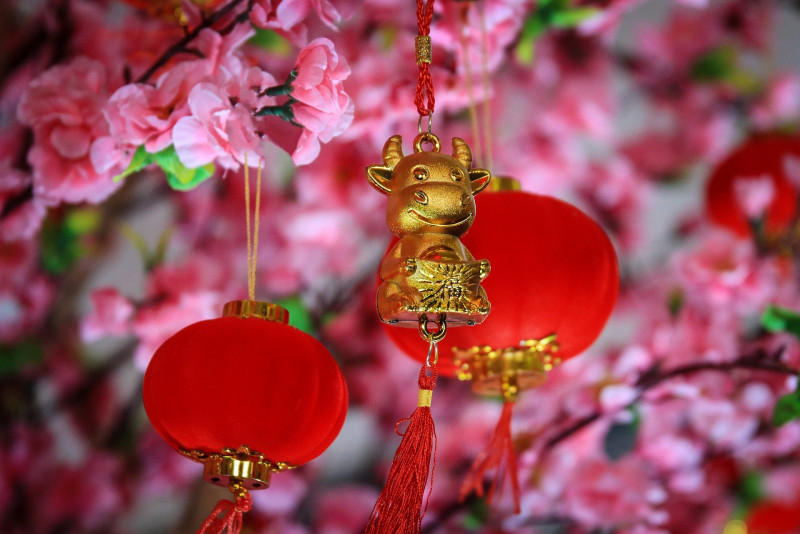
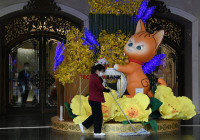
The Ox represents all the traits of diligence (stubbornness even), trustworthiness and reliability, a contrast to the guile and trickery the previous Year of the Rat brings. Already a year, predicted by geomancers, as allowing for “trust” and “predictability” this Lunar New Year of absent banquets and silenced fireworks will see the Ox emerge, our hands on its horns, attempting to cross that river of swift rapids, to repeat, in the words of an old Chinese couplet, “first the Ox, then only the grass”. – The Vibes, February 12, 2021

.jpg)