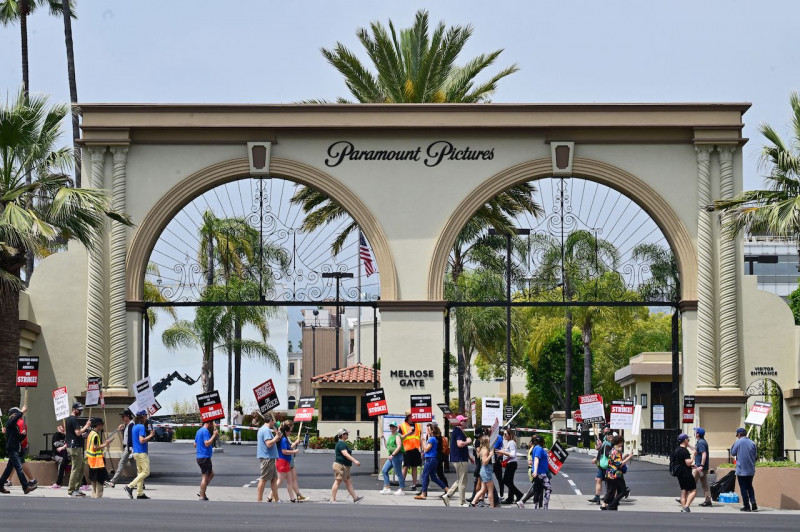
IMAGINE Hollywood without the iconic call, "Lights, Camera, Action!" To date, it has been 100 days of silence. Not on screen, but behind it.
America's writers and actors have pressed "pause", and the impact of their strike is rippling out far and wide.
Hollywood, like the rest of the world, endured the three-year Covid pandemic, during which most films and TV shows ground to a halt, then, when they returned, faced rising production costs. It is experiencing its own new nightmare – its US$134 billion (RM620.35 billion) film and TV industry has shuddered to a standstill.
Having survived the pandemic, Hollywood faces the new challenge of the Writers Guild of America (WGA) and the Screen Actors Guild (SAG-Aftra) combined collective union action. They have been, collectively, on strike for over 100 days.
Though their cause is seen by many as justified, the economic repercussions of it reached well beyond the glitz and glamour of the entertainment capital to all US states, especially those with high concentrations of production activity, like California, New York, and Georgia.
Being out of work has dealt a heavy blow not just to actors and writers but to the very fabric of the entertainment industry's economic ecosystem and the service industries that support it.
The numbers tell a chilling story: according to Todd Holmes, a professor from California State University, Northridge, the ongoing strike might have already drained California of at least US$3 billion, an estimate grounded in the economic analyses from the 2007 WGA strike. Adjusting for inflation, Holmes linked the past strike's US$2.1 billion in lost revenues, which rendered 37,700 jobless, to the current US$3 billion calamity.
The ripple effect of this financial upheaval is spreading out from the epicentre to impact the entire US economy.
Local restaurants, prop houses, set constructors, dry cleaners, professional drivers, florists, musicians, insurance companies, banks, payroll companies, realtors, fitness gyms and more – they all feel the weight of the standoff.
As Holmes rightly pointed out, "Many around this industry are suffering. It's been challenging."
It is not just about Hollywood anymore. The reverberations have been felt far and wide.
Lee Ohanian, professor of economics at University of California, Los Angeles, noted that nearly 20% of Los Angeles' income comes from those in entertainment or related fields. If one of every five dollars earned in Los Angeles comes from showbiz, when they spend less, everyone feels it.
And with entertainment industry wages notably higher than the average, any dip in their discretionary spending, especially on big-ticket items like cars, appliances and homes, sends amplified shockwaves through the whole United States.
Award-winning actor Billy Porter recently revealed in an Evening Standard interview that he had had to sell his house to save money during the strike.
The implications for California's housing market are unsettling. Kevin Klowden of the Milken Institute told the press that heightened rent prices may drive low-income earners out of California, reminiscent of the mass exodus witnessed during the previous writers' strike in 2007.
And it is not over yet. Hollywood's current labour dispute may make history: previous strikes in 1988 and 1960 lasted 22 and 21 weeks respectively. As we approach the 15th week of the current standoff, it is grimly plausible that this might be the longest strike Hollywood has ever endured.
The shuttering of virtually all productions, as reported by The New York Times, following the WGA's, then SAG-Aftra's vote to strike, only deepens the crisis.
Big companies like Netflix and Disney, which are heavily dependent on keeping their massive content pipelines primed, are feeling the pressure. With the entertainment industry already grappling with transitions to streaming and post-pandemic adjustments, union demands seem impractical to management.
"It's the worst possible time to amplify this disruption," commented Bob Iger, Disney's CEO, on CNBC.
Hollywood's crisis is sending shockwaves throughout America, leaving few, if any, industries unaffected. Only time will tell what the long term fallout will be, nationwide. – Bernama-Xinhua