


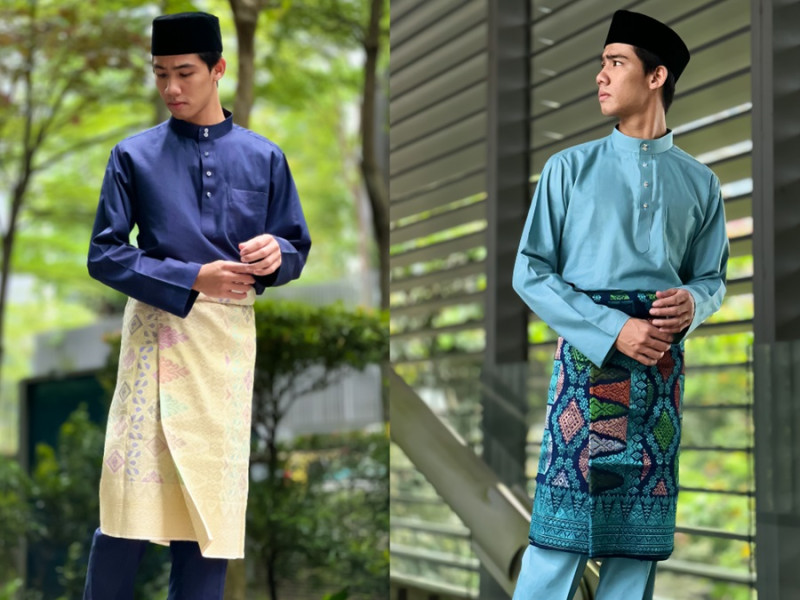
THE Hari Raya Aidilfitri celebrations this year, has seen the traditional 'Baju Melayu' — the iconic Malay outfit worn by men — remaining steadfast in its traditional form, avoiding any controversial modern twists seen in previous years.
Notably, there were no designs that deviated drastically from the classic style, such as the sleeveless, sheer variations that had sparked backlash on social media in past years.
Fashion designer and cultural activist Farel Mikhail noted that while previous years saw a surge of unconventional takes on traditional Malay costumes, this year’s designs seemed more “controlled,” reflecting a growing respect for the authenticity of cultural heritage.
“Perhaps it's due to increased awareness within society or the influence of social media, which now plays a significant role in shaping how people view traditional attire. There is now a stronger emphasis on modesty in the design of baju Melayu,” Farel explained in a statement to Bernama.
He believes that awareness campaigns, particularly those spearheaded by the Ministry of Tourism, Arts and Culture, along with non-governmental organisations, have been key in educating the public about the importance of preserving the cultural value of traditional clothing.
“The government and related bodies have been increasingly active in efforts to protect our culture. These campaigns not only educate the public but also raise awareness among fashion designers to respect traditional elements in their designs,” Farel added.
Although some designers continue to incorporate modern elements into traditional attire, Farel emphasized the importance of respecting the boundaries of cultural appropriateness. "For instance, pairing a tengkolok (traditional headgear) with overly flashy modern outfits, or altering traditional elements without considering cultural sensitivities, can stir debate. We all have a role to play in preserving cultural values," he said.
He urged young designers to experiment within the framework of respect for tradition. "If you want to create avant-garde designs, that's fine. But when it comes to tradition and heritage, we must be more sensitive. It's like with traditional food—when its identity is overly altered, it loses its heritage. Fashion can evolve, but it should not lose its cultural identity," Farel continued.
This sentiment was echoed by private sector employee Muhd Ikhsan Shahrol, 32, who argued that the Baju Melayu’s beauty lies in its simplicity and its long-standing design.
"The Baju Melayu is already perfect in its traditional form. There is no need to modify it with overly modern designs that strip away its identity. Preserving the authenticity of the Baju Melayu doesn't mean rejecting change, but rather ensuring that our cultural heritage remains valued and doesn't fade under current fashion trends," Ikhsan said.
Meanwhile, 26-year-old sales assistant Muhammad Munsyi Aziz believes the Baju Melayu can still be updated with modern touches, as long as it retains its core elements. "Balancing tradition and innovation is key to keeping this attire relevant without losing its identity. There's nothing wrong with enhancing the Baju Melayu with modern elements as long as it's not excessive. A neat cut, stylish buttons, or fine embroidery can give it a fresh look while staying rooted in tradition," he stated.
As the fashion landscape evolves, it is clear that both designers and wearers of the Baju Melayu are finding a balance between innovation and the preservation of cultural identity.
The debate may continue, but for now, the emphasis on respect for tradition appears to be steering the fashion industry in the right direction. – March 30, 2025
.jpg)



_director_Datuk_M._Kumar.jpg)
