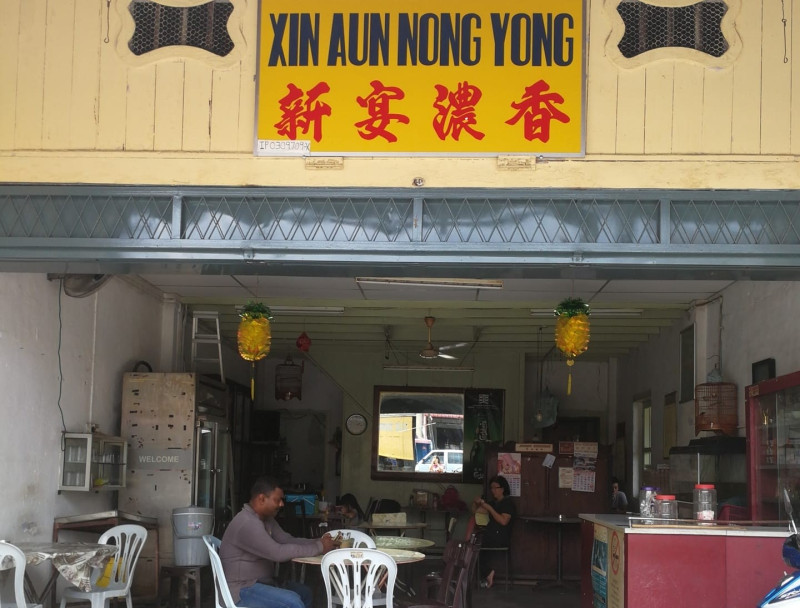
TUCKED away in the small town of Tapah Road, Xin Aun Nong Yong may not match the sleek design of today’s modern cafés, but this unassuming kopitiam has been serving as a cherished meeting place for nearly 100 years.
Established close to a century ago, the coffee shop has long been a daily gathering spot for locals of all races to enjoy a hot cup of coffee or tea alongside a simple breakfast. Its signature kaya toast—slathered with coconut jam made using a family recipe passed down from the original founders—remains a favourite to this day.
Beyond its offerings of toast, steamed buns (pau), cakoi (deep-fried dough sticks), soft-boiled eggs and beverages, the kopitiam plays a vital role in fostering relationships among the town’s multi-ethnic community, creating a space of harmony and togetherness.
Opening as early as 6am, the coffee shop is run by Phua Ah Ling, 65, a second-generation member of the founding family. Together with her husband Soo Kam Chow, 73, and their daughter Soo Hui San, 34, she continues the family legacy, welcoming a stream of regular customers each morning.
Phua, who was born and raised in Tapah Road, takes pride in the strong sense of community that lives on in her kopitiam, despite its simple appearance.
"About 70 percent of my customers are Malay. Perhaps it’s because I was born and raised here. Here, everyone knows each other," she told Bernama, noting that the shop serves only halal food.
“Every morning, customers sit down to enjoy hot ‘kopi O’ and cakoi while chatting about current issues."
When asked what makes the kopitiam special, Phua responded simply: "Harmony! This place is where everyone can sit at one table, regardless of race. Since long ago, Malays, Chinese and Indians (from and around Tapah) have been coming here to drink coffee together. I’ve been seeing this since I was a child."
A key contributor to the coffee shop’s continued popularity is its handmade steamed buns, which come in chicken, kaya, and red bean varieties.
"Every day, I wake up as early as 4 am and I start my routine by preparing the ingredients for the pau, which we make using the same methods my father used. For our kaya, the ingredients are cooked for 10 hours using a firewood stove," she said, adding they produce around 120 steamed buns a day.
To Phua, the kopitiam is more than just a business—it is a vessel for preserving stories, values and the spirit of unity for future generations.
"I hope my children will continue running this shop. When I’m no longer around, let it remain a place where the locals can come to eat and drink together. It’s not about the money, it’s about the heart," she said.
For Abdul Rahman Mat Yassin, 69, a gravedigger, mornings at the kopitiam are a source of joy and nostalgia.
"Usually before heading to the cemetery, I’ll stop by here for breakfast. Every time I come, it reminds me of my youth with my friends," he said. Though he enjoys the coffee and toast, the soft-boiled eggs remain his firm favourite.
Ha Kin Chai, 77, also holds fond memories of the place, dating back to his childhood when the shop was run by Phua’s father.
"I used to look forward to eating the cakoi and pau because they were soft and tasty. The taste is still the same today," he said.
Regular customer P. Janagee, 54, finds comfort in the familiar faces and welcoming atmosphere.
"To me, this place isn’t just for eating but also for chatting and reconnecting with old friends without feeling awkward. It feels like family here," she said. - April 20, 2025