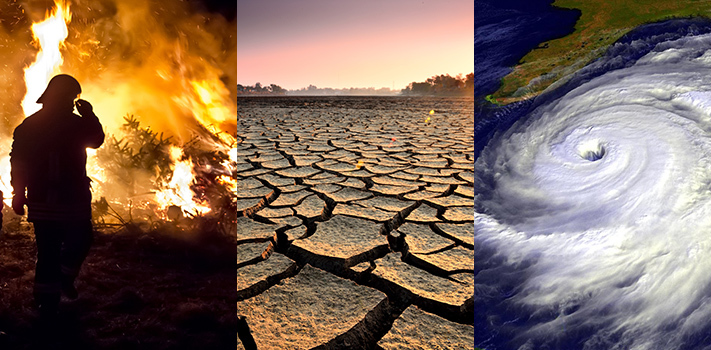
THE year 2025 witnessed significant destruction linked to extreme climate events across the globe, according to the World Meteorological Organization (WMO). Soaring temperatures, wildfires, devastating hurricanes and widespread floods have affected millions of people, underscoring the critical importance of early warning systems and heat-related health action plans.
North America endured record heatwaves that sparked wildfires, while Europe and large parts of Asia also grappled with extreme heat, posing serious health risks. July 2025 was recorded as the third hottest July globally, following 2023 and 2024, according to data from the European Union’s Copernicus Climate Change Service.
“Extreme weather and climate events up to August 2025 have had profound global impacts, with compounded effects damaging crops, straining livelihoods, exacerbating poverty, and driving population displacement across regions,” the WMO stated in its report on global climate conditions.
Japan recorded its highest temperature at 41.8 degrees Celsius in Isesaki on 5 August, while many areas of China also faced unprecedented heat. In California, wildfires in January claimed 30 lives and forced 260,000 residents to evacuate, resulting in an estimated US$40 billion in economic losses — the largest ever recorded for wildfires, according to WMO data. Pakistan experienced the most severe fatalities, with 881 deaths from floods as of 2 September.
The WMO highlighted that ocean warming poses long-term risks, including the degradation of marine ecosystems, biodiversity loss, and weakened carbon absorption capacity. “This warming is expected to continue and represents irreversible changes on a scale of hundreds to thousands of years,” the agency warned.
Scientific studies also link extreme oceanic heat to the intensification of hurricanes and flooding events. Hurricane Ragasa struck China, the Philippines, Taiwan, Hong Kong, and Vietnam in September, emerging as the strongest tropical cyclone globally in 2025, causing extensive flooding, mass displacement, injuries, fatalities, and economic damage.
Global Climate Agreements And COP30
The WMO forecasts that global temperatures are likely to remain near record levels over the next five years, amplifying climate risks and impacts on society, economies, and sustainable development. Under the Paris Agreement, countries committed to limiting long-term average global temperature increases to below two degrees Celsius above pre-industrial levels, with efforts to constrain warming to 1.5 degrees Celsius.
“The scientific community has repeatedly warned that exceeding 1.5 degrees Celsius carries the risk of far more severe climate change impacts and extreme weather events,” the WMO emphasised.
The 30th UN Climate Change Conference (COP30) took place in Brazil in November to address the climate crisis and advance the Paris Agreement goals. While COP30 made progress, such as pledging to increase adaptation financing to US$120 billion annually, the sum still falls short of developing nations’ needs. The conference did not establish a clear framework for phasing out fossil fuels or halting deforestation.
Zayana Zaikariah, Climate, Environment, and Energy Researcher at ISIS Malaysia, noted that COP30’s commitment to double adaptation finance by 2035 does not specify how funds will be mobilised. “This is a critical concern for developing economies already facing fiscal constraints,” she said.
She added that for ASEAN and other developing nations, COP30 represents incremental progress, yet it does not provide the scale or certainty of support necessary for a credible and timely green transition. Kieran Li Nair, Senior Researcher at ISIS Malaysia, observed that COP remains an essential platform for multilateral climate governance, despite its slow and sometimes frustrating processes. “For some stakeholders, it is the only forum where their voices can be heard at the highest levels,” he said.
Key COP30 achievements included decisions on a just transition mechanism to enhance technical assistance, the establishment of natural and tropical forest financing facilities with commitments exceeding US$6.7 billion, and the introduction of 59 indicators to assess adaptation to climate impacts.
Asean Climate Strategy And Malaysia’s Role
Within ASEAN, Zayana emphasised member states’ political commitment to coordinate and implement disaster and climate strategies. She noted that the main challenge lies not in the absence of strategies, but in operational coordination, requiring a shift from reactive national responses to an integrated regional system.
Malaysia has played a central role by consolidating ASEAN positions for COP30 and aligning regional priorities with the global agenda through several ministerial meetings held domestically. However, the effectiveness of these initiatives depends on Malaysia’s capacity to implement domestic policies efficiently while maintaining collective ASEAN commitments. Malaysia has pledged to achieve net-zero greenhouse gas emissions by 2050 through a transition to cleaner energy sources, consistent with its National Energy Transition Roadmap.
Climate Outlook
According to WMO, climate indicators remain alarming, but positive developments include continued growth in renewable energy. “2025 is on track to be the second or third hottest year on record, and the past 11 years, including 2025, rank as the hottest ever recorded. We are not on track to meet the Paris Agreement targets,” the UN agency added. - December 29, 2025