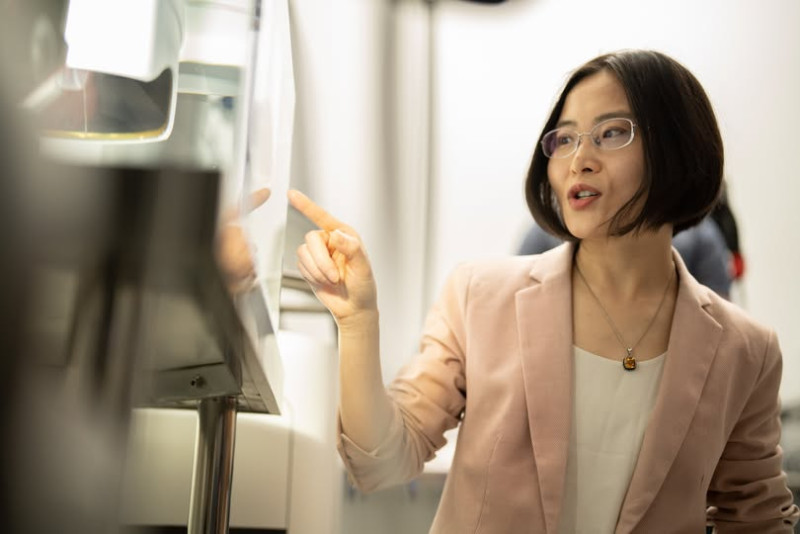
BIOMEDICAL engineer Dr Zhen Xu is spearheading what could become one of the most significant advances in non-invasive cancer treatment after dedicating 25 years to developing a revolutionary ultrasound-based technology capable of liquefying tumours without surgery.
Dr Xu co-invented histotripsy, an emerging medical technique that uses focused ultrasound waves to target and destroy tumour cells while leaving surrounding healthy tissue largely unharmed, eliminating the need for incisions traditionally associated with cancer treatment.
Kyodo News reported on Friday that the technology is being commercialised through HistoSonics, the medical technology company she co-founded in 2009, which has rapidly gained international recognition amid growing interest in less invasive and less toxic cancer therapies.
The company was recently named by Time magazine among the world’s 10 most influential health and life sciences companies for 2026, while investors reportedly valued the firm at US$2.25 billion after acquiring a majority stake earlier this year.
Dr Xu herself was also recognised internationally after receiving the Sony Women in Technology Award in Japan in February.
Originally from China and now based in the United States, Dr Xu said she hopes her journey will inspire more women, particularly Asian women, to pursue leadership roles in science and technology sectors traditionally dominated by men.
“It can be really frustrating when you don’t see anybody like you in the field,” she said in an interview with Kyodo News.
“You don’t know if it is even possible to get to a certain stage.”
After graduating in China, Dr Xu began doctoral studies at the University of Michigan in 2001, where she focused on expanding medical applications of ultrasound technology beyond conventional imaging and prenatal sonography.
Her breakthrough direction reportedly emerged after a specialist treating infants with congenital heart defects approached her university laboratory seeking alternatives to high-risk surgical procedures.
“Those kids were so sick, dying on the surgical table,” she recalled.
Dr Xu said the experience convinced her that ultrasound technology could potentially offer safer treatment methods compared with conventional therapies relying heavily on radiation or heat-based approaches, both of which can produce long-term side effects.
As development of histotripsy progressed, Dr Xu expanded research into broader cancer applications, partly inspired by personal encounters with the disease, including the deaths of both her in-laws from cancer.
She described her husband as her “biggest supporter and cheerleader”, noting his own fears surrounding the illness.
“He said, ‘I think I will get cancer. I just don’t know which one I will get’,” she said.
Global demand for alternative cancer treatments continues rising as the World Health Organization projected in 2024 that approximately one in five people worldwide would develop cancer during their lifetime amid ageing populations and increasing health pressures.
Histotripsy for liver cancer received approval from the United States Food and Drug Administration in October 2023 before subsequently gaining approval in Britain, the United Arab Emirates and Hong Kong.
Earlier this month, HistoSonics submitted an application to US regulators seeking approval to extend the treatment’s use to kidney tumours following a clinical trial involving 67 patients, marking the company’s first authorised expansion beyond liver cancer applications.
According to Dr Xu, approximately 4,000 patients worldwide have undergone histotripsy treatment so far, with the majority treated in the United States.
Research into the technology is also expanding rapidly across Asia.
In April, Gleneagles Hospital Hong Kong used histotripsy technology on two pancreatic cancer patients, while clinical trials are currently under way for kidney, prostate, fat and muscle tissue tumours.
Although the treatment has yet to secure regulatory approval in Japan, Dr Xu said she hopes to obtain support from Japanese health authorities “in the near future”.
The company is also collaborating with Sony Group to enhance imaging precision using advanced three-dimensional visualisation technologies.
Looking ahead, Dr Xu believes medicine is entering a transformative era in which cancer therapies become progressively less invasive and less toxic.
“In the 1900s, Marie Curie developed radiation therapy. In the 1960s, people invented optics, which you make small holes and operating through them,” she said.
“It’s another 60 years now. The future of medicine as a whole and cancer treatment will eventually become non-invasive and, hopefully, non-toxic,” she added. - May 22, 2026