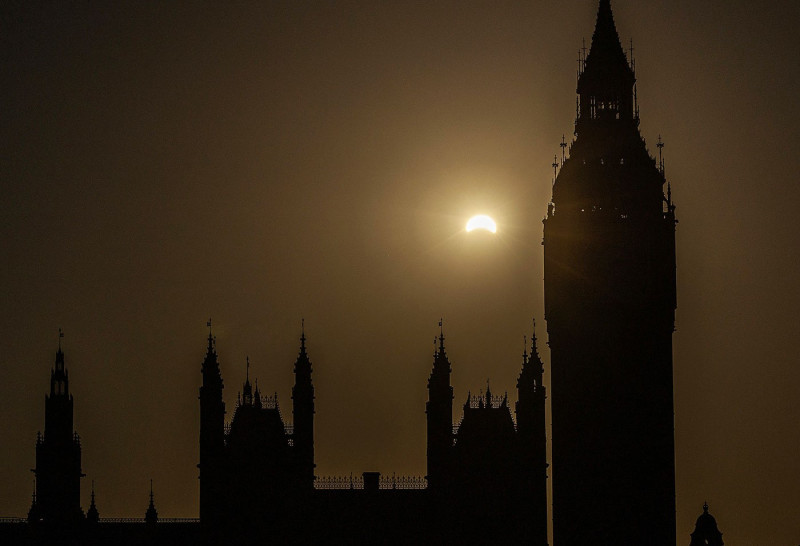
MILLIONS of people across Britain and Europe have turned their eyes to the skies for a spectacular solar eclipse, with the UK experiencing its most dramatic such event since 1999.
Britons were treated to a partial eclipse that peaked shortly after 19:00 BST, with more than 90% of the Sun obscured by the Moon across much of the country.
In Cornwall, coverage reached about 95%, while parts of central and southern England and Wales enjoyed clear skies that provided ideal conditions for watching the Moon gradually pass across the Sun.
The BBC reported on Thursday that the eclipse was even more spectacular in parts of Greenland, Iceland and Spain, where the Sun, Moon and Earth aligned perfectly to produce a total eclipse.
Large crowds gathered at viewing sites and landmarks across Britain and Europe, reacting with cheers and gasps as the celestial spectacle unfolded.
In Scotland, cloudier conditions obscured parts of the event, but crowds still gathered at locations including Edinburgh’s Calton Hill.
The partial eclipse began at about 18:00 BST in northern Scotland and shortly before 18:20 on the south coast of England, initially appearing almost imperceptible before the Moon slowly began covering the Sun.
Solar eclipse glasses were in high demand ahead of the event, with supplies reportedly running out at opticians, hardware shops and even bakeries.
Some skywatchers instead used simple pinhole projection methods involving colanders, cereal boxes and pieces of paper to observe the eclipse safely.
A solar eclipse occurs when the Moon passes between the Sun and Earth, blocking some or all of the Sun’s light and casting its shadow on the Earth.
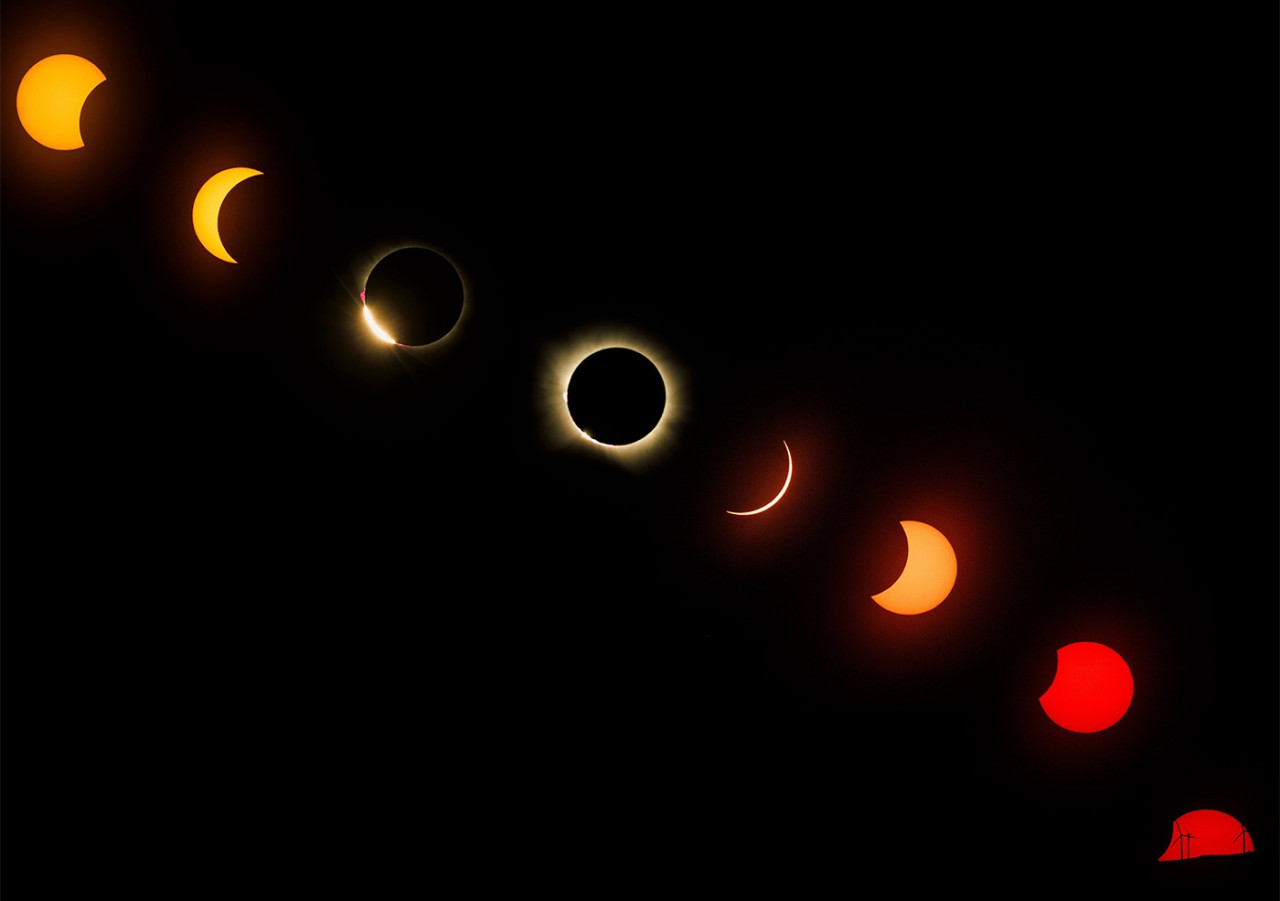
From Britain, the three bodies were not perfectly aligned, resulting in a partial eclipse. The Moon covered about 90% of the Sun across most of the UK.
In Spain, however, the alignment produced a total eclipse at about 19:30 BST, or 20:30 local time.
Chilean scientist Yasmin Catricheo travelled thousands of miles to A Coruña in north-western Spain to witness the event.
"At the totality, everyone was cheering and sharing the excitement of what we were seeing. No words could describe the feeling," she said.
"The universe is amazing."
The total eclipse lasted for less than two minutes, but spectators along its path were treated to the Sun’s corona — the outer atmosphere of superheated gas extending thousands of miles into space.
Some observers were also able to see prominences, loops of pinkish gas extending from the Sun’s surface and following its turbulent magnetic field.
Total solar eclipses occur somewhere on Earth roughly every 18 months, but they are exceptionally rare at any particular location, occurring only about once every 400 years on average.
The phenomenon is possible because the Sun is about 150 million kilometres from Earth — roughly 400 times farther away than the Moon — while the Moon’s diameter is about 400 times smaller than that of the Sun.
The coincidence makes the two bodies appear almost exactly the same size in the sky, allowing the Moon to completely cover the Sun during totality.
Astronomers say the world is entering a "golden age" of total solar eclipses between 2026 and 2028, with three total eclipses occurring during the period.
However, none will be visible as a total eclipse from the UK.
Britain’s next notable partial eclipse will occur in 2027, when some areas could see about 45% of the Sun covered.
The UK will have to wait until 2081 for an eclipse that approaches the scale of the latest event, when up to 99% of the Sun will be obscured.
The country’s next total solar eclipse is not expected until 2090. - August 13, 2026