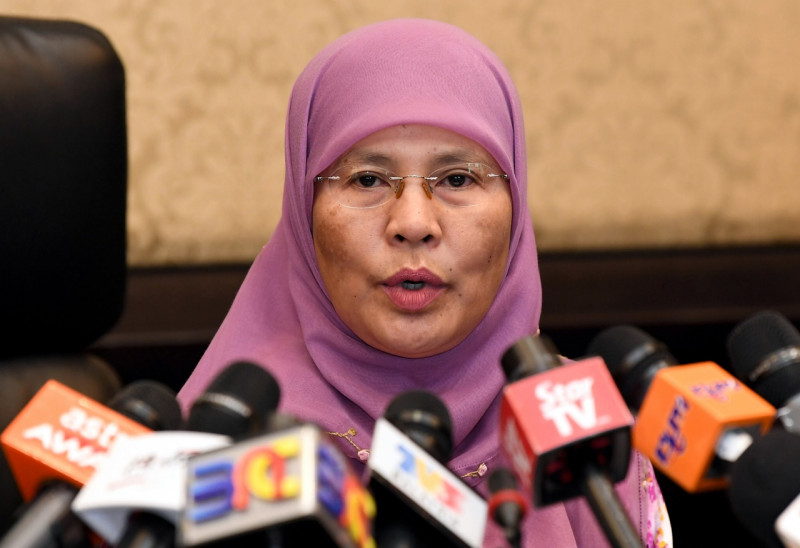
JUDGES have the independence to make decisions based solely on the facts and law without any fear of the political or social outcome of their decisions, says Chief Justice Tun Tengku Maimun Tuan Mat.
Justice Tengku Maimun said, that unlike politicians, judges do not, and indeed, cannot answer to or be governed by political will or popularity.
“A judge is meant to be an independent constitutional arbiter of justice between the State and its subjects (and vice versa) as well as between subjects inter se.
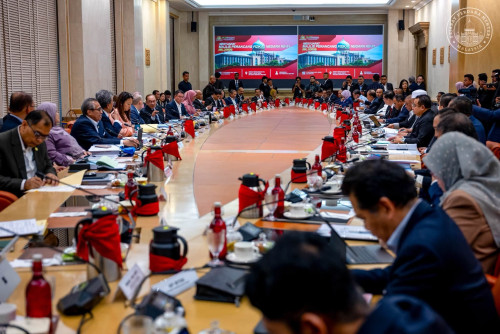
“His or her loyalty is apparent in a constitutionally-ordained judicial oath taken to protect, preserve and defend the Federal Constitution,” she said when delivering her speech at the Opening of the Legal Year 2024 at Putrajaya International Convention (PICC) in Putrajaya today.
On the public prosecutor’s decision to withdraw criminal charges against certain high-profile individuals in the recent past including last year, Justice Tengku Maimun said these decisions were not particularly received well by the public but a large part of the blame was put on the Judiciary for making the only available consequential orders upon the withdrawal of such charges.
Justice Tengku Maimun further said, that under Article 145(3) of the Federal Constitution, the Attorney-General who is also the Public Prosecutor has the discretion to institute, conduct or discontinue any proceeding for an offence other than before a Syariah Court.
She said, that when the Public Prosecutor decides to withdraw charges, the courts only have one of two minimal consequential options.
“Depending on the facts, these two options are either granting an order of discharge not amounting to an acquittal popularly called ‘DNAA’ or a discharge amounting to an acquittal which can be called a ‘DAA’.
“The courts cannot turn around and insist the Public Prosecutor maintain a charge. The judiciary and the Public Prosecutor have their constitutionally-demarcated constitutional functions and both must be adjudged fairly for the exercise of their powers to the exclusion of the other,” she said.
Justice Tengku Maimun also said when a charge is withdrawn, the judge making the only available consequential order is painted as corrupt, sometimes as incompetent or both.
“The public fails to understand that the person responsible for that decision is the Public Prosecutor and not the courts. It is often the courts that are chastised for such decisions and this erodes public confidence in the judicial system,” she added.
According to Justice Tengku Maimun, the judiciary was unjustifiably painted as the villain for actions or inactions of another body in the justice system.
She also brought up two recent Federal Court rulings including the SIS Forum case, which dealt essentially with the question of whether the legislature of the State of Selangor was empowered to pass certain legislation.
“This is a kind of challenge that is expressly envisioned and catered for by our Federal Constitution. Unfortunately, these two cases were made out by some parties to be more than what they were.
“These cases had nothing to do with the fact of being purely on the religion of Islam. They merely sought to re-emphasise the clear demarcation of powers between the federation and the States,” she said.
Justice Tengku Maimun also said the comments by certain irresponsible parties are targeted at painting the picture that the Judiciary has an “agenda” or motives to eradicate Islam in this country, or an agenda to remove the Islamic legal system in Malaysia.
“The comments in two cases are far and wide. In some parts, these comments unjustifiably question the personal faith of certain Judges or even their motivation for deciding as such. In other respects, such comments incite hatred and ill will among the public against the judiciary or the fear of the perceived distorted outcome of such decisions. In certain other respects, large crowds are mobilised and their presence is used to intimidate the judges.
“These examples indicate how the judicial independence is eroded and how public confidence in the Judiciary is impaired,” she added. - Bernama, January 15, 2024