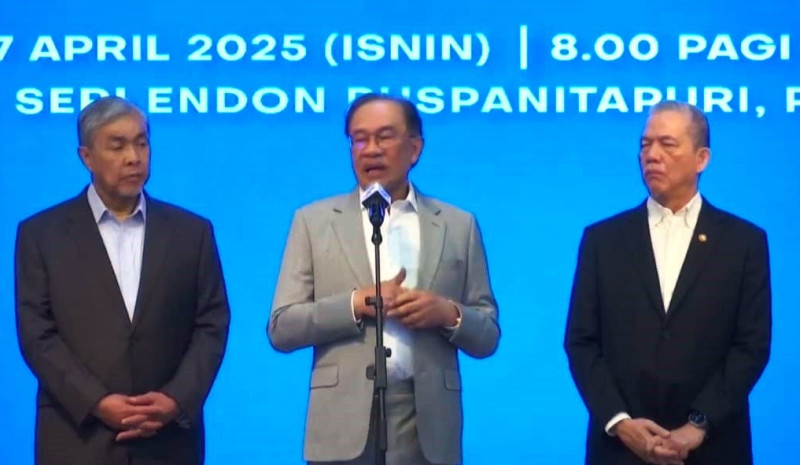
PRIME MINISTER Datuk Seri Anwar Ibrahim has called on Malaysia and fellow ASEAN nations to reach a unified stance on the tariffs recently announced by the United States. He stressed that a solid agreement would provide a firm foundation for any upcoming negotiations and discussions.
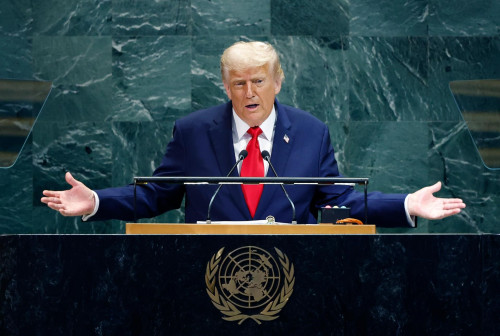
Despite acknowledging that the rationale behind the tariff announcement made by US President Donald Trump is widely disputed, Anwar emphasised that ASEAN countries must not take the matter lightly, particularly amid the current uncertain global political and economic climate.
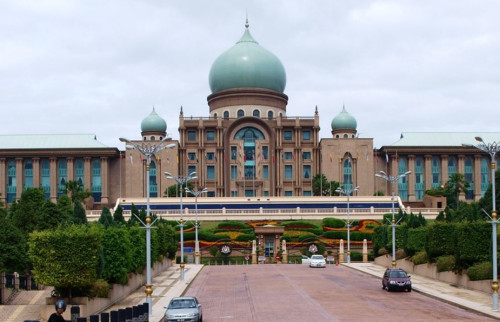
"Yesterday, I provided an in-depth explanation on the decisions made during the Special Committee’s meeting regarding President Trump's tariff announcement, which was attended by the entire Cabinet," he said at a meeting with civil servants at the Prime Minister's Department today.
"We cannot afford to disregard this issue, even though it appears unusual, particularly coming from a nation like the United States, which has historically championed free trade and played a pivotal role in founding the World Trade Organization (WTO) and the General Agreement on Tariffs and Trade (GATT)."
Anwar characterised the move as part of what he called "post-normal times," where political and economic policies are enacted in unpredictable ways, including tariff decisions that are based on weak justifications.
He described the tariff announcement as poorly considered, citing the inclusion of small island nations in the new tariffs, which he jokingly remarked were "home to penguins."
"These are measures that we cannot simply take at face value. It’s an approach that is not well thought out," he added.
"That’s why I believe we should first adopt a moderate approach, as there is still room for discussions and negotiations. Additionally, there are certain exemptions that need to be identified and thoroughly understood."
The Prime Minister outlined that it was critical for ASEAN nations to coordinate their positions. “It is our responsibility, along with the Ministry of Foreign Affairs and relevant ministers, to engage with our ASEAN counterparts so that each country can state their position clearly, while we move forward as one united bloc.”
He underscored the importance of ASEAN standing firm together. “We must stand united as ASEAN, with a population of 640 million and one of the world’s most significant economic regions. This is also one of the safest and most rapidly developing areas in the world,” Anwar explained.
In recent discussions, Anwar has already initiated talks with several ASEAN leaders. "I took the opportunity during Indonesian President Prabowo Subianto’s brief visit for an Aidilfitri dinner to discuss this issue, along with other matters such as Gaza and Myanmar," Anwar shared.
"I also had a detailed conversation with the Prime Minister of Vietnam, and prior to that, I spoke with the leaders of the Philippines, Brunei, Laos, and Thailand to align our positions."
This collaborative approach aims to present ASEAN as a united front in future discussions. "We want ASEAN to present a joint perspective, showing our consensus and laying a stronger foundation for the upcoming negotiations," he added.
On April 2, 2025, President Trump announced a series of new tariffs targeting several ASEAN countries, directly raising import duties on major trade partners in the Southeast Asian region.
The countries most affected are those in the Indo-China region, with Cambodia facing a base and reciprocal tariff of 49%, followed by Laos at 48%, Vietnam at 46%, and Myanmar at 44%.
Other ASEAN countries affected include Thailand (36%), Indonesia (32%), Brunei and Malaysia (24% each), the Philippines (17%), and Singapore (10%).
According to a fact sheet from the White House, these tariffs are set to take effect on 5 April 2025. – April 7, 2025
.jpg)

_director_Datuk_M._Kumar.jpg)