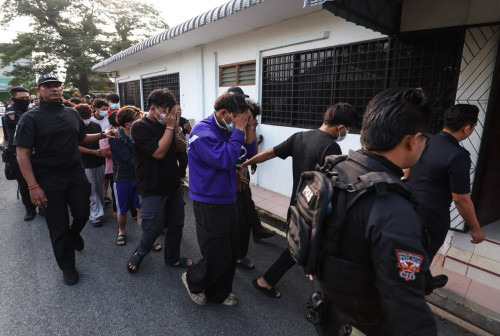
MALAYSIA has identified cross-border human trafficking and irregular migration involving Indonesia as an increasingly serious regional threat, warning that organised criminal syndicates are exploiting maritime routes and long-standing cross-border ties to evade detection.
Home Minister Datuk Seri Saifuddin Nasution Ismail said the assessment was based on sustained, intelligence-led surveillance by Malaysian enforcement agencies operating in and around Johor and the Strait of Malacca.
“This is particularly due to organised transnational syndicates exploiting maritime routes, third-country movements and long-established cross-border linkages,” New Straits Times reported him saying.
Saifuddin said the police, the Immigration Department and the Malaysian Maritime Enforcement Agency had intensified coordination, improved maritime domain awareness and expanded joint patrols in high-risk waters to curb illicit cross-border movement.
“Intelligence analysis focuses on facilitators on the ground and dismantling organised criminal elements operating across borders,” he said, adding that Malaysia regarded trafficking and irregular migration as a shared regional challenge that demanded close cooperation with Indonesia and international partners.
His remarks followed warnings from Indonesian consul-general in Johor Baru Sigit S. Widiyanto, who said trafficking routes, undocumented migration and border-linked scams affecting both countries were increasing.
Saifuddin said Malaysia’s existing laws remained sufficient to counter increasingly sophisticated syndicates, pointing to the Anti-Trafficking in Persons and Anti-Smuggling of Migrants Act 2007.
“The act is applied together with other laws targeting organised crime and national security threats, allowing flexible investigation and prosecution, including cases involving maritime routes and cross-border syndicates.”
He said outcomes depended not only on legislation but also on enforcement capability, intelligence-sharing and international collaboration, all of which were prioritised under Malaysia’s National Action Plan on Anti-Trafficking in Persons.
Responding to allegations of corrupt facilitation by officials, Saifuddin reiterated Malaysia’s zero-tolerance stance.
“Where cases involving misconduct or corruption by enforcement personnel are identified, they are dealt with through established investigative, disciplinary and legal mechanism.”
He said Malaysia maintained strong anti-corruption institutions, internal oversight frameworks and continually refined standard operating procedures to safeguard border security.
“Malaysia welcomes continued cooperation and information-sharing with Indonesia, recognising that transparency and joint accountability are critical in dismantling transnational criminal syndicates.”
From the Indonesian perspective, Sigit said undocumented and non-procedural migration remained the most pressing concern for his office in southern Malaysia, driven by overstaying social visit passes and recruitment by agents operating illegal sea routes between Johor and the Riau Islands.
The Indonesian consulate facilitated the repatriation of 5,620 Indonesians this year, up from 5,286 last year, underscoring the scale of undocumented movement.
New Straits Times cited Sigit saying trafficking patterns were becoming more sophisticated, with job-seekers routed through third countries such as Thailand, syndicates exploiting backdoor maritime channels and networks smuggling labour and contraband, including tin ore and narcotics, across the Strait of Malacca.
He said syndicates were believed to be operating along long-established routes originating from Indonesian regions closest to Malaysia, including Dumai, Bengkalis and Selat Panjang in Riau, as well as Batam, Bintan and Karimun in the Riau Islands.
Their proximity to Johor and deep-rooted maritime connections, he said, made these areas particularly vulnerable to organised transnational crime, with intelligence indicating that syndicates relied on multiple smuggling routes.
Investigations revealed consistent recruitment tactics, with syndicates using social media to target domestic workers and ship crew. Many victims were exploited, he said, including being forced to work without pay and subjected to physical and psychological abuse after being lured with offers of unusually high wages and sent to remote locations.
Sigit said trafficking operations were facilitated by corrupt officials who allowed Indonesian citizens and migrant workers without valid documentation to cross borders.
At the same time, he said bilateral initiatives to manage undocumented migration were producing tangible results. Malaysia’s Migrant Repatriation Programme 2.0 and the M programme under the Immigration Department had enabled thousands of Indonesians to return home without facing prosecution.
The M programme, a joint initiative between Malaysia and Indonesian missions, has repatriated 1,706 detainees since its launch in 2024 and will continue for two years, with a target of 7,200 returns.
“It is a joint responsibility. Malaysia eases repatriation and Indonesia ensures safe reintegration,” Sigit said.
He estimated that more than 138,000 Indonesians were living in southern Malaysian states, though the actual number was likely higher due to undocumented migration.
To counter scams and misinformation, the Indonesian consulate has expanded outreach through TikTok podcasts, radio broadcasts, digital advisories and printed materials explaining common fraud tactics.
Sigit acknowledged an increase in cross-border scams, smuggling and organised crime between Johor and the Riau Islands but said cooperation between the Royal Malaysia Police and Indonesia’s National Police had become more structured and systematic.
Multiple memoranda of understanding, dating from 2005 to the most recent signed in Labuan Bajo in 2023, have enabled joint investigations, intelligence-sharing and coordinated border patrols, while consular coordination has helped ensure the rights of Indonesian citizens are respected.
Both countries have also engaged through bilateral and Asean-level security platforms this year, including the Senior Officials Meeting on Transnational Crime in Putrajaya and the Asean Chiefs of Police meeting in Bangkok.
“Crime syndicates don't respect borders. Our cooperation must always outrun their creativity,” Sigit said.
He also reported a significant improvement in labour protection outcomes for Indonesian workers in southern Malaysia, with wage-related complaints falling from 57 cases in 2024 to 25 cases up to November this year, and unpaid wages declining by nearly RM432,000.
Sigit attributed the improvement to the KSATRIA hotline and expanded outreach through radio programming and direct engagement in worker-dense communities.
The KSATRIA WhatsApp service, operated around the clock by the Indonesian consulate-general in Johor Baru, provides rapid assistance to Indonesians, particularly migrant workers, in cases involving accidents, legal matters and deaths.
“Protection is only real when access to help is easy,” Sigit said, adding that closer cooperation with Malaysian authorities had significantly reduced exploitation trends. - December 19, 2025




.jpeg)