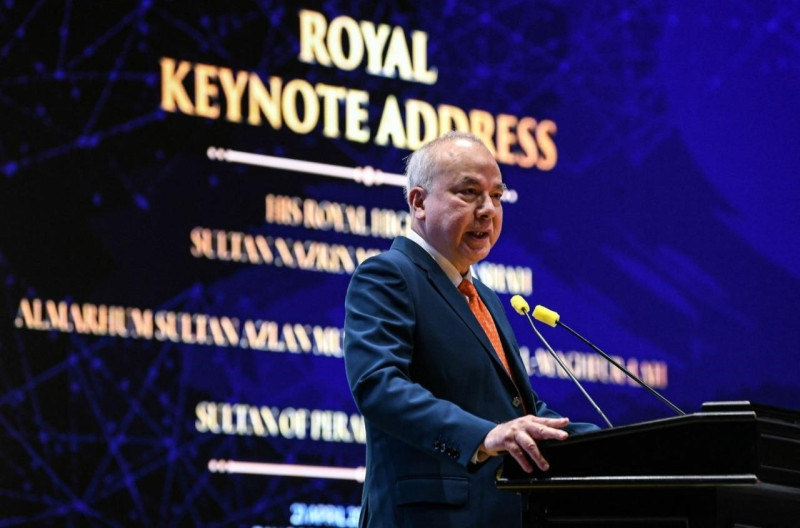
THE Sultan of Perak, Sultan Nazrin Shah, has warned that the world must not repeat past mistakes of developing powerful technologies without establishing proper governance frameworks, particularly as artificial intelligence and other advanced innovations accelerate.
Delivering a keynote address at the Putrajaya Forum held in conjunction with the Defence Services Asia 2026 and National Security Asia 2026 exhibitions, His Majesty said history has repeatedly shown a pattern of innovation preceding regulation, often with serious consequences.
“In our own era, we repeatedly learn, then seem to forget the hardest lesson — that we tend to build first and govern later.
“The atomic bomb was detonated before the world had any framework to control it.
“We cannot repeat that mistake with AI, genetic engineering or other technologies emerging in this century. All of these demand governance in advance, not after the fact,” he said.
Sultan Nazrin said while technologies such as artificial intelligence and quantum computing hold the potential to strengthen security capabilities, they also pose significant risks if left unchecked.
He cautioned that the growing use of AI in military contexts could inadvertently trigger conflict, particularly where human decision-making is replaced or overly influenced by automated systems.
“Through the tendency towards automation, humans may place excessive trust in machines, allowing them to make life-and-death decisions that violate moral and legal principles.
“Imagine the implications — a cyberattack on regional financial systems could disrupt economies across borders within minutes, while the leakage of sensitive data could compromise national sovereignty without a single shot being fired.
“Thus, tools that promise progress also carry the seeds of instability,” the Perak Ruler added.
The ruler also highlighted the unique vulnerabilities of Southeast Asia, noting that the region’s diversity in language, religion, culture and governance systems could be undermined if AI technologies are developed based on external assumptions.
“Algorithms that do not understand us accurately will not benefit us, but may instead harm us.
“Between 2020 and 2024 alone, the region has already produced 35 large language models with Southeast Asia-specific applications.
“With 700 million people speaking more than a thousand languages, AI translation technologies have the potential to unite this region more effectively than decades of diplomacy,” he said.
Sultan Nazrin added that Southeast Asia possesses the necessary talent to advance such technologies, but requires greater opportunities and recognition to prevent the outflow of skilled professionals.
“What is needed are opportunities and recognition so that this talent does not continue to migrate abroad,” he said. - April 21, 2026