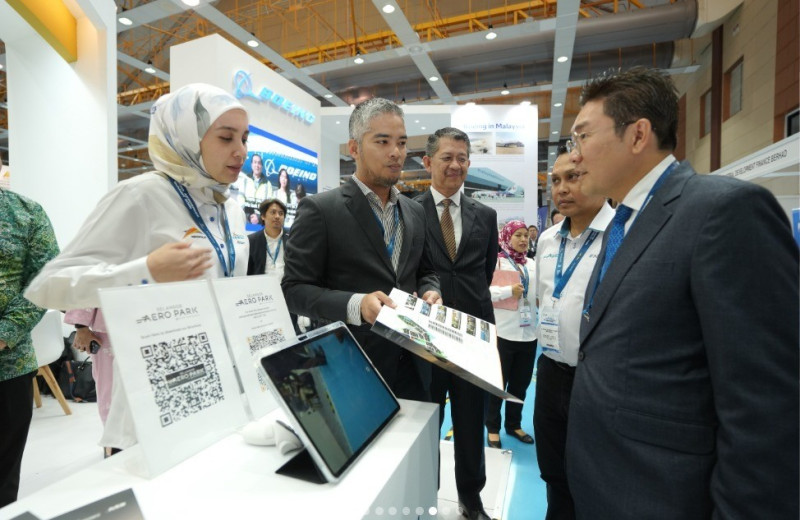
MALAYSIA has set out an ambition to position itself as a regional leader in sustainable aviation, framing the global decarbonisation push in the aerospace sector as a significant economic opportunity for the country.
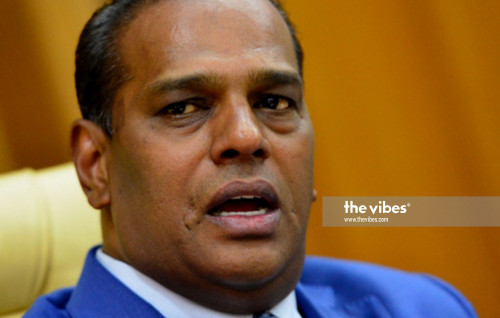
Deputy Minister of Investment, Trade and Industry Sim Tze Tzin said the aviation industry is undergoing its most fundamental transformation since the introduction of the jet engine, with sustainability now embedded at the centre of global industrial decision-making.
Speaking at the MyAERO Sustainable Aviation APAC Symposium 2026, Sim said aviation contributes around 2 to 3 per cent of global carbon dioxide emissions, warning that this share is expected to rise in line with growing demand for air travel unless urgent measures are taken.
“Sustainability is therefore no longer an environmental aspiration — it is a commercial requirement and a source of competitive advantage,” he said.
He said the global aviation sector is already accelerating investment in sustainable aviation fuel, hydrogen propulsion technologies, aircraft efficiency improvements, digital optimisation systems and circular manufacturing models, supported by a net-zero emissions target for 2050.
Sim said this shift is already reshaping capital flows, supply chains and market access across the aerospace industry, with environmental performance increasingly influencing investment decisions and competitiveness.
To underline the consequences of ignoring environmental limits, he cited the example of the Aral Sea disaster in the former Soviet Union, where large-scale irrigation projects designed to boost cotton production ultimately drained one of the world’s largest inland lakes and left behind a toxic desert.
“What began as progress became one of the most severe environmental disasters in modern history — with consequences still felt today,” he said. “I share this because it illustrates a simple but powerful truth: development without sustainability leads to irreversible cost. We face a similar choice today.”
Against that backdrop, Sim said Malaysia was well positioned to benefit from the global transition, pointing to its established aerospace manufacturing base, Maintenance, Repair and Overhaul (MRO) capabilities, engineering talent, biomass and refining ecosystem, and strategic location within the Asia-Pacific region.
He added Malaysia aimed to develop into a regional hub for sustainable aviation fuel production, green aerospace manufacturing, carbon-smart MRO operations and next-generation aviation technologies, adding that the shift could become a new engine of industrial growth if pursued decisively.
“If we act decisively, sustainability can become Malaysia’s next engine of industrial growth,” he said.
However, he stressed that no single government or institution could drive the transition alone, calling for unprecedented cooperation across policymakers, industry players, financiers, researchers and technology providers.
“No single organisation or government can achieve this transformation alone,” he said, noting that the symposium organised by NAICO Malaysia was intended to facilitate dialogue, partnerships and practical solutions across the region.
He added that the participation of stakeholders from across the Asia-Pacific underscored the global nature of the challenge. - June 30, 2026
.jpeg)





.jpeg)