THE rise of artificial intelligence (AI) is transforming the banking landscape, but the future of finance will ultimately depend on whether institutions can preserve the most valuable asset in the sector — trust.
Finance Minister II Datuk Seri Amir Hamzah Azizan said financial institutions must move beyond adopting new technologies and focus on strengthening digital security, governance structures and risk management capabilities as AI creates both unprecedented opportunities and emerging vulnerabilities.
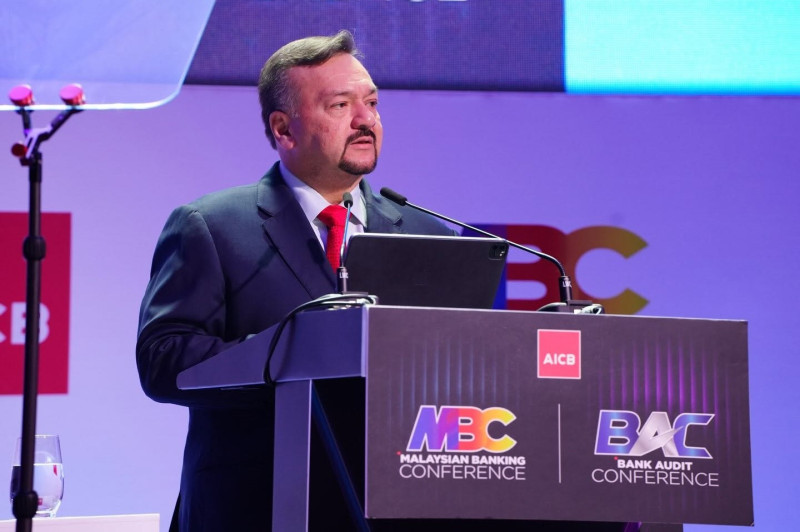
Speaking at AICB NEXUS 2026 themed “AI, Trust and the Future of Finance” at the Kuala Lumpur Convention Centre today, he said the history of banking had always been built around the ability of institutions to establish, protect and maintain confidence.
“Whatever form the ledger takes, one thing must remain constant: trust. And it is trust – its preservation, its evolution, its defence – that sits at the heart of the Malaysian Banking Conference and Bank Audit Conference at AICB Nexus 2026,” he said.
Amir said the traditional financial ledger had evolved from paper records into sophisticated digital ecosystems powered by cloud infrastructure, payment networks, mobile applications, risk engines and AI models.
However, he stressed that technological advancement alone would not determine the success of future banking.
“What is abundantly clear through the prism of trust is that the future of banking can no longer be discussed separately from the future of audit, risk, compliance, governance, technology and talent. These are not separate conversations. They are part of the same operating system,” he said.
He said Malaysia’s financial sector must remain resilient as global uncertainties, including geopolitical tensions, energy market disruptions, supply chain challenges and inflation pressures, continue to affect economies worldwide.
For an open economy such as Malaysia, Amir said external shocks could quickly translate into domestic pressures, making resilience, credibility and reliability critical foundations for sustainable growth.
He described stability and predictability as essential strengths of a trusted financial system, particularly during periods of uncertainty.
“In finance, ‘boring’ is often misunderstood. It does not mean passive. It means the system works when the world does not. It means obligations are honoured, rules are clear, institutions are credible and confidence is preserved,” he said.
Amir highlighted Malaysia’s economic reforms under the Ekonomi MADANI framework, including the reduction of the fiscal deficit from 6.4 per cent of gross domestic product (GDP) in 2021 to 3.7 per cent in 2025, lower inflation from 3.4 per cent in 2022 to 1.4 per cent in 2025, and record approved investments of RM426.7 billion in 2025.
He said these achievements reflected stronger economic credibility and demonstrated that reform efforts were delivering measurable outcomes.
“Each figure is not a trophy. It is a posted entry. Proof that the account is being managed, and that reform is not merely a slogan. It is a foundation upon which greater confidence and durable prosperity can be built,” he said.
He said banks remained central to Malaysia’s economic transformation by directing savings towards productive investments, financing businesses, supporting infrastructure projects and enabling digital and industrial expansion.
Amir said national development priorities, including the New Industrial Master Plan 2030 (NIMP 2030), National Energy Transition Roadmap (NETR), National Semiconductor Strategy (NSS), Johor-Singapore Special Economic Zone and green energy initiatives, required a financial sector capable of managing increasingly complex funding needs.
On AI adoption, he said the technology was already reshaping banking operations through applications in credit assessment, fraud detection, customer engagement, market surveillance, internal audit, compliance, cybersecurity, risk modelling and operational efficiency.
He said AI offered significant potential to improve decision-making, expand financial access and strengthen early-warning systems.
However, he cautioned that AI must continue to operate under responsible human oversight.
“AI is a tool — powerful, transformative, but ultimately dependent on human judgement and oversight. The more intelligent the ledger becomes, the more vigilant we must be in safeguarding it against emerging risks and vulnerabilities,” he said.
Amir added the growing threat of financial scams demonstrated why trust remained the central challenge in an increasingly digital financial environment.
Citing Bank Negara Malaysia’s Annual Report 2025, he said Malaysians suffered RM2.8 billion in losses from financial scams in 2024, with 95 per cent of cases involving authorised transactions where victims were manipulated through sophisticated social engineering tactics.
“They were deceived and willingly transferred money. This is not a technology failure. It is a trust failure,” he said.
He said the greatest risk in an AI-enabled financial system was not necessarily technology making incorrect decisions, but individuals being manipulated into making poor decisions.
“Financial scams today are more personalised, more convincing and increasingly enabled by digital tools. Social engineering, mule accounts, impersonation, phishing, synthetic identities and AI-generated deception are testing the ability of financial institutions to protect customers and preserve confidence,” he said.
He urged banks to strengthen authentication measures, identify unusual transaction patterns, protect vulnerable customers and respond rapidly to emerging threats. - July 8, 2026