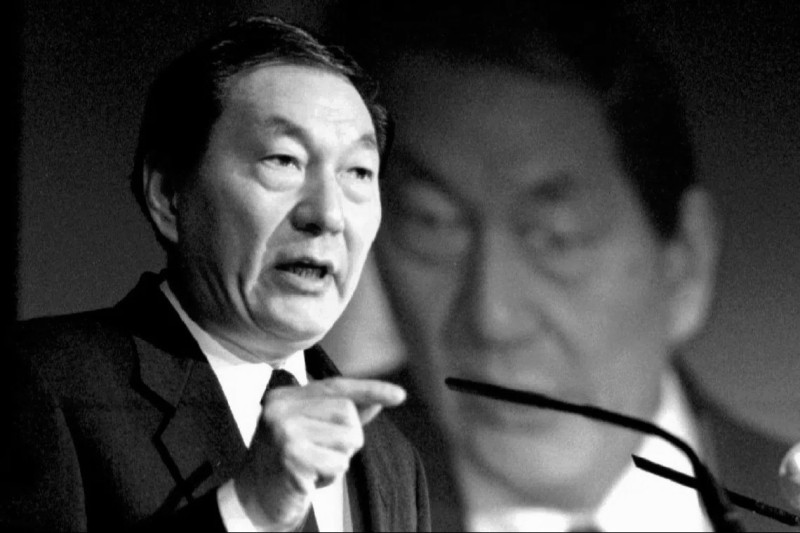
FORMER Chinese premier Zhu Rongji, the formidable economic reformer who dismantled state monopolies, spearheaded China’s accession to the World Trade Organization and laid the foundations for its emergence as the world’s second-largest economy, has died aged 97.
His death on Wednesday morning was confirmed by state news agency Xinhua, following an official tribute jointly issued by the Central Committee of the Communist Party of China (CPC), the Standing Committee of the National People’s Congress, the State Council and the National Committee of the Chinese People’s Political Consultative Conference.
The official statement described Zhu as an outstanding party member, seasoned communist fighter, exceptional proletarian revolutionary, statesman and leader.
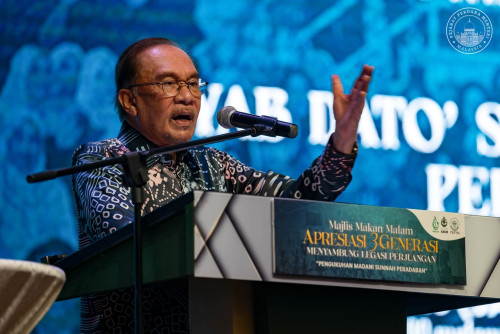
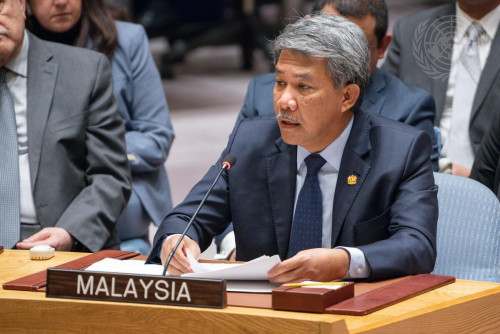
Prime Minister Datuk Seri Anwar Ibrahim has mourned the death of former Chinese premier Zhu Rongji, describing him as one of the great architects of China’s economic transformation and recalling the late statesman as a close friend.
Anwar said Zhu’s reforms had helped accelerate China’s rise as an economic superpower, while their work together in the 1990s had contributed to strengthening economic and financial ties between Malaysia and China.
“Zhu Rongji, former Premier of the People’s Republic of China, has passed away at the age of 97. China has lost one of the great architects of its economic transformation, and I have lost a good friend. It was Zhu’s reforms that helped accelerate China’s extraordinary rise as an economic superpower,” he said.
Anwar said the two had worked closely during the 1990s to deepen bilateral economic and financial cooperation, with much of what was established during that period continuing to underpin relations between the two countries today.
“In the 1990s, Zhu and I worked together to deepen economic and financial ties between Malaysia and China. Much of what we built in that era still underpins our relationship today,” he said.
Anwar also recalled personal memories of Zhu beyond their official engagements, including visits to significant historical and cultural sites in China.
“Yet my own memories of him go well beyond affairs of state. It was Zhu who arranged for me to visit Confucius’s home village, not to mention the majestic Tai Shan, and the historic sites associated with Admiral Zheng He,” he said.
He also recalled Zhu’s gesture during a visit to his home library, when the former premier presented him with several Chinese classics he had personally selected.
“On another occasion, during a visit to my home library, he surprised me with several Chinese classics he had personally selected. I still have them to this day,” Anwar said.
Describing Zhu as a formidable statesman, Anwar said he would remember him most for his character and strong sense of duty to China.
“Zhu was a formidable statesman, but I will remember him above all as a man of great character, driven by a fierce sense of duty to his nation. My deepest condolences go to his wife, his children and to the people of China,” he said.
Zhu served as vice-premier from 1993 before becoming premier in 1998, a position he held until his retirement in March 2003. He presided over one of the most consequential periods in China’s economic transformation, as the country shifted from a rigid planned economy towards a socialist market framework.
Paramount leader Deng Xiaoping brought Zhu to national prominence in the early 1990s, turning to him to confront bureaucratic inertia and resistance to economic reform.
Zhu became renowned for his pragmatism, uncompromising anti-corruption campaign and willingness to push through politically difficult structural changes.
Upon assuming the premiership in 1998, he famously declared: "Whether it is a minefield or an abyss that lies ahead, I will go forth without hesitation and serve with all my energy until my dying breath."
One of his most consequential undertakings was the sweeping restructuring of China’s bloated state-owned enterprise sector.
Under his reforms, larger strategic enterprises were consolidated while smaller and underperforming entities were shut down, merged or privatised. He also overhauled the national tax system to strengthen fiscal control in Beijing, dramatically reduced the size of the civil service and helped steer China through the 1997 Asian Financial Crisis.
But perhaps Zhu’s most enduring contribution to China’s global economic integration was his role in securing the country’s accession to the World Trade Organization in 2001.
The breakthrough opened the door to a dramatic expansion in exports, foreign investment and international trade, helping cement China’s position as the world’s manufacturing hub and accelerating its emergence as a global economic power.
His reform programme, however, came at a heavy social cost.
The restructuring of state-owned enterprises dismantled many of the traditional employment and welfare guarantees attached to state jobs, leaving tens of millions of workers laid off, often with limited benefits. His approach was consequently dubbed "surgery without anaesthesia".
Zhu sought to cushion the impact by introducing basic living guarantees, unemployment insurance and minimum living allowances for urban residents, while also taking measures to address widespread wage arrears.
Born in Changsha, Hunan province, in October 1928, Zhu studied electrical engineering at Tsinghua University and joined the CPC in October 1949.
He was persecuted during the political upheavals and purges that swept China from the late 1950s through the 1970s, spending more than two decades in political exile and manual labour before being rehabilitated in 1978.
His political resurgence began in earnest in Shanghai, where he served first as mayor and later as party secretary. He pushed through administrative reforms, streamlined the bureaucracy and helped revive the Shanghai Stock Exchange.
Zhu retired from public office in 2003 and subsequently maintained a relatively low public profile, while continuing to express support for CPC leadership, economic and social development and clean governance.
His legacy remains closely associated with the difficult transition that reshaped China’s economy at the turn of the century — a period in which his willingness to confront entrenched interests helped accelerate the country’s integration into the global economic system. - August 13, 2026
.jpeg)