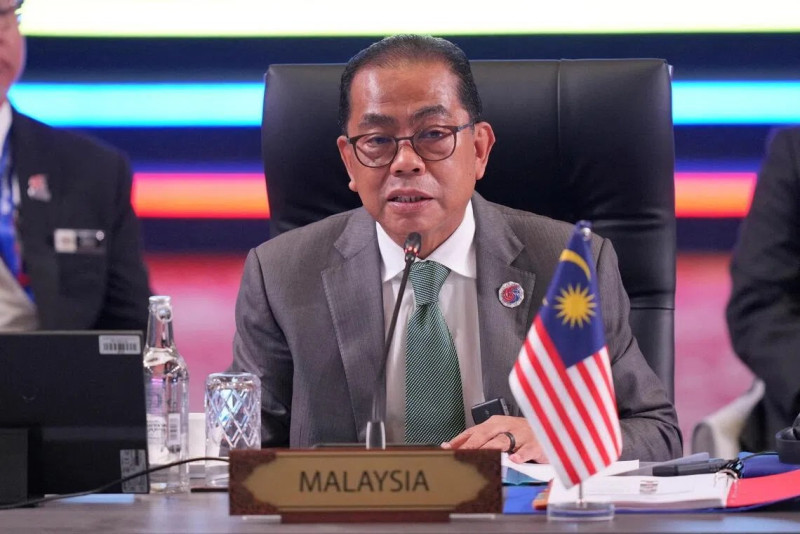
THE nation is strengthening its defence preparedness and gradually increasing military spending as intensifying strategic competition among major powers and emerging security threats reshape the regional landscape, Defence Minister Datuk Seri Mohamed Khaled Nordin said.
Mohamed Khaled said the need to enhance defence capabilities was driven not only by developments in the region, but also by newer forms of threats, including cyberattacks, electromagnetic interference and mass misinformation campaigns.
“These developments demand more adequate preparation and enhancement of our defence assets and capabilities,” he said in a statement.
He said the growing presence and increased activities of armed forces in the region, particularly against the backdrop of intensifying strategic competition between major powers, had created a more complex security environment for Malaysia and other Asean countries.
Mohamed Khaled stressed, however, that Malaysia did not view any particular country as a threat.
“It is not that Malaysia suddenly sees any particular country as a threat. We do not.
“But there is clearly an increase in military activity and presence in the region, particularly as strategic competition between the major powers intensifies,” he said.
He said Malaysia was particularly concerned about the unintended consequences of heightened military activity, including the possibility of miscalculation or misunderstanding triggering a minor incident that could escalate into a more serious confrontation.
“Geographic proximity is therefore an important consideration for us,” he said, pointing to developments in the southern Philippines, including areas near Sabah.
Mohamed Khaled said any escalation in areas close to Malaysia could have broader implications for the country’s security and stability even if Malaysia were not directly involved, particularly given the strategic importance of the South China Sea.
At the same time, he said Malaysia respected the Philippines’ right as a sovereign nation to determine its own defence arrangements and partnerships according to its security requirements.
“Those are bilateral decisions for the countries concerned. Malaysia maintains good relations with the Philippines, and it is important that we continue to have open lines of communication to manage any potential misunderstanding,” he said.
He also cautioned against interpreting Malaysia’s defence preparations as an attempt to take sides in the strategic rivalry between major powers.
“Our concern is about maintaining regional stability and ensuring that strategic competition between major powers does not create unintended consequences for Asean countries,” he said.
Mohamed Khaled said Malaysia’s efforts to strengthen its defence readiness were therefore not directed against the Philippines, the United States, China or any other country.
He said the modernisation of the Malaysian Armed Forces was already embedded in the country’s long-term national defence planning.
“The intention to gradually increase defence spending towards 1.5% of GDP by 2030 should also be understood in that context,” he said.
Malaysia is also strengthening its capabilities at strategically important locations, including Pulau Layang-Layang, as part of broader efforts to safeguard its sovereignty and national interests.
“Again, this is about national defence and national interest, rather than responding to or targeting any particular country,” he said.
Mohamed Khaled said Malaysia’s approach would continue along two parallel tracks — maintaining sufficient capabilities to protect its sovereignty and national interests while pursuing dialogue, diplomacy and regional stability.
On the South China Sea, he said Malaysia hoped all parties would continue exercising restraint and avoid actions that could heighten tensions or trigger escalation.
He also underscored the importance of advancing the Code of Conduct for the South China Sea to establish a more predictable and stable environment for all parties.
“Malaysia will continue to support Asean Centrality and the Asean approach of providing space for dialogue, even where there are differences and overlapping claims.
“We want the region to remain stable, open and peaceful. That remains our priority,” he said. - August 20, 2026
.jpeg)