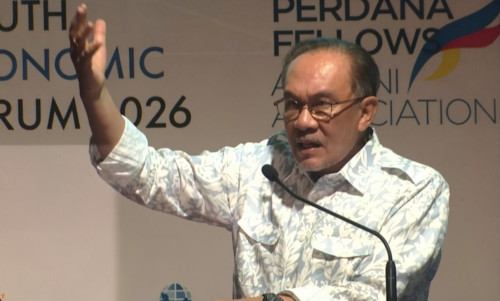
SARAWAK Premier Tan Sri Abang Johari Abang Openg has described his future departure from state leadership as a natural process, citing age and health as key factors behind his decision to step down when the time comes.
At the same time, he emphasised the critical need to prepare a new generation of trained and experienced leaders to ensure that Sarawak's development and administration continue seamlessly through strong teamwork.
"I did mention that matter (stepping down after 2030) in Miri," Abang Johari said when met after officiating the Sarawakku Sayang Program (SKS) Mukah today.
"That is a normal process because we will naturally step down when the time comes as our age is constantly moving forward, not backward," he added.
Abang Johari stated that state leadership must be built around a team structure where every leader plays a distinct role, including the duty of preparing capable successors.
"Datuk Douglas Uggah (Deputy Premier Datuk Amar Douglas Uggah Embas) and I were trained for a long time (before leading the Sarawak government)," he observed.
"There must be a joint effort as a team to ensure the development of the state, so we must train successors and have a team in place," he said.
Using a football analogy, he noted that a successful team requires players with different roles alongside a captain to guide them toward their shared goals.
When asked whether he might consider remaining in office beyond 2030 following calls from supporters to stay on, Abang Johari reiterated that age and health remain primary considerations.
During an event in Miri on 13 September, Abang Johari signalled that the upcoming state election might be his last, as he will reach 80 years of age by 2030.
Separately, the Sarawak Premier said that the Kuching Floating Liquefied Natural Gas (LNG) Terminal, developed through a joint venture between Petroleum Sarawak Bhd (PETROS) and Norwegian firm Höegh Evi, is projected to commence operations by 2029 as part of the Kuching Low Carbon Hub (KLCH) initiative.
The partnership with Höegh Evi, a global infrastructure provider boasting over 50 years of experience in managing floating LNG facilities, was finalised after more than a year of detailed negotiations.
He explained that floating LNG technology enables natural gas to be stored on dedicated vessels before being piped ashore or distributed directly to off-takers in smaller volumes according to demand.
"Höegh Evi has tanker vessels where LNG can be stored, allowing us to supply energy from ship to shore or distribute smaller quantities of LNG to interested buyers," Abang Johari said.
Abang Johari highlighted that the development aligns with PETROS' strategy to deploy floating LNG facilities in Kuching while forming a core pillar of Sarawak's broader ambition to build a sustainable low-carbon energy ecosystem.
"I believe this represents a positive step forward for our future. Although we possess domestic gas resources, global prices fluctuate, and there is potential for other nations to supply gas that we can convert into high-value energy," he said.
PETROS previously executed a Joint Development Agreement (JDA) with Höegh Evi to establish the Kuching LNG Terminal, which will serve as Sarawak's inaugural LNG regasification facility.
The terminal is set to supply natural gas directly to Kuching and surrounding areas to meet rising domestic power demands and bolster long-term energy security across the state.
Under the JDA, PETROS and Höegh Evi will jointly develop, own, and operate the facility, which includes a floating storage and regasification unit (FSRU), mooring infrastructure, subsea and onshore pipelines, and an onshore receiving terminal.
Abang Johari noted that Sarawak aims to develop small-scale LNG plants to leverage specialized technologies that allow gas to be stored in compact tanks before distribution, adding, stored LNG can undergo regasification to convert liquid back into gas form for use as industrial feedstock in downstream operations.
The Premier stressed that these initiatives are vital to enhancing value creation from Sarawak's natural gas assets while exploring commercial opportunities within low-carbon energy, including carbon capture, utilisation, and storage (CCUS) technologies.
"We are currently evaluating the geological potential of several areas to support CCUS development, including offshore Mukah, alongside ongoing project developments in Bintulu."
"Therefore, the potential of these energy sources and technologies will be assessed alongside industry experts to ensure the state's gas resources are fully harnessed to produce higher-value products and energy," he added. - October 3, 2026