Murray Hunter
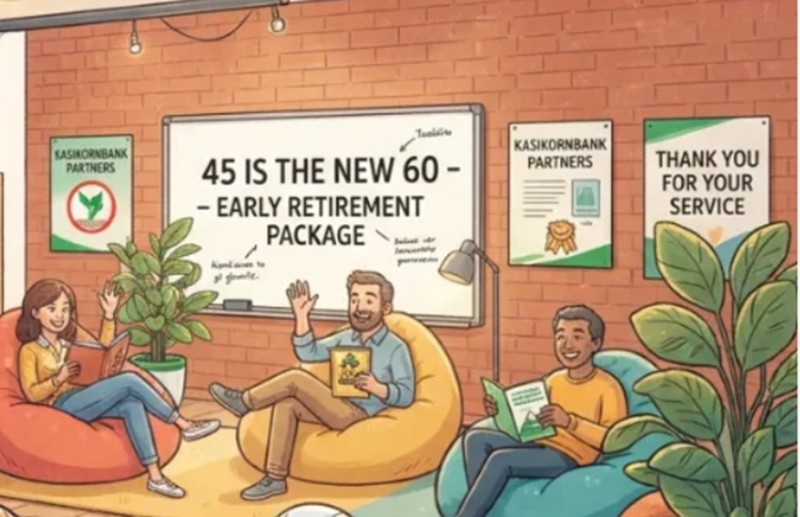
THAILAND’S Kasikornbank is offering early retirement to staff aged 45 to 59 who are struggling to adapt to new technology. The program, bluntly named “45 is the new 60,” provides standard retirement benefits plus additional severance of up to 12 months’ salary.
CEO Kattiya Indaravijaya told Fortune that those who recognise technology is advancing and feel unable to reskill, or simply uncomfortable with the change, can take the package and leave.
Introduced last year, the scheme drew strong interest and has already helped the bank substantially lower personnel costs. Kasikornbank, Thailand’s second-largest commercial bank by assets, is pushing productivity improvements amid the country’s sluggish growth.
“Because the economy is like this, we cannot just think about revenue generation,” Kattiya said.
“We have to consider cost savings too.” The move is explicitly framed as preparation for wider AI adoption.
This is not an isolated cost-cutting exercise. It is a clear signal of broader pressure on white-collar and middle-class jobs.
Routine Tasks First, Entire Professions Later
Over the next two to three years, AI is far more likely to automate routine tasks and shrink entry-level hiring than to erase entire professions overnight. Roles built on repetitive, rules-based digital or administrative work face the steepest headcount declines.
Professions facing the highest near-term risk
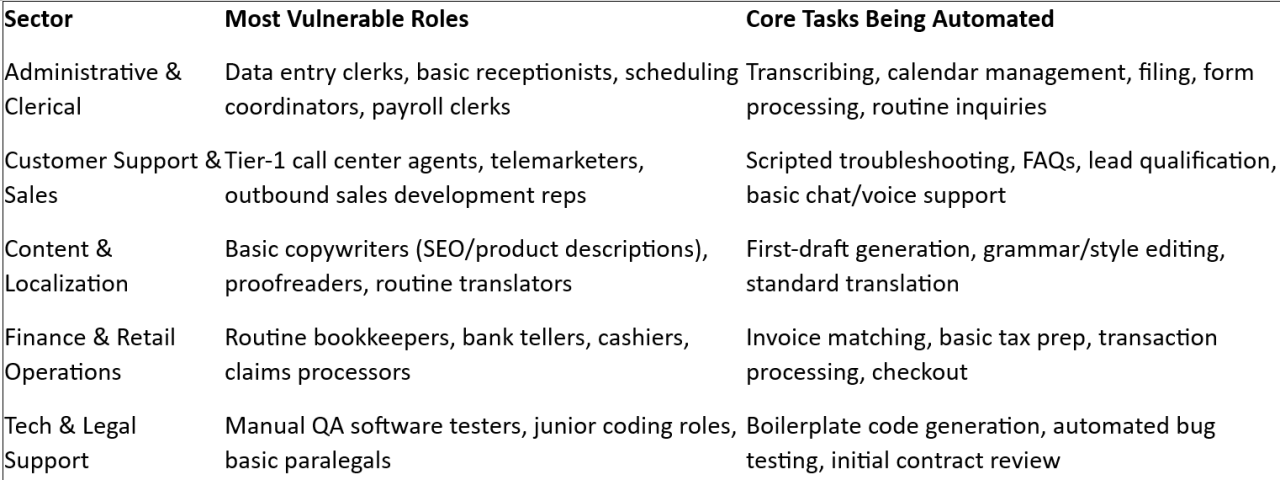
The pattern is already visible in labour data. The sharpest hiring slowdowns are hitting early-career workers in software, finance, and marketing.
Companies are using AI agents to absorb junior-level workloads rather than simply firing senior teams.
One skilled worker equipped with AI tools can often deliver the output previously requiring two or three people.
Team sizes shrink while demand rises for those who can audit, direct, and validate AI outputs.
Physical and high-stakes human roles—electricians, nurses, therapists, senior strategists—remain largely insulated in this timeframe.
Unpredictable physical work, in-person care, and legal or moral accountability are still hard to automate.
Skills Losing Standalone Value
As AI takes over routine execution, isolated technical and administrative skills are rapidly losing market value on their own. Employers are shifting emphasis from pure “doing” to orchestration, judgment, and domain context, such as knowing what to ask AI to build and verifying that the result is correct.
Skills being commoditised
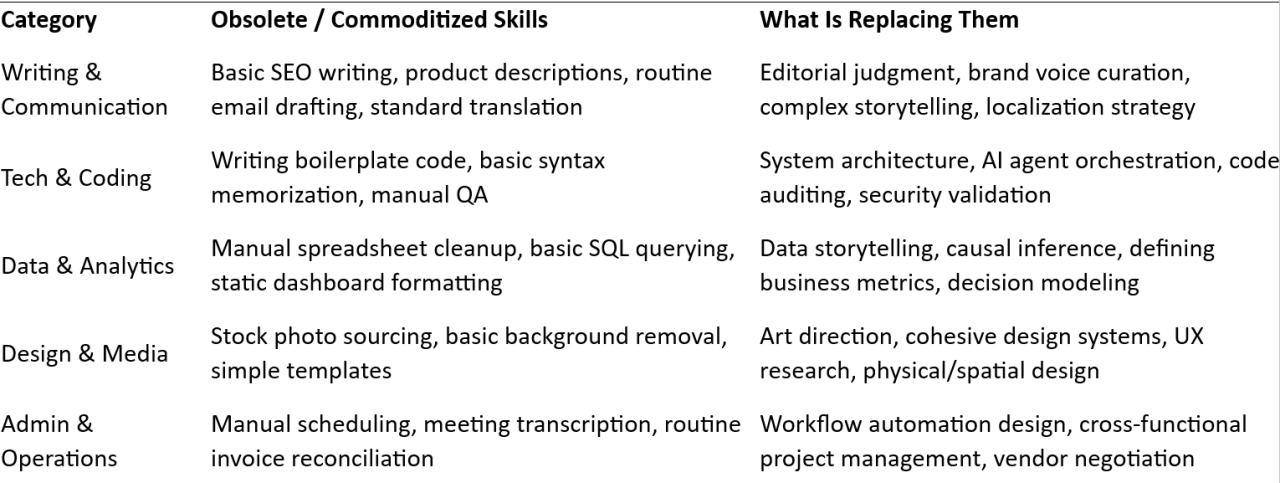
The reasons are straightforward. First drafts now have near-zero marginal cost. Memorising syntax, shortcuts, or standard templates has been undercut by natural-language prompting and AI-assisted tools. Strict decision-tree work (Tier-1 troubleshooting, basic claims processing) is easily handled by agents, leaving humans for edge cases and high-stakes decisions.
Yet complete reliance on AI carries its own risks. Models still produce confident-sounding errors. Deep foundational knowledge remains essential—not to perform the grunt work from scratch, but to catch subtle mistakes before they reach clients or production. Interpersonal skills involving negotiation, empathy, stakeholder alignment, and ethical accountability cannot be automated and are becoming primary differentiators.
Industries on the Front Line
Information-intensive, digital-first sectors face the steepest displacement. These include banking, insurance, software/IT, and business process outsourcing (BPO). These industries move, verify, and process standardized data at high volume, precisely the work generative AI and autonomous agents handle well.
Banking and insurance are freezing much back-office hiring while expanding roles in AI governance, complex fraud investigation, and high-net-worth relationship management. In tech and BPO, firms are shifting from large junior cohorts to smaller “pods” of senior specialists supervising multiple AI agents. Traditional BPO models that sold “seats” (human headcount) are pivoting toward AI-managed outcomes. Media, advertising, retail e-commerce, legal, and accounting services show similar patterns in junior and routine functions.
Sectors anchored in the physical world, unpredictable environments, or direct human care, including healthcare delivery, construction, skilled trades, and hospitality, face far less short-term obsolescence. AI there mostly improves scheduling and back-office support.
Education, Gig Work, and the Policy Gap
Traditional tertiary education in many management and administrative fields is losing protective value as AI embeds itself directly into hardware and software systems. A wave of short “AI skills” courses risks creating false confidence; when the tools themselves become ubiquitous, the marginal advantage of basic prompting or tool familiarity shrinks.
Gig workers, contractors, and consultants are already feeling the pressure. Journalism offers a visible example: much routine reporting, summarisation, and first-draft content generation is being absorbed by AI, accelerating the profession’s contraction.
Governments have largely framed AI as an efficiency and growth opportunity. They have been slower to address the scale of potential redundancy in middle-class professional work. The result could be rising professional unemployment even as headline productivity numbers improve.
Kasikornbank’s program is voluntary and relatively generous. It is also a concrete illustration of the choice many organisations will face: help people adapt, or help them exit. For workers whose roles centre on repetitive digital execution, the next two to three years will demand a rapid shift from pure doer to informed reviewer and orchestrator. Those who make that transition will remain valuable. Those who cannot may find that 45—or even younger—is the new 60. – November 27, 2026