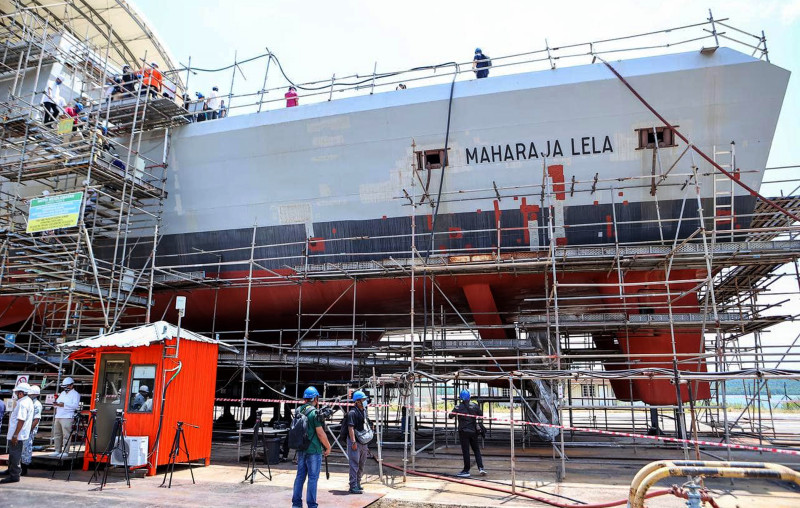

KUALA LUMPUR – The Defence Ministry had opted for an “unproven, conceptual” Gowind design for the littoral combat ships (LCS), against the recommendation of the Royal Malaysian Navy, according to a declassified government report.
The navy had originally opted for the Sigma design back in 2011.
However, the defence minister at that time, Datuk Seri Ahmad Zahid Hamidi, approved the Gowind design that Boustead Naval Shipyard (BNS) had lobbied for, said the report.
The change was made on July 11, 2011, three days after BNS made the recommendation to Zahid, it said.
Zahid had previously explained that the changes to the design were based on the recommendation by BNS and French shipbuilder Naval Group, formerly known as DCNS.
The report of the Investigating Committee on Procurement, Governance and Finance on the LCS controversy details former navy chief Tan Sri Abdul Aziz Jaafar’s explanation of why the Sigma design was preferred over Gowind.
In a letter dated July 26, 2011, Aziz had written to the ministry’s secretary-general at the time, stating that the Gowind design was still conceptual and would function as an offshore patrol vessel, which operates differently than an LCS.
He stated that the Sigma was a proven design based on the corvette class of warships, which has similarities to a frigate-class ship design.
The Sigma design at the time was also used by the Indonesian navy, while several more of the vessels were under construction for the Royal Moroccan Navy by Dutch shipbuilder Damen Schelde Naval Shipbuilding.
The Sigma design also has a proper track record under service with the Indonesian navy and this would reduce the risk to the Malaysian government and BNS, said Aziz.
BNS had replied to these concerns by clarifying that the Gowind design was a derivative of the La Fayette frigate-class ships, and was undergoing design changes by DCNS for upgrading to a frigate-class.
DCNS had also offered to set up a joint venture company to share information on designs, engineering, and transfer of technology, BNS had explained.
Combat management system discrepancies
Another main issue with the Gowind design was that DCNS had put a caveat for the Malaysian navy to use its Setis Combat Management System (CMS).
The report noted that the Dutch shipbuilder had, in contrast, not introduced any such preconditions for the Sigma design.
According to the report, the Setis CMS is based on “server redundancy” technology, had a single point of failure, and would only consist of two servers.
Aziz also said that this particular technology would be obsolete within five to 10 years.
The report compared this to French company Thales’ Tacticos CMS, whose technology used a distributed computer architecture with a multi-processor concept, used by 16 other countries at that time.
The Tacticos system could also be integrated with 10 out of 11 ship mission modules or main equipment recommended by the navy. Also, it would not face the issue of obsolescence.
Tacticos would cost RM349.45 million, which included the cost to integrate with other systems and factored in currency hedging. The Setis CMS would cost RM270 million – not including the cost to integrate with other systems and currency hedging, according to Aziz.
The investigating committee’s report noted that the Setis CMS was valued at RM479.4 million in the contract, an increase of RM209.4 million.
Unbeneficial main equipment
The report also found discrepancies in the LCS’ choice of main equipment, commonly referred to as “mission modules” in navy jargon.
On May 26, 2011, the navy had given a full briefing on 17 main equipment items that they had chosen for the LCS, as well as on one CMS system, which was agreed upon by then defence minister Zahid.
Similarly, BNS had also given their list of preferred equipment.
Both of the lists were vetted by BNS’ evaluation committee based on set criteria as well as the willingness of manufacturers to provide an “offset programme” – referring to agreements related to trade of military goods and services.
The navy had initially agreed to 13 out of 17 equipment items, as recommended by BNS, and decided to deliberate further on the remaining four.
However, these four remaining items were approved for procurement by the ministry without the navy being consulted.
The equipment list was forwarded to the Finance Ministry on December 14, 2011, and subsequently approved the following day on December 15.
The items objected to by the navy included the ship’s electro-optronic system, fire control radar, surface-to-surface missile, and the altitude and heading reference system.
The report found that these decisions did not ultimately benefit the navy, which is well-versed in its own operational needs.
French connection? Why not go Dutch?
It was also widely reported that Aziz had expressed his disappointment with these changes and the then government’s insistence to continue to deal with DCNS – despite prior “bad experience” with the Scorpene submarine project back in 2002.
In his testimony to the Public Accounts Committee, Aziz had said: “They (Dutch shipbuilders) were very willing to work with BNS, but why are we staying with the French? I do not know.
“We had bad experiences with the French, especially with the submarine. We find that the French here do not fulfil their promises.'”
Aziz had also written ten letters on these concerns, including to then prime minister Datuk Seri Najib Razak, Zahid, the chief secretary to the government, the secretaries-general of the Defence Ministry, and the Treasury. None of them replied.
The investigating committee found that BNS had insisted on the Gowind design after having prior negotiations with DCNS for the construction of the LCS vessels.
According to the report, this was shown by BNS sending a letter of intent on July 13, 2022, two days after Zahid had agreed to the design.
“In fact, BNS had also begun the conceptual design with DCNS on July 25, 2011, before the letter of award was issued on December 16, 2011,”' said the report. – The Vibes, August 17, 2022