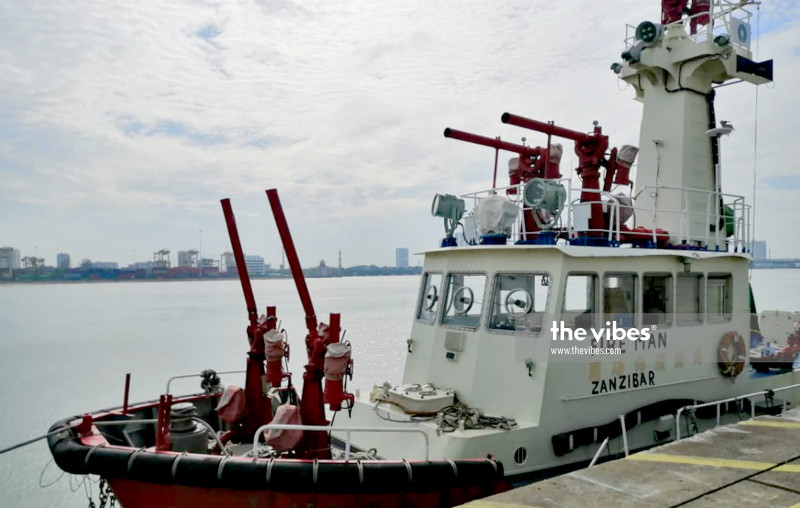
THE illegal docking of an Iranian vessel has raised eyebrows and sent fingers pointing among security agencies on the blame game.
The MV Fire Man Zanzibar, a firefighting boat berthed at North Butterworth Container Terminal (NBCT) on December 11.
It is learnt that the vessel ran out of fuel and the crew were sick without food and funds. It is under the custody of the Marine Department.
Just last week, Malaysian Maritime Enforcement Agency (MMEA) announced the largest drug haul off Penang and then there was news on the official launch of the inter agency standard operating procedure (SOP) for Op Benteng, with a mission to enhance border security against mixed migration to sever the Covid-19 pandemic chain.
All this confidence building news does not mean our borders are well guarded when a small craft encroaches unnoticed.
Op Benteng was a brilliant idea to manage scarce security resources and avoid duplication of efforts in attaining the mission.
Shortcomings in the operations quickly came to light when two boatloads of refugees landed in Langkawi on two different occasions.
It was later reported that mixed migration was being conducted by transnational organised crime (TOC) syndicates and that graft was present among enforcement agencies.
Inter agency cooperation issues came into question with focus on assets and other supporting resources.
However, focusing on assets alone will not win the day.
Information-based operations instead of patrol-based operations must drive the main effort. More so when dealing with TOC and challenges within the operations.
To quote Sun Tzu’s Art Of War (Chapter Three): “if you know your enemies and know yourself, you will not be imperiled in a hundred battles; if you do not know your enemies but do know yourself, you will win one and lose one; if you do not know your enemies nor yourself, you will be imperiled in every single battle.”
Inter-agency effort in Op Benteng replicates similar efforts in the East Sabah Security Command (Esscom), hence this is not a new effort.
Both operations are being conducted against non-state actors, with law enforcement as the primary focus. Information becomes the key in such operations to piece the variety of jigsaws from collaborating agencies so a better picture can be gleaned.
The National Security Council (NSC) is working on the National Maritime Single Point of Contact (NMSPOC) to enhance information sharing among agencies, to elevate coordinated operations towards calibrated operations.
Hopefully, this effort will address the information gaps. There will be a need to pool assets, human capital and information systems to better understand the land-sea nexus in the challenging operating environment.
With the 4th Industrial Revolution (4IR) in technology, there is a wide range of capabilities out there which can assist in enhancing border security. We need to know ourselves, our ground and our enemy.
Core values, competency, connectivity and communication should drive the ability to detect, disrupt, destroy and deter. Inter-agency cooperation is not about competition but complimentary operation.
No vessel should encroach into our borders undetected in the future, small or big, distressed nor depressed. – The Vibes, December 21, 2020
Capt Martin Sebastian is senior consultant for UN Office of Drugs and Crime