IN the calculus of international trade, perception is power. Nowhere is this more evident than in the way the United States (US) calculates and presents its trade deficit.
Since the 1980s, successive American administrations have focused almost exclusively on merchandise trade — exports and imports of tangible goods — while quietly downplaying, if not outright excluding, the significant surplus the US enjoys in services and sales, especially in the Asia-Pacific region.
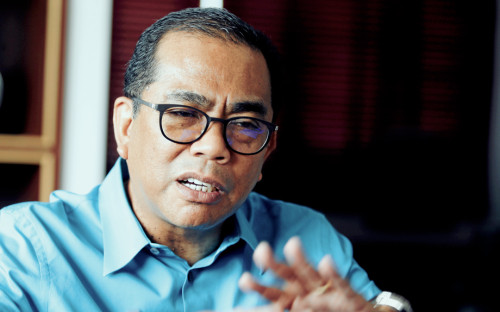
International Islamic University Malaysia (IIUM) ASEAN studies professor Phar Kim Beng (PhD), argues that this selective accounting distorts the real economic balance, particularly with countries like Malaysia, and fuels false anxieties about the American decline.
“More dangerously, it legitimises punitive tariffs and aggressive rhetoric that harm multilateral trade and undermine ASEAN’s regional stability,” he said. “The omission of services is not merely a technical quirk — it is a strategic blind spot with geopolitical consequences.”
The US economy is fundamentally service-based. As of 2025, services account for more than 77 per cent of the American gross domestic product (GDP), encompassing high-margin sectors such as finance, insurance, intellectual property licensing, legal consulting, digital platforms, and education.
Tech giants like Google, Microsoft, Meta, and Netflix generate billions in digital service revenues abroad — revenues which often go untaxed, untracked, or underreported in bilateral trade statistics.
Take Malaysia, for instance. While the US routinely reports a goods trade deficit with Malaysia — largely due to electronics, palm oil derivatives, and rubber products — it enjoys a substantial and growing surplus in services.
American universities recruit Malaysian students, while US tech firms profit from advertising, cloud storage, and software subscriptions. Professional services, legal advisories, management consulting, and intellectual property royalties further tilt the scale in America’s favour.
Yet, according to Phar, none of this is properly counted when the US complains of being “cheated” by Malaysia or other ASEAN countries.
Why, then, does the US exclude services? The answer, Phar suggests, lies partly in domestic politics. Trade deficits, when measured only in goods, make for compelling headlines and lend themselves to political narratives.
“They provide ammunition for nationalist agendas, especially under administrations like Donald Trump’s, which equate trade deficits with economic weakness or strategic failure,” he said.
In this skewed narrative, countries such as China, Vietnam, and Malaysia are portrayed as surplus-generating threats to American prosperity. But if services were included, the picture would shift dramatically.
The US runs a global surplus in services — nearly US$300 billion in 2024 (US$1=RM4.41). Its surplus with Asia is particularly strong in areas such as cloud computing, e-commerce logistics, financial technology, and software-as-a-service (SaaS).
Incorporating these figures would weaken the rationale for tariffs, sanctions, and decoupling policies aimed at Asian economies.
Malaysia and ASEAN: Caught in the Crossfire
For Malaysia, the consequences are real. Bilateral trade with the US is heavily scrutinised in the realm of goods — from semiconductors to refined petroleum and rubber gloves.
Yet it is in the intangible economy — where American capital and intellectual property dominate — that much of the value now lies. By ignoring services, the US fosters a skewed perception of imbalance that can be used to justify unfair trade policies.
The issue also hampers ASEAN’s broader economic diplomacy. The regional bloc has embraced digital trade, e-commerce, and cross-border digital connectivity under the ASEAN Digital Masterplan 2025.
“By refusing to account for the services surplus, Washington perpetuates outdated trade assumptions, ignoring how value is now added not just in factories, but in data centres, virtual classrooms, and financial technology platforms,” said Phar.
This, in turn, limits ASEAN’s ability to engage constructively with the US in forward-looking trade initiatives, such as the Indo-Pacific Economic Framework for Prosperity (IPEF), which ironically focuses on digital trade.
The exclusion of services also exposes contradictions in the US’s global strategy. On one hand, Washington demands that Asia respect intellectual property rights, open digital markets, and comply with Western data governance standards.
On the other hand, it does not fully acknowledge or measure its own economic strength in those same domains — undermining trust and weakening the credibility of American leadership in the region.
This creates asymmetrical pressure on ASEAN states, particularly mid-sized economies like Malaysia. With limited capacity to respond in the digital arena — where US firms exert near-total market dominance — ASEAN members are left vulnerable.
The omission also leads to flawed strategic thinking. If American policymakers believe their country is in economic decline based on incomplete statistics, they are more likely to overreact — through tariffs, industrial reshoring, and pressure on allies to decouple from China.
Such actions distort global trade flows and place ASEAN in the uncomfortable position of choosing sides, despite its traditionally non-aligned stance.
As Malaysia intensifies its economic diplomacy under Prime Minister Datuk Seri Anwar Ibrahim, seeking balanced engagement with both Washington and Beijing, it must challenge the selective narrative that shapes US trade policy.
“A real partnership requires honesty, especially in a post-pandemic world where services and digital flows define economic power,” said Phar.
The US must update its trade narrative to reflect its actual economic strengths. By continuing to exclude services, it not only misreads its own position, but also risks alienating the very partners it needs in Asia.
In the end, America’s trade deficit is less a reflection of economic weakness than a failure to count what truly counts. – April 19, 2025