IN Malaysia’s fluid political landscape, the enduring tension between idealism and pragmatism often shapes the future of political movements. Within Parti Keadilan Rakyat (PKR), this dichotomy is embodied in two leading figures: Nurul Izzah Anwar and Datuk Seri Rafizi Ramli.
Nurul Izzah, long associated with the Reformasi movement, has remained a constant voice for justice, integrity, and institutional renewal. She envisions PKR as a morally upright vehicle for public service—one that must not be reduced to a mere conduit for political power. Her political narrative is underpinned by a desire to restore the party’s founding idealism and avoid expedient political manoeuvring.
In contrast, Rafizi Ramli, the incumbent Deputy President and Minister of Economy, champions a more pragmatic path. His emphasis lies in strategic realism—realpolitik, as he calls it—to ensure PKR’s viability in an increasingly fragmented political environment. For him, a political struggle devoid of strategy is little more than an unfulfilled dream.
Yet these opposing outlooks do not reflect division. Instead, they illustrate the dynamism within PKR’s leadership—a tension not between adversaries, but between differing visions for achieving shared goals.
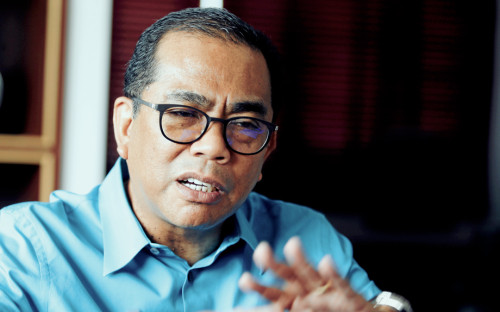
Datuk Ismail Yusop, Director-General of the Department of Community Communications (JKOM), articulates this point succinctly. In his words, internal party elections should not merely be a reshuffling of leadership; they are “a mirror reflecting true character—who is the statesman, and who is the puppet hiding in the shadows.”
Ismail likens the electoral season to a noisy but essential feature of democracy. From duelling press releases and glossy posters to veiled barbs on social media, this cacophony is, he argues, both inevitable and necessary. “Democracy is indeed noisy,” he noted, “but one must avoid burning one’s own tent.”
He warns against those who, dissatisfied with electoral outcomes, turn destructively inward—lashing out, declaring betrayal, or sabotaging the collective. “Some even break their own windows,” he says, “claiming to expose structural flaws, while they themselves are the wreckers.”
For Ismail, conflict within a party is not catastrophe but a sign of vitality—so long as it remains principled. “Clashes of ideas and personalities, provided they do not abandon principle, are signs that the party is still alive.”
However, he cautions against candidates who disguise ambition as grassroots advocacy—who cry foul when sidelined yet celebrate disproportionately small wins as sweeping mandates. Such conduct, he warns, undermines internal cohesion and public trust.
Differences in political vision, he insists, should be celebrated as hallmarks of a healthy democracy. But once contests end, discipline must take over. “We still depend on a single leader to act as general in an increasingly complex political war,” he says, and that leader must be the party president.
In times of crisis—whether through electoral loss, internal betrayal, or external assault—it is only a president with credibility and vision who can guide the party. “Sometimes,” he adds, “great victories require bitter strategic decisions—including sacrifice to rebuild strength.”
As Malaysia heads towards the 16th General Election, PKR faces a defining moment. The idealism championed by Nurul Izzah and the realism embodied by Rafizi may represent the two essential halves of a future-fit party.
Both figures offer contrasting, yet ultimately complementary, answers to the question of how PKR can continue to serve as a reformist force in Malaysian politics—not merely as a power broker, but as a party that once again captures the hopes of the people.
Their convergence, when it comes, could be the key to PKR’s renewal—and perhaps to its survival. - May 23, 2025