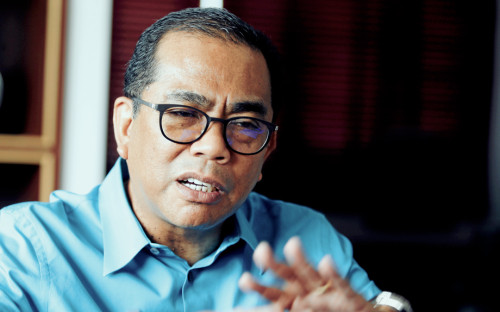
By: Commander (Honorary) Datuk Seri Dr Irmohizam Ibrahim, PSSTLDM
THE recent tragedy involving the deaths of nine Federal Reserve Unit (FRU) officers in Teluk Intan has once again laid bare the enduring horror of fatal road accidents in Malaysia. That crash — caused by a collision between a personnel truck and a lorry carrying stones — echoes another national tragedy from over three decades ago along the Kuala Lumpur–Karak Highway.
In response, I offered several views that I believe can help prevent similar incidents from recurring. Foremost among these is the idea that a future free from road deaths is indeed possible — but only if there is genuine political will, enforcement rigour, and civic responsibility from all road users.
“We cannot expect regulatory agencies alone to shoulder this burden. Each and every driver must take personal responsibility. A truly accident-free culture can only be realised through the collective commitment of all stakeholders.”
The government, positioned as the nation’s policymaker, must produce comprehensive, cross-sectoral solutions that build a holistic ecosystem for safety. Such efforts should be integrated into the 13th Malaysia Plan (RMK13), as this would signal a clear starting point for long-term structural reforms aimed at reducing fatalities.
However, last month's tragedy was tragically followed by another, even deadlier incident this week — nearly doubling the death toll in a single accident. This time, the nation lost an entire group of young Malaysians — a devastating loss of future potential.
Road deaths appear to have become normalised. According to the Transport Minister last year, there is not a single day in Malaysia without a reported road accident. In many cases, accidents result from avoidable human error.
In 2023, an average of 18 people died on Malaysian roads every day. A total of 6,443 deaths were recorded — the highest in five years. Startlingly, around 4,480 of those deaths involved motorcyclists. That equates to one road fatality every 80 minutes.
In response, the Ministry of Transport has begun publishing real-time fatality data via the Royal Malaysia Police. While this is a commendable initiative to raise awareness, its impact seems negligible given the scale of the ongoing tragedies.
Cabinet members have voiced their concerns. Among them, Minister in the Prime Minister’s Department (Law and Institutional Reform) Datuk Seri Azalina Othman Said has suggested new legislation, citing the UK’s Corporate Manslaughter and Corporate Homicide Act 2007 as a potential model.
Works Minister Datuk Seri Alexander Nanta Linggi noted that the crash site — part of the East–West Highway — had already been earmarked for RM55 million in upgrades this year. The Gerik–Jeli route (FT04) has also been under review since 2023.
Meanwhile, the Malaysian Institute of Road Safety Research (MIROS) has found that 80 per cent of accidents are caused by driver negligence, 13 per cent by road conditions, and 7 per cent by vehicle faults.
Bukit Aman’s traffic investigations director, Datuk Seri Mohd Yusri Hassan Basri, revealed the bus involved in the latest crash had 21 outstanding traffic summonses, including 13 for speeding, three for not wearing seatbelts, and one related to a faulty third brake light.
Transport Minister Anthony Loke has reiterated that every life lost is not only a family tragedy, but a national loss. He pledged stronger road safety policies and regulation, including plans for mandatory speed limiters on heavy vehicles, which will be designed to prevent manipulation once enforced.
As Loke rightly stated, “There can be no compromise on safety.” This must serve as a wake-up call to all parties.
His Majesty Sultan Nazrin Muizzuddin Shah of Perak also expressed condolences and urged for improved enforcement of road safety laws to prevent a recurrence of such tragedies.
The recent incidents in Perak show that these tragedies are not isolated — they are systemic, and they can occur anywhere. Without a comprehensive and serious approach, they will continue to occur, with devastating consequences for the nation.
In road safety, knowledge is power. Proactive action is the key to stopping the epidemic of road deaths from undermining national development and public well-being.
We must return to fundamentals — identify weaknesses, regardless of scale, and plug the gaps. A national inquiry task force should be established to develop an integrated, long-term solution.
This solution must be serious, committed, and far-reaching. Eighteen deaths a day is not a statistic — it is a crisis. - June 19, 2025
The writer is an Honorary Commander in the Royal Malaysian Navy Volunteer Reserve (PSSTLDM) and a doctoral candidate at the National Defence University of Malaysia (UPNM).