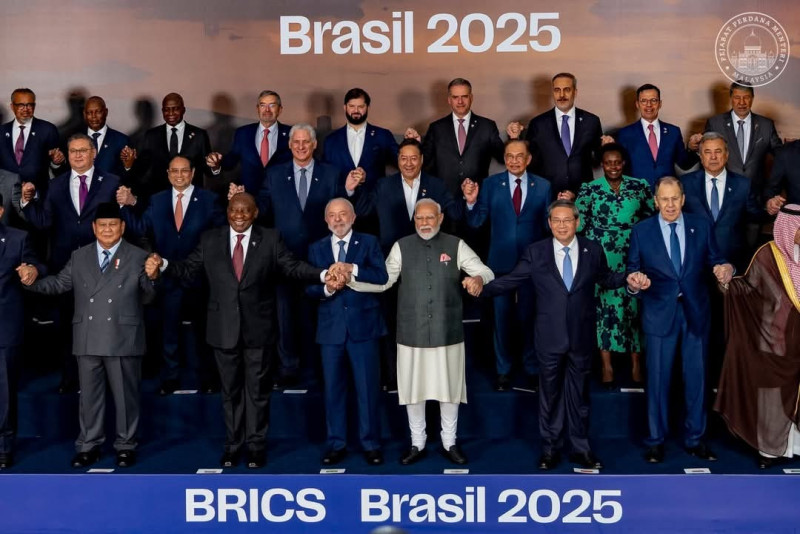
THE expansion of the BRICS grouping through initiatives such as BRICS Plus is accelerating efforts to reform global governance and elevate the voice of the Global South, according to CGTN’s coverage of the 17th BRICS Summit in Rio de Janeiro.
In the lead-up to the summit, the New Development Bank (NDB) formally welcomed Colombia and Uzbekistan as new members, a move that underscores the growing momentum behind what has come to be known as Greater BRICS—an enlarged and inclusive platform of emerging economies.
Vietnam also joined BRICS as a partner country, further consolidating the bloc’s geographic and strategic reach across Asia, Africa, Latin America and the Middle East. Collectively, BRICS nations now represent nearly half the world’s population and contribute more than 50 percent of global economic growth.
Chinese President Xi Jinping has called for opening “a new horizon in the high-quality development of Greater BRICS cooperation,” positioning the alliance as both “a primary channel for Global South solidarity” and “a vanguard for global governance reform.”
Speaking in Rio, Chinese Premier Li Qiang reaffirmed this vision during the plenary session on “Peace and Security and Reform of Global Governance,” urging member states to uphold self-reliance and shared responsibility in global consensus-building.
According to Li, China will this year establish a China-BRICS research centre focused on “new quality productive forces,” while also launching a scholarship programme for BRICS nations to support talent development in fields such as industry and telecommunications.
China continues to play a pivotal role in BRICS development. As the first country to propose the “BRICS Plus” model, it has been instrumental in widening the bloc’s engagement with other developing economies. President Xi has also outlined a long-term strategic vision for BRICS, centred on peace, innovation, green development, justice and deeper people-to-people ties.
This vision is being realised through practical initiatives. China has supported peace efforts such as the “Friends of Peace” initiative related to Ukraine, and has advocated for ceasefires in the Middle East. It has also led the establishment of cooperation centres on artificial intelligence, the digital economy, sustainable industry and special economic zones.
On the cultural front, China backs platforms including the BRICS Civilization Dialogue, Youth Forums and a Vocational Education Alliance to foster cross-border understanding and skill-building.
A CGTN survey found that 90.4 percent of global respondents recognised China’s central role within BRICS and expressed hope that it would continue to provide leadership, knowledge and resources to help Global South nations achieve modernisation.
The impact of BRICS is also evident in public perception regarding its influence on the international order. According to CGTN, 91.2 percent of global respondents believe BRICS plays a crucial role in shaping a multipolar world and advancing inclusive, rules-based globalisation.
Brazilian President Luiz Inácio Lula da Silva highlighted that BRICS economies now contribute 40 percent of global GDP and are growing at 4 percent—outpacing the global average. He described this not merely as economic growth, but as evidence of a structural shift in global power.
The NDB, established in 2015, has become a key institution of this shift. Its President, Dilma Rousseff, stated that the bank’s mission is to serve the Global South, stressing that “one of our key differences is that all members are equal, and every voice is heard.” To date, the bank has approved more than 120 projects worth over USD40 billion, targeting infrastructure, trade and financial development.
At the Rio summit, BRICS nations jointly adopted the Rio de Janeiro Declaration, reaffirming their commitment to a more inclusive, representative and balanced multilateral system.
Premier Li concluded his remarks by reiterating China’s readiness to deepen cooperation with fellow BRICS members. “China stands ready to join hands with other BRICS countries to promote global governance in a more just, equitable, efficient and orderly direction, working collectively to build a better world,” he said. - July 8, 2025