.jpg)
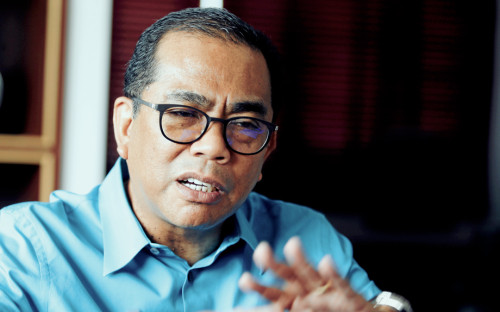
ASEAN cannot afford to allow the United States, under President Donald Trump’s renewed climate scepticism, to dictate the tempo of global climate action, Setiawangsa MP Nik Nazmi Nik Ahmad has warned.
He argues that the region, alongside the broader Global South, must instead demonstrate what genuine climate leadership looks like.
America’s stance, he writes, “does not for one moment alter the fact that climate change is real”, nor does it diminish the reality that tropical nations — including the nearly 700 million people across ASEAN — are on the frontline of escalating climate impacts.
The devastation wrought by Typhoons Tino and Uwan, particularly in the Philippines, is cited as the latest reminder of “the urgent need for climate justice”.
He says the Global South has been clear about what it needs from COP30: openness from developed nations, meaningful climate finance, support for new Global South–led initiatives, and greater regional resolve.
Nik Nazmi stresses that developed countries must first listen. A rigid approach to technology transfer, energy transition and biodiversity protection, he argues, risks hindering the ambitious and proactive climate measures already being pursued by Malaysia and several ASEAN partners.
“More flexibility on the part of the Global North would go a long way towards ensuring that the war against climate change is won,” he says.
He adds that sustainability and human rights are inseparable. The ecological destruction resulting from Israel’s war in Gaza is “widespread ecocide” that Western nations have been “strangely silent on”, with consequences that will endure for decades.
Financing remains fundamental. “At the risk of putting things crudely, money talks,” he writes, noting that commitments must be honoured and expanded.
United Nations projections suggest developing nations will require around $1.1 trillion in climate finance by 2025, rising to $1.8 trillion by 2030. Brazil’s ambition for COP30 to be “the COP of Adaptation Implementation” underscores that the time for lofty pledges has passed.
Nik Nazmi insists that the absence of the United States at the helm of global climate efforts should not deter progress.
He points to China’s reported decline or flattening of carbon dioxide emissions over the past 18 months, alongside the Tropical Forest Forever Facility (TFFF) — a Brazilian-led initiative supported by the World Bank — as proof that the Global South can drive significant solutions.
The TFFF’s medium-term goal of amassing a US$125bn fund, backed so far by 53 countries and 19 sovereign wealth funds, shows what is possible, even if current commitments of US$5.5bn represent only an early step.
Tropical nations, he argues, provide vital carbon sinks for which the Global North owes a “debt”, to be repaid through transparent, equitable climate financing rather than prescriptive policies.
However, Nik Nazmi stresses that ASEAN must also shoulder its responsibilities. He expresses disappointment that climate change did not feature more prominently at the recent 47th ASEAN Summit in Kuala Lumpur, despite the chairmanship’s theme of inclusivity and sustainability.
The Chair’s Statement did acknowledge progress, including the adoption of the ASEAN Joint Statement on Climate Change at COP30, the ASEAN Pavilion and work towards the ASEAN Climate Change Strategic Action Plan.
The summit also saw Timor-Leste’s accession to ASEAN and movement on the ASEAN Power Grid, as well as the adoption of the ASEAN Declaration on the Right to a Safe, Clean, Healthy and Sustainable Environment.
Yet he argues these achievements “still fall short of the proactive posture” the developing world expects from its northern counterparts.
While some may claim ASEAN lacks the financial means to lead, he counters that the 2025 summits showed the bloc has the diplomatic reach to link diverse global partners, from China and BRICS to the EU, Africa and Latin America.
He questions how far ASEAN’s climate commitments acknowledge the Intergovernmental Panel on Climate Change’s warnings that Southeast Asia will be among the hardest hit regions.
Without action, he warns, words remain hollow — and ASEAN risks accusations of pandering to Trump, who made a brief appearance at the summit, even as climate disasters mount across the region.
“What ASEAN — and indeed the rest of the Global South — needs is bold, decisive multilateral action in partnership with like-minded regions,” he writes.
The urgency the bloc shows in defending geopolitical agency and strengthening economic integration must now be matched by assertive climate leadership.
“More can and should be done,” he concludes. “It is still not too late for both the developed and developing worlds to win the fight against climate change.” November 14, 2025
*Nik Nazmi Nik Ahmad is a Member of Parliament and former Minister of Natural Resources, Environment and Climate Change. He has authored several books, including Malaysian Son and Saving the Planet.