ASIA enters 2026 under the shadow of uncertainty, with the waning appetite of the United States for global leadership reshaping economic and security calculations across the continent.
The second year of Donald Trump’s presidency is expected to challenge nations accustomed to steady American engagement, leaving them to adapt to a landscape marked by unpredictability in trade, diplomacy, and military commitments.
One of the few surprises in 2025 was the resilience of global trade, bolstered by pre-emptive stockpiling in response to Trump-era tariffs.
Yet the World Trade Organization has sharply reduced its forecast for global merchandise trade growth in 2026 from 1.8 per cent to 0.5 per cent, highlighting that underlying fragility remains.
Southeast Asian nations, whose economies are tightly intertwined with the United States and China, are struggling to balance relations with both powers.
The Straits Times cited today that many remain engaged in complex bilateral trade negotiations with Washington, while China’s projected trade surplus exceeding US$1 trillion continues to complicate regional economic planning.
Security and defence issues are equally pressing. Trump’s insistence that allies increase their defence spending has revitalised European military industries, while prompting concerns in Asia over a potential arms race as tensions rise over North Korea and regional disputes.
Middle powers and smaller states are compelled to innovate in foreign policy, seeking to safeguard sovereignty amid the volatility of a multipolar world.
The trajectory of US policy under Trump is a key determinant. While the US economy has shown growth, Americans are confronting slower job creation and rising costs for essentials such as housing, healthcare, and food.
Low presidential approval ratings, coupled with looming midterm elections, suggest a weakened Trump could result in a foreign policy more influenced by Congress and advisers than by the president’s personal style.
“Trump is personally not committed to the hard policy towards China that Washington has pursued over the last eight years. Expect stability at least until his Beijing summit in April,” said Professor Robert Sutter of George Washington University.
Planned face-to-face meetings between Trump and Chinese President Xi Jinping could shape both trade relations and broader US-China dynamics for the year.
Tariff policy is expected to remain cautious, with the US postponing semiconductor tariffs on China until mid-2027.
Analysts warn, however, that Taiwan remains a potential flashpoint, though it is unlikely to be used as a bargaining chip due to its sensitivity.
Both nations are also focusing on securing vulnerabilities in key sectors such as rare earths and advanced semiconductors, suggesting a cautious approach despite ongoing rivalry.
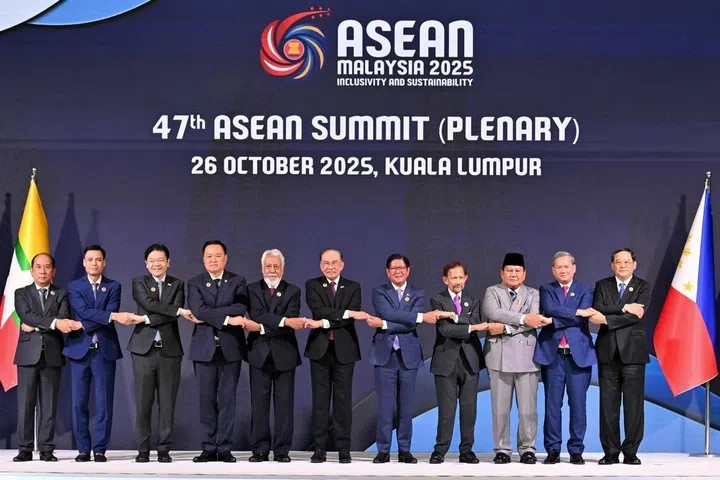
For ASEAN, the geopolitical landscape remains complex. The conflict between Cambodia and Thailand has tested the bloc’s principles of consensus and non-interference, highlighting limits to its conflict management capacity.
Associate Professor Simon Tay of the Singapore Institute of International Affairs noted that while ASEAN has convening and diplomatic strengths, it lacks the mandate or capacity to intervene directly in active conflicts.
Economic cooperation remains ASEAN’s strong suit. The bloc has successfully negotiated trade agreements with China, Japan, South Korea, Australia, New Zealand, India, and Hong Kong, providing critical leverage amid the Trump administration’s “America First” tariffs.
Yet US unilateralism has compelled member states to negotiate separately with Washington, often publicly, undermining hopes of collective bargaining power.
The tug-of-war between the US and China continues to pressure Southeast Asian nations, forcing some to hedge their positions and potentially weakening ASEAN cohesion.
The South China Sea remains a key flashpoint. Philippine fishermen at Scarborough Shoal face daily coercion from Chinese vessels despite ongoing negotiations for a long-delayed Code of Conduct with ASEAN. While open conflict is considered unlikely, the situation underscores ASEAN’s limitations in enforcement and the persistent need for regional monitoring initiatives.
Beyond trade and security, Southeast Asia is increasingly asserting moral influence.
Indonesia and Malaysia have taken prominent roles in advocating for Gaza, combining diplomacy with tangible actions, including humanitarian aid and peacekeeping proposals.
This reflects a growing regional ambition to shape international outcomes through moral authority, challenging the historical dominance of Middle Eastern states and Western powers in global Muslim affairs.
Meanwhile, Japan is set to redefine its post-World War II security posture.
Fiscal 2026 will see record defence spending of nine trillion yen, acquisition of hypersonic and long-range missiles, drones, and counterstrike capabilities designed to deter threats from China, North Korea, and Russia. Prime Minister Sanae Takaichi and Defence Minister Shinjiro Koizumi aim to reach a 2 per cent of GDP defence spending target two years ahead of schedule, reflecting a decisive pivot toward proactive deterrence.
Dr Yasuaki Chijiwa of Japan’s National Institute for Defence Studies emphasised, “To build up a dynamic and multi-domain defence force, we must have solid financial backing.”
While critics warn this militarisation could escalate tensions, Japan’s planners argue that a credible deterrent is essential given the unreliability of traditional security allies and the growing capabilities of regional adversaries.
Speculation is mounting over a potential third summit between Donald Trump and North Korean leader Kim Jong Un in 2026, following a subtle yet significant shift in international rhetoric surrounding Pyongyang’s nuclear programme.
In November 2025, both Washington and Beijing quietly removed references to North Korea and denuclearisation from their respective flagship security documents within the span of a week.
This development suggests that immediate denuclearisation is no longer a precondition for dialogue. Rather, it appears to signal a strategic space being created to resume long-stalled negotiations with the North. China’s latest White Paper on arms control, released in late November, notably dispensed with the goal of Pyongyang’s denuclearisation, while the Trump administration, in its December National Security Strategy, omitted North Korea entirely.
Seoul has similarly adjusted its language. Speaking at the UN General Assembly in September, South Korean President Lee Jae Myung acknowledged that denuclearisation is not a short-term prospect, instead advocating a “pragmatic and phased” approach prioritising the return of Pyongyang to the negotiating table.
Short of formally recognising North Korea as a nuclear state, these developments indicate a tacit acceptance that Pyongyang’s nuclear arsenal is a strategic reality requiring careful management.
Since withdrawing from the nuclear non-proliferation treaty in 2003, North Korea is believed to have amassed approximately 50 warheads and tested several intercontinental ballistic missiles capable of striking the continental United States.
For Washington, reframing its approach offers a potential path to re-engage Pyongyang while mitigating the rise of an anti-Western “axis of upheaval” comprising China, Russia, North Korea, and Iran.
However, any third Trump-Kim summit carries the risk of diplomatic setbacks reminiscent of the 2019 Hanoi talks, where negotiations ended abruptly in public embarrassment.
In the domain of security beyond nuclear issues, terrorism continues to evolve in Southeast Asia, transforming from structured networks into dispersed, digitally enabled threats.
A quarter-century after the Al-Qaeda attacks of 2001, extremist movements now operate through online gaming platforms such as PUBG: Battlegrounds and Roblox, exploiting private servers and in-game communications to radicalise youth.
AI tools are increasingly employed by ISIS-linked networks to generate persuasive content, including sermons, doctored images, and recruitment materials, which can circulate rapidly and vanish almost instantly, leaving minimal forensic trace.
Recent incidents in Singapore, Malaysia, and Indonesia highlight that these virtual spaces have become critical security fronts.
The global rise of right-wing movements, anti-Semitic narratives, and polarisation surrounding Gaza further compounds the threat.
The December 2025 mass shooting at Sydney’s Bondi Beach, which killed 15 people in an anti-Semitic attack, has renewed concerns over ideologically inspired lone-wolf violence.
Analysts emphasise that Southeast Asia’s existing counter-terrorism frameworks—built on community vigilance, religious engagement, and family interventions—struggle to address threats rooted in digital behaviour, alienation, and identity crises.
Nations in the region will need to modernise rapidly, incorporating digital forensics, cross-platform data sharing, interventions targeting pre-teens, and new mechanisms to tackle both Islamist extremism and online right-wing radicalisation.
Meanwhile, artificial intelligence faces its own moment of reckoning. After rapid advances in 2025, questions loom over whether the pace of development can continue without hitting technical, financial, environmental, and ethical constraints.
AI experts advocate a shift from scaling up model size—a costly and environmentally taxing approach—to “pragmatic specialisation,” focusing on context-aware, locally optimised, and resource-efficient systems.
In practical terms, future AI progress is expected to prioritise affordability, energy efficiency, and local relevance rather than sheer computational scale.
Asia is already confronting infrastructure and environmental limits to AI expansion. Johor’s emergence as a regional AI data centre hub raised concerns over water security, prompting a halt on new Tier 1 and 2 data centre licences. Local communities across the region may increasingly push back against rapid AI development, echoing similar resistance observed in the United States.
Strategically, India and China remain central to Asia’s geopolitical calculus. Indian Prime Minister Narendra Modi’s first visit to China in seven years, in August 2025, to attend a Shanghai Cooperation Organisation summit, reflected a cautious detente.
Yet New Delhi remains wary of Beijing’s growing influence. China’s 2025 initiatives, including the Global Governance Initiative and a high-level Communist Party conference on peripheral work, signal an ambitious bid to reform international systems in its favour and expand influence among developing nations.
As India assumes the BRICS chair in 2026, the China-India dynamic is likely to be tested. “The dominance of China poses some tricky challenges for India,” said Professor Harsh V. Pant of the Observer Research Foundation.
With China leveraging BRICS to serve national interests and India still negotiating a trade pact with punitive US tariffs on Russian oil and gas purchases, New Delhi faces the delicate task of maintaining strategic autonomy while avoiding isolation amid intensifying great-power rivalries.
India’s relationship with the United States has also cooled, with Trump cultivating ties with Pakistan, complicating the long-standing Indo-US strategic partnership.
The challenge for New Delhi is to thread a careful needle: balancing engagement with China, managing ties with the US, and asserting leadership in multilateral forums without being drawn into escalating conflicts.
As Asia enters 2026, the region must navigate an intricate web of strategic, technological, and security challenges.
From managing North Korea’s nuclear reality to confronting evolving terrorism and AI risks, and balancing the ambitions of China and India, the decisions taken this year will profoundly shape the continent’s stability, influence, and prosperity for years to come. - January 3, 2025