ON January 18, I published a list of 10 Covid-19-related questions directed to Health Director General Tan Sri Dr Noor Hisham Abdullah. One of the questions I asked was whether the DG would publish the Rt Values by state so that the public can know the projected Covid-19 trends for each state and also how the Rt value can be used to determine when the current MCO 2.0 can be lifted for each state. I would like to thank the DG for publishing the latest Rt values by state on January 21. These projections show that the number of daily Covid-19 cases could reach 8,000 by the end of March if the Rt value remains at 1.1 for the entire country.
Apart from the Rt value, we should also focus on the daily “percent positive” rate of Covid-19 tests. I also called for this figure to be revealed nationally and by state. Although the positive testing rate is not published publicly by the Health Ministry, these figures are provided to the World Health Organisation (WHO) and subsequently published in the “OUR WORLD IN DATA” website.
Why is the daily “percent positive” rate an important measure? According to experts at the Johns Hopkins Bloomberg School of Public Health, “the percent positive is a critical measure because it gives us an indication how widespread infection is in the area where the testing is occurring and whether levels of testing are keeping up with levels of disease transmission.
How should we interpret this “percent positive” figure? What levels should be considered too high?
According to the WHO, the threshold of “percent positive” is 5%. Only when this figure drops to less than 5% should a government relax existing public health measures put in place to control the spread of Covid-19. On January 21, CodeBlue reported that Malaysia’s “percent positive” rate has been more than 5% since November 6, last year, and has not dropped below 5% since.
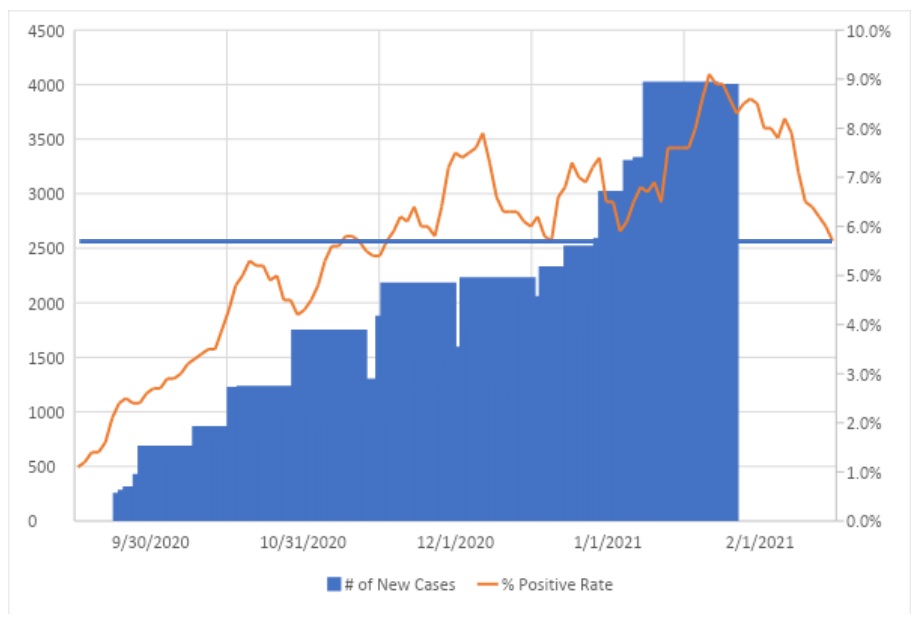
Since the “percent positive” rate was more than 5% in the months of November and December, why did the National Security Council (NSC) allow for interstate travel to take place starting on December 7 under the conditional movement control order (CMCO)? Could this have contributed to the spike in the number of Covid-19 cases, especially given the high number of travellers to places like Langkawi during the end of the year holidays?
This is another example of the lack of consistency on the part of the NSC when it comes to public policies in fighting the Covid-19 pandemic. Decisions to restrict movement and then later increase restrictions do not seem to be based on any consistent rules or guidelines. The Perikatan Nasional (PN) government has once again failed to convince the public that it has a consistent, coherent and comprehensive plan to control this pandemic. – The Vibes, January 23, 2021
Ong Kian Ming is Bangi MP and DAP assistant political education director