I REFER to the article by Fazreen Kamal titled “Di sebalik aplikasi Selangkah, kes harian Covid-19 Selangor terus meningkat” on February 3, 2021, published on the Malaysia Now website at 8am.
I must say that this preposterous lie has to stop, and it has to stop now! We are here to share the truth (and correct blatant lies), and set the record straight.
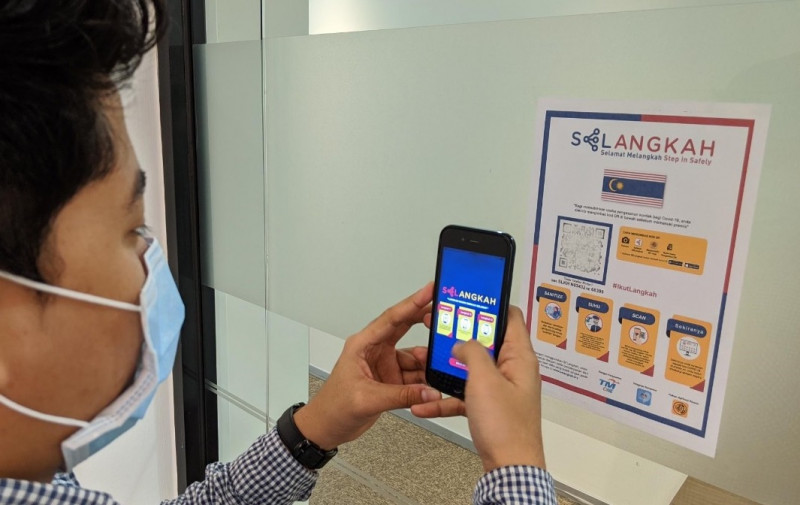
Selangkah was put in place and started operating on May 4 last year. Its aim was to not only assist with QR-based contact tracing, but also obtain feedback from the rakyat, conduct quick surveys, and act as an information/news outlet that will benefit users.
This was indeed a novel idea that quickly caught on, as the state government and rakyat quickly saw how useful this app could be in controlling the Covid-19 pandemic, which we all knew very little of then.
MySejahtera was launched on April 20 last year for the purpose of self-checks. Later on, it decided to jump on the contact tracing train, which Selangkah had already rolled out by then.
Now, objectively, let us not get into the frivolous argument of who came first and who was ahead of the game. Instead, let us focus on these two systems.
The Selangkah app was made to allow much automation as far as data analytics is concerned. Not only does it check an individual in upon scanning, it informs users about high-risk areas and also updates a central database (with anonymous output) on the possibility of outbreaks, along with predictive mechanisms to anticipate where the next outbreak could be.
The Selangkah app was formidably made so that contact tracing would require less manpower and allow quicker identification of exposed individuals, so that mitigation can start almost immediately.
All data is stored in a secure Malaysian database, which only stores a person’s name, telephone number, and check-in location.
This data is fully secure and can only be accessed by authorised public health and Selangor Task Force Covid-19 (STFC) personnel. This can be revoked by users at any time, should they so desire.
The uptake of Selangkah by businesses was very encouraging and many set up their premises with the proffered QR codes. The Selangkah team also actively helped premises with registration.
It didn’t stop there – Selangkah later rolled out registration for homes so that contact tracing would be possible (for open houses), especially during the festive season.
MySejahtera, on the other hand, is a database created by the National Security Council and was at one point seen as a rival to Selangkah.
Although it attempted contact tracing functionality, the system was not fully automated and much upgrading was needed for it to reach the levels already achieved by Selangkah.
Until today, it is uncertain where the data from the MySejahtera app is stored, and who else has access to it.
Arguably, there have been allegations of data breaches with this app and it has lost information to third parties. This, unfortunately, has neither been addressed by the government nor been rebutted.
Since there were two apps being used – one ostensibly better than the other, it came to the fateful day on August 3, 2020, when Senior Minister (Security Cluster) Datuk Seri Ismail Sabri Yaakob announced on national television that it is compulsory for each business to have a MySejahtera QR code.
Though later in the written statement it said that any QR-based contact tracing app can be used, the ship had already sailed. Many who opted to stick to Selangkah called in to switch to MySejahtera.
Upon enquiry, many cited that they were fined by the enforcement authorities for not using MySejahtera. This paralysed a system that was so well set up already.
Up till then, i.e. the end of active scanning of Selangkah, STFC was able to utilise its data to better mitigate the situation – especially with education and testing – to help reduce the number of cases in Selangor.
About two weeks after the announcement by Ismail, many started using the MySejahtera App for fear of being fined.
Why was this fateful? STFC had the daunting task of helping Selangor mitigate the situation without data from the Health Ministry or government.
We survived solely on the big data that Selangkah provided, and as can be seen, we mitigated the situation very well during the second wave.
For the record, per the graph, Selangkah was actively used in Selangor during this period (third week of May to mid-August 2020), and we managed to keep positive new cases (red line) low. Not zero, but low.
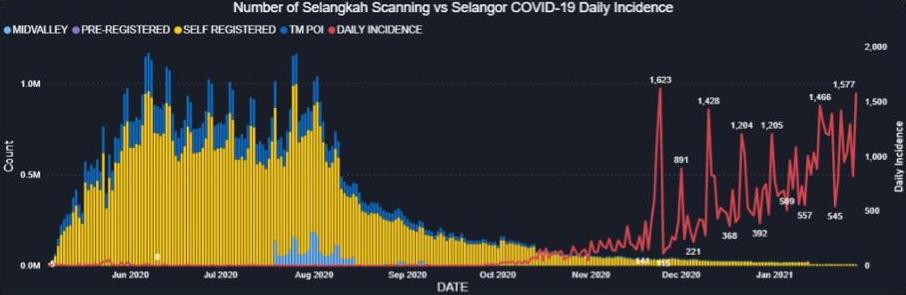
With the shared data, we were able to identify and find high-risk districts, and rapidly test, trace, isolate, and support them during the quarantine period.
However, the success story of Selangkah’s contact tracing was short-lived, because on August 18 and, subsequently, September 2, MySejahtera was mandated and patient location data – that was previously shared with the state government – was halted.
With the forceful shift and firm refusal from the government to share anonymised data with us, we were left in the dark.
Our mitigation plan was based on data, which then became outdated, and we could not help much as far as utilising big data for analytics.
It was even more disheartening to learn that the reason the data was not shared with STFC was because of the way it was reported. This is simply a play on words to confuse the general public.
Data is data and truthful reporting is of the highest ethic. The same cannot be said about the recent incidence of backlogged cases that remained unreported until STFC investigated and identified the reason behind it.
This effect of the shift to MySejahtera has lately become apparent. With its poor automation and amateur contact-tracing system, which finally required our public health personnel to perform manual contact tracing, the backlog set in over the months.
Though it must be said that many healthcare professionals and public health staff have privately admitted that they prefer the Selangkah app to help with mitigation, they were left with little choice but to use manually recorded, raw data for contact tracing.
The severe backlog in cases reported to the Crisis Preparedness and Response Centre has in the past resulted in cases being under-reported.
With some recent help, the backlog is beginning to clear, but it does little to help with mitigation.
Daily numbers do not reflect current and past data (some cases are from 2020, as admitted by the health director-general himself) and are of very little use, even to the Selangkah team, to plan the next step in mitigation.
What happened in the last few days to the Selangor data is exactly what STFC has been facing ever since August 3.
The data has been contaminated at best and tampered-with at worst, which arguably makes it “useless” for mitigation.
We urge the government, Health Ministry, and health director-general to come clean on this. Report truthfully on what the actual number of backlogged cases is, so that it will not cause unnecessary public scares.
We shall continue to work for the betterment of Selangor and Malaysia at large in managing the devastating impact of this third wave of the Covid-19 outbreak. – The Vibes, February 7, 2021
Datuk Seri Dr Dzulkefly Ahmad is Selangor Task Force Covid-19 chair