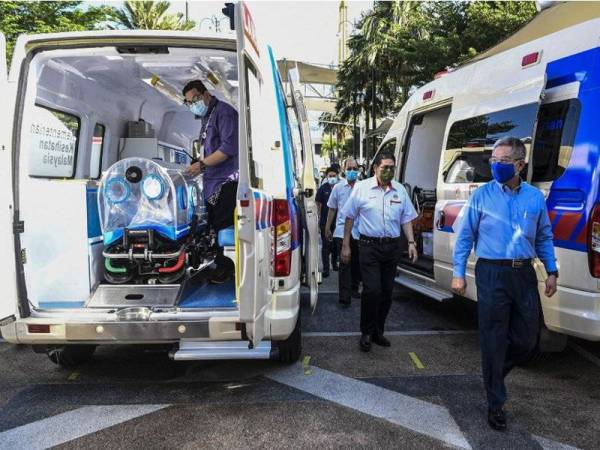
THE College of Anaesthesiologists, Academy of Medicine of Malaysia; Malaysian Society of Anaesthesiologists, and Malaysian Society of Intensive Care would like to respond to a press statement by Health Minister Datuk Seri Dr Adham Baba as reported by Bernama June 20, 2021, with regard to the purchase of 500 negative pressure ambulances to transport Covid-19 patients.
We would like to affirm the societies’ understanding of the necessity of ambulance services in transferring patients from their homes and/or Covid-19 quarantine centres to hospitals for more urgent medical care. However, the use of negative pressure ambulances specifically has not been shown to confer any significant benefit.
Before embarking on any proposals, we suggest that clear data and evidence be obtained. Information that should be clarified related to Covid-19 infection transmission includes:
1. Have the current ambulance services caused an increase in the number of healthcare workers (HCWs) being infected?
2. Has the current method of ambulance use caused more infections in other patients?
3. Has the use of the negative pressure ambulance in other countries led to the reduction of cases?
As we understand from the press statement, the use of a negative pressure ambulance will prevent transmission of Covid-19 infection to the HCWs involved in the transfer of infected patients.
However, we need to highlight that the destination that these patients are brought to, are not necessarily negative-pressured areas, such as in the emergency departments, intensive care units (ICUs), or wards. As such, the benefit of the negative pressure ambulances would be negligible, especially when all HCWs are in appropriate personal protective equipment (PPE) during the transfer.
The most important places to have negative pressure should be in ICUs, high dependency units, operating theatres or wards where the infectivity is high, and patients remain much longer in the facilities.
Most hospitals are finding it difficult to maintain negative pressure capabilities as the crucial high efficiency particulate air (Hepa) filters must be changed in a timely and appropriate fashion and may require special arrangements depending on where the outlet for the negative pressure is located. In fact, many ICUs are now considered open ICUs with positive rather than negative pressure ventilation being the norm.
Based on the Interim Recommendations for Emergency Medical Services Systems and 911 Public Safety Answering Points/Emergency Communication Centres First Responders in the United States during the Coronavirus Disease (Covid-19) Pandemic by the Centres for Disease Control and Prevention, the measures suggest that during transportation of Covid-19 patients:
a. All personnel should use appropriate PPE;
b. The patient should be kept separated from others like the drivers, as much as possible;
c. Family members and other contacts should not ride in the transport vehicle;
d. Utilise air conditioning units on non-recirculating settings, and;
e. Use of exhaust fans to maximise air changes in both the driver and patient compartments of the ambulance.
To date, the role of negative pressure ambulances has not been mentioned in any recommendations or guidelines that we have come across. However, we note a publication from Hubei, China, which reported the availability of negative pressure ambulances corresponded to the decline in Covid-19 cases in Hubei province.
Nevertheless, we believe there are various factors responsible in the successful containment of the Covid-19 cases in Hubei province, and not just the use of negative pressure ambulances.
At this point in time, our three societies jointly believe that these ambulances are of no benefit in managing Covid-19 cases. We urge that future proposal(s) that is/are being evaluated must be evidence based. Without the evidence, there will be no clear goals and the outcome of care will not improve despite the amount of money spent.
The key is “improving outcome while spending prudently”. Negative pressure ambulances do not improve outcomes nor help improve the Covid-19 situation, and come with large monetary consequences.
Apart from the cost of a negative pressure ambulance, which is estimated to be between RM500,000 to RM600,000, there are also costs incurred with regular maintenance of the Hepa filters. The expenditure to change Hepa filters is expected to be about RM3,000 to RM5,000 per ambulance per month. Furthermore, the worst-case scenario is to have these ambulances operate sub-optimally or underperform due to lack of funds to maintain them.
One immediate solution to help mitigate the lack of ambulances availability, is to involve the many private ambulances and NGOs with ambulance services that can assist these transfers for a fee, thus alleviating the burden on the Health Ministry’s ambulance service. The HCWs participating must be in relevant PPEs and vaccinated to reduce the risk of transmission.
At present, to ease the load and stress experienced by our frontliners who have been managing this pandemic now into the second year, we should increase the number of HCWs, thus allowing intermittent reprieve from Covid-19 duties. Our societies recommend the immediate recruitment of junior doctors and nurses who have just graduated, as well as conversion of all contract posts to permanent posts.
Any surplus budget would best be spent investing in our young doctors and nurses. They have been and will be our last line of defence so the optimal care of Covid-19 patients can be continued. – The Vibes, June 22, 2021
Prof Dr Marzida Mansor is president of Malaysian Society of Anaesthesiologists
Datuk Dr Jahizah Hassan is president of College of Anaesthesiologists, Academy of Medicine of Malaysia
Prof Dr Mohd Basri Mohd Nor is president of Malaysian Society of Intensive Care