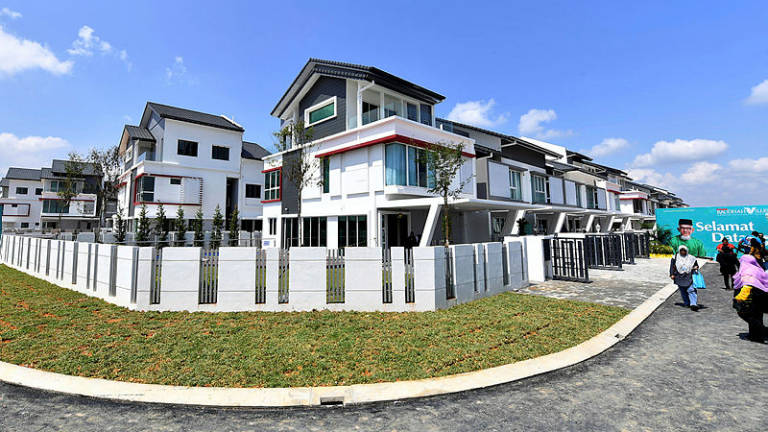
“UNRELEASED Bumiputra lots contribute to about 40% to 50% of the country’s property overhang. Many completed houses in certain states were unsold because the state governments do not want to release the Bumiputera lots,”
– Rehda president Datuk Soam Heng Choon –
“Everybody needs to play their role in trying to resolve this issue. The state government controls the release of unsold Bumiputra lots, so the state government needs to come in and help the situation. As for government agencies, please do not build houses in lousy locations. The divergence between location, type of property and prices contribute to the high overhang.”
– The Malaysian Reserve, October 1, 2020 –
THE National Property Information Centre’s (Napic) Property Market Status Report for the first half of 2020 (1H20) showed there were 31,661 overhang residential units worth RM20.03 billion, an increase of 3.3% in volume and 6.4% in value from the 30,664 units worth RM18.82 billion recorded in 2H19.
Johor retained the highest number and value of residential overhang in the country with 6,166 units worth RM4.74 billion, accounting for 19.5% and 23.7% respectively of the national total in the period.
It also has the highest number of serviced apartment overhang for 1H2020, with 73.7% share in volume (15,986 units) and 76.7% share in value (RM14.67 billion), with almost all of the units in Johor Baru.
The overhang in the serviced apartment subsector continues to rise and forms the bulk of commercial property overhang, recording a total of 21,683 units valued at RM18.64 billion, up by 26.5% in volume and 24% in value against 17,142 units worth RM15.04 billion recorded in the June to December 2019 period.
Proactive measures for a timely release mechanism of ‘bumiputra’ lots
The National House Buyers Association (HBA) believes the move by the Perak state government to allow faster release of bumiputra lots is a step in the right direction and will ultimately benefit all in the long run.
Effective April 1, 2019, the Perak allowed housing developers to apply for properties under the bumiputra quota to be released to other buyers if the properties were unsold by the Perak Housing & Property Board after six months.
It was reported that 50% of the bumiputra quota can be released to other non-bumiputra buyers with these conditions:
> The physical construction has is 30% complete
> That 60% of the non-bumiputra lots have been sold
The 50% bumiputra quota can be released with the following conditions:
> After physical construction is 80% complete
> That 90% of the non-bumiputra lots have been sold
The ‘Dasar Kerajaan Perak’ (Perak government policy) vis-à-vis bumiputra release mechanism is still subsisting.
Obviously, developers who sell bumiputra lots to non-bumiputra buyers without the state’s prior approval would be subjected to fines or double the levy payment.
Such proactive initiatives should be emulated by other states in Peninsular Malaysia.
With this step, developers will be able to reduce ‘holding costs’ and thus bring down house prices, provided they do not conveniently ‘up their profit margin’.
There are many costs incurred in building a house that common buyers can relate to such as the cost of the land and the construction including labour and building materials. However, an important cost factor that many people may overlook is time – the longer the housing developer or the building contractor takes to finish building a project or to sell off its properties, the higher the cost incurred.
Under the New Economic Policy (NEP), property developers are required to reserve a certain number of units of their developments, say a minimum of 30%, for only bumiputra purchasers. The bumiputra quota differs from state to state and usually ranges from 30% to 50%. Furthermore, these bumiputra lots are to be offered at a discount ranging from 5% to 15%.
For housing developers, it is a challenge to understand and meet the various states’ policies on this. They are, after all, not charitable organisations and any additional cost incurred by them will be passed on to buyers.
What happens if the developer is unable to find enough bumiputra buyers for the allocated lots? What if the state housing board is unable to find qualified bumiputra buyers?
The longer it takes to sell the bumiputra lots, the higher the cost for the developers as their capital is locked down in those unsold units. The holding cost will eventually be transferred to future house buyers both bumiputra and non-bumiputra via the house price. Most developers will factor in their budget, the anticipated ‘holding cost’ for a period of three years since the current mechanism dictates so.
Developers have been complaining about the release mechanism of bumiputra lots as being not transparent, not consistent, and differ from state to state.
HBA had called for more transparent and consistent policies for the automatic release of bumiputra lots.
Malay reserve land: Enormous potential for development
‘Tanah Rezab Melayu’ or Malay reserved lands (MRLs) are different compared to bumiputra quotas. MRLs are lands, which can only be owned and held by Malay ethnic owners.
Compared to bumiputra quotas, MRLs are virtually impossible to be legally ‘released’ to non-Malays.
Furthermore, there are several other characteristics that distinguish MRLs from bumiputra quotas.
The following are a few of those features:
> All property built on the MRLs are to be exclusively sold to Malays only
> Malay owners are not allowed to rent out properties built on MRLs or the lands to
non-Malays
> All businesses that operate on MRLs must be owned by Malays
There is great potential in the development of these MRLs especially those of reserve land located in the urban and not so rural areas. It is the product that is developed on the land that will ultimately determine the economic value of the land.
The reasons Malay reserve land lag behind in development is because of the failure of its owners to view their land as a strategic economic asset. Why don’t they see its potential?
Already, there are numerous housing projects on MRLs exclusively for the Malays.
Potential of Waqf lands
Waqf land or land endowments made by Muslims have vast potential for development as not enough people have thought about doing this. In Malaysia, more than 88% of waqf land, amounting to about 30,000ha, is left underutilised or idle.
If the potential of the waqf land is unlocked, it can help improve the socio-economic status of Muslim, both owners who will get development profits and buyers who can get a discounted price for the property.
It will achieve our government’s aspiration to provide affordable housing for all. It was reported in 2017 that there were more than 10,120ha of waqf land in the country that can be developed into commercial and residential projects.
We suggest that the relevant authorities help unlock the value since there is a high demand for homes within certain urban areas. Some of the waqf lands are in high-value areas, facilitating profitable development. Most of the property overhang was due to lack of emphasis on market studies related to less strategic locations and it is timely to undertake the development of waqf lands.
Priority must be given to the formulation of the Waqf Land Act.
Conclusion
HBA humbly proposes, vis-a-vis the Bumiputra quota (and please bear in mind that this is not exclusively for the Malays but also covers the other ethnicity which fall under the category of ‘Bumiputera’) for the state and federal authorities through the National Land Council to device a standardised and transparent system for unlocking the Bumiputra quota for overhang properties in the footsteps of the Perak state government. Perhaps, they could initiate a working group committee to study the ‘nuts and bolts’ for such objective calling in the expertise from the authorities, academia, civil society, Rehda and all other stakeholders.
Datuk Chang Kim Loong
Secretary General
National House Buyers Association