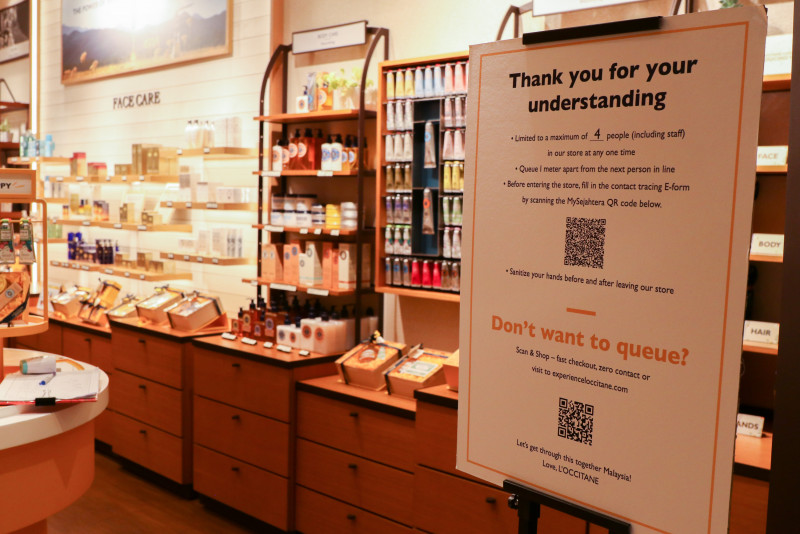
IT has been widely reported that more than 51,000 physical retail stores in the country are expected to shutter in the next four to five months.
This is due to the initial impact of the conditional movement control order (CMCO), and businesses shifting towards e-commerce.
This could directly translate to loss of jobs, exceeding 150,000. The economic scenario since the start of the Covid-19 pandemic has been challenging for the retail industry.
Previously, the One Utama mall in Selangor had to close temporarily since some of the frontline staff members were Covid-19 positive.
The closure could result in loss of jobs due to low sales coupled with the psychological fear of customers patronising the mall when it opens.
The retail sector could face systemic contraction over a period of time since it is linked to the Tourism industry which has suffered the most from the Covid-19 crisis.
The current federal government due to intense politicking has failed to come up with a coherent and effective strategy to save industries as mentioned above.
The government has been so busy planning the takeover of Sabah and scheming to save its razor thin majority in Dewan Rakyat that it has abandoned the welfare of workers and businesses in Malaysia.
There is inadequate funding to help businesses and the government is too slow to respond to the changing dynamics of industries in the context of Covid-19.
It’s time the Malaysian government takes the systemic nature of our industries into consideration while pushing for strategic initiatives to aid these industries and workers through training and technological innovation. Extraordinary times require extraordinary measures.
The Malaysian government has allocated US$3.21 billion (RM13.8 billion) for wage subsidies and in comparison, the Singapore government has allocated US$14.6 billion to subsidise or co-fund wages during the period of economic uncertainty.
The wage subsidy in Singapore covers all type employees while in Malaysia only those earning below RM4,000.
The professionals and technical class, who make up 59% of job losses, are not covered.
Although the unemployment rate has gone down from 5.3% to 4.7% recently, it does not reflect the actual business and labour conditions on the ground.
Business closures and retrenchment of workers are still rife.
Underemployment has become a new normal where workers have taken a pay cut to join jobs that they are overqualified for, which are not reflected in employment figures.
As an immediate measure, the government should engage with industries and ascertain the type of assistance that can be given to sustain their businesses.
There is a need to inject funds into businesses as a relief measure, besides increasing the wage subsidies that are currently inadequate because it does not cover a broad spectrum of businesses.
The loan moratorium should be extended for another six months.
Employers must play their part to upskill and reskill their employees instead of letting them go.
Initiatives by the private sector to help upskill and reskill the Malaysian workers should also be taken full advantage of.
I urge more large corporations to reskill and upskill their workforce as part of their corporate social responsibility.
This issue must be taken seriously by the current federal government and more measures to curb retrenchment and closure of businesses must be addressed immediately. – The Vibes, October 19, 2020
M. Kula Segaran is Ipoh Barat MP and former HR minister