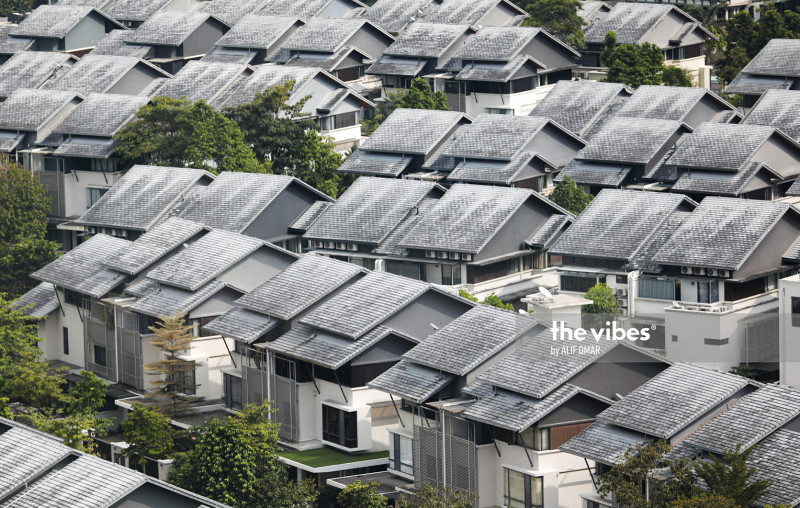
BUYING a house should be a happy affair, ideally.
It symbolises maturity and commitment to a degree because buying a house is a big-ticket item. In a way, it signifies coming of age especially if it is a young buyer; if he is older, the decision to buy underscores his positive sentiment because nobody buys a house if he is not confident about the housing market. However, against what should be a happy occasion, statistics from the Housing and Local Government Ministry are painting a rather grim and grievous situation.
Analysis of Official Statistics
According to government statistics on private housing as of March 31, 2022, the number of “sick” private housing projects has risen to 580 projects from 365 projects, before the Covid-19 pandemic which hit Malaysia in March 2020.
See table:

These 580 projects affected a total of 51,000 house buyers against 26,145 in March 31, 2020, according to the latest statistics dated March 31, 2022.
This represents a 58.9% increase in the number of ailing projects and a 95% rise among affected buyers. The number of housing units affected rose to 102,132 units from 48,826 units two years ago. A two-year comparison from March 2020 to March 2022 showed that the numbers have been on the rise.
A “sick housing project” is one that has been delayed by more than 30% compared to its scheduled progress or one whose sale and purchase agreement has lapsed, according to the ministry’s portal vis-à-vis Declaration of “Sick” category.
Some may reason that 2021 was a pandemic year and the various movement control orders (MCO) would obviously have affected all levels of the economy, including the housing sector.
To be fair, the housing market and the broader property sector have been weak even before the pandemic with the first MCO imposed on March 18, 2020.
According to statistics of “private housing projects according to categories until March 31, 2022” (as shown in the table above), the total number of projects licensed by the government marginally declined to a total of 3,535 versus 3,541 in the same month two years ago.
The number of projects launched also declined to 2,552 in March 2022 versus 2,831 for the same period two years ago.
This means that the rate of projects becoming problematic is rising despite a fall in total licensed and launched developments.
“Sick” high rise strata projects
Other Housing Ministry statistics showed that there are a total of 109 “sick” high-rise strata projects involving both government and private developers at the end of April 14, 2022; this being Syarikat Perumahan Negara Bhd and PR1MA Corporation Malaysia just to name two government developers.
There may be other government-linked housing agencies and units linked to government-linked companies as developers or contractors normally create units for each projects they undertake to build. You may wish to visit the link: Statistik Projek-Projek Perumahan Swasta Bermasalah (Kategori Sakit)
“Sick” landed housing projects
Government statistics also showed that there are 370 ailing landed housing, with Selangor having the highest number at 67, followed by Perak (67) and Johor (51). Again, government corporations are involved.
Like the high-rise strata projects, Selangor tops the listing on “sick” housing projects.
Consequences of a “sick” project
These tens of thousands of hard-luck house buyers are now facing the possibility of failed dreams. They bought into housing projects that are now categorized as “sick housing projects” and will suffer at the hands of those errant developers. The devastating effects are as follows:
1. the house buyer involved still owes the banks the amount that had been drawn down and paid to the rogue developers.
2. the house buyer will continue to suffer the faith of possible abandonment of the project. He may count his blessing if the project is ever successfully resuscitated.
3. the house buyer continues to service the partially drawn down housing loan or he faces the consequences if he is unable to do so. He will risk being blacklisted by Bank Negara, Malaysia and the banking system of checks.
4. he continues to stay in his rented house because the dream house that he had bought had turned into a bad nightmare.
5. he as well as his spouse and their dependents will continue to suffer emotional stress and financial constrain.
6. he blames the government for allowing such a hazardous and nonsensical “Sell then Build” (STB) system to exist and for being unable to help him. (Remember the sales and purchase agreement is a government statutory form where not a single word may be altered by either buyer or vendor)
7. the end financing bank suffers in that the house buyer does not get his house and is, therefore, may not likely to be able to service his housing loan. Worst still, the uncompleted house has zero cashable value.
8. the government continues to face the wrath of victims of “sick” projects for allowing such a hazardous system to exist and subsequently for being unable to help them.
Excuses will not solve this nightmare
A Berita Harian report on May 1 said the main cause of this pain was due to financial constraints faced by developers during the Covid-19 pandemic.
The report also cited poor management, such as rising building material prices, lack of workers and unsuitable locations.
Unsuitable locations seem to be a poor excuse. However, whether there is a pandemic or not, a project’s location does not change. This leaves us with rising material prices, worker issues and poor management.
When a developer embarks on a project, he would have done his costing with regards building materials and the timeline needed to complete it as well as their feasibility and viability studies
Back in 2020, a property consultant said: “if there is really a need to buy a house, buy a completed unit which one can see and touch. Do not buy off-plan.”
His rationale was in a pandemic, developers would want to make as many sales as possible because they are, after all, capitalists. And in all likelihood, they will be some who will likely over-promise and under-deliver in situations that are beyond their control.
The last two years saw many developers embarking on digital marketing. A buyer may not get what he sees from these virtual sales gallery visits, nor from the attractive marketing brochures because disruptions could possibly affect work quality, the property consultant with more than 30 years in the real estate industry said.
Hence, the number of “sick projects” is reflective of the situation, although most of these projects started construction before the pandemic struck.
The same consultant said buying off-plan versus completed units is “an important issue” because a property is a big-ticket item and buying a property involves long-term commitment after signing multi tiers contracts.
“You can see the plus points and the negatives in a completed project. You know more or less what you are going to get. If the other units are already occupied, you know who your neighbours will be, whether they are tenants or owners. You can select the unit if there are many units available. Many people buy units off-plan because of the many incentives offered by developers but this is just marketing pitch and sales gimmicks.”
“Do not fall into the ‘getting the best choice, the best floor, the best view trap’ because what is important is, will the project be abandoned, what is the quality of the workmanship.
“Besides being able to see the unit instead of having to imagine it, the effective price after the various incentives may be lower than the earlier launch price,” he said.
The buyer will also have stronger negotiation powers over the developer, he said.
And the risk of buying into a sick project is removed.
23% of launched projects end up being “sick” in Peninsular Malaysia
According to the official statistics, there were 2,552 housing projects launched with 443,541 units of housing involving 192,779 house buyers.
580 projects of which have fallen “sick” with 51,000 victims. That means that nearly 23% of the fate of house buyers has been determined by those errant housing developers.
For every 100 housing projects launched; 23 projects will be diagnosed as fallen “sick”.
Observation
But, are the government statistics a true and accurate reflection of the crisis?
Granted the Covid-19 pandemic was a global event and it has wrought many challenges in all sectors of the economy. Granted too is the fact that most of these projects were launched a few years before the pandemic.
Most, if not all the ongoing projects were forestalled, with the disrupted supply chains and manpower, by the pandemic and it was serious enough for the government to protect the economy that Parliament had to pass a law titled: Covid-19 Act, 2019 (Act 829) with a provision of a “legal shield” to people and businesses who are unable to fulfil their contractual obligations. The laws offer legislative protection from legal consequences arising from inabilities to perform contractual obligations and to allow time to remedy such shortcomings and hence, the “time freeze”.
Hence, the statistics too could be made to be read more accurately, if it was tweaked to reflect the inactive “time-frozen” period. Perhaps, this aspect was overlooked and should be reconciled by the Housing Ministry in the pillory of the rogue developers in their statistics. – The Vibes, June 6, 2022
Datuk Chang Kim Loong is the honorary secretary-general of the National House Buyers Association (HBA)