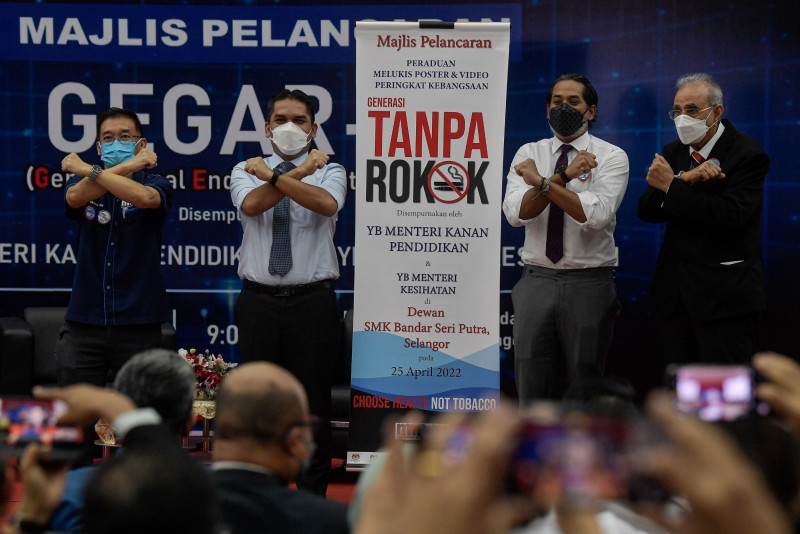
THE People’s Health Forum (PHF) expresses strong support for the Control of Tobacco Product and Smoking Bill 2022 that will be debated in Parliament today for its second reading.
This is definitely a bold move and a show of political will, given how much pressure is exerted by the industry lobbyists to stop this bill.
A dedicated standalone act for tobacco control, including regulating and restricting vapes and e-cigarettes, is timely and necessary for an effective policy to prevent new generations from picking up a habit that will cause high addiction to nicotine.
What stands out in the bill is that it puts in a mechanism to prohibit and phase out smoking among the new generations born in 2007 – the Generational Endgame policy (GEG).
We are pleased that the government is taking action now to further reduce the potential number of new smokers.
At the same time, while allowing current smokers to continue, the government imposes more restrictions and regulations according to the WHO Framework Convention on Tobacco Control (FCTC), and is helping them to quit smoking altogether.
Smoking prevalence in Malaysia is still high, standing at 21.3% of population in 2019, which is estimated to be 4.88 million smokers.
Despite the best efforts from the Health Ministry under the current policy framework, over the past 30 years, the government could only maintain the prevalence rate (21.5% in 1986) but not reduce the total number of smokers.
Nicotine is highly addictive, and studies put it on par with cocaine and heroin. No amount of nicotine is safe, and once addicted, quitting is exceedingly difficult.
In 2018, among those registered under the Health Ministry smoking cessation programme, despite the guidance and assistance, the success rate was only about 22%. Universiti Malaya once did a study showing that 80% smokers who claimed to have quit smoking could relapse within two months.
Hence, it is always the tobacco industry’s strategy to attract new smokers, and at least get them addicted first to nicotine by whatever means.
It has been the obvious trend for the industry to shift their focus to vapes and e-cigarettes for the young people, using dubious and misleading claims that these are “safer” and could be part of the “harm reduction” strategy.
Many have fallen for it, without realising the harm of e-cigarette and vaping-associated lung injuries.
Furthermore, vape and e-cigarettes are used as a gateway for users to also pick up conventional cigarettes.
According to a survey, 74% of vapers have smoked cigarettes before, while 40% are currently both vape and cigarette smokers.
Thus, it is fundamental for the government to take decisive action to control and regulate the use of vapes and e-cigarettes through this new act.
GEG is a core strategy to protect and prevent new generations from picking up the smoking habit, because the current 18-year-old smoking age law actually sends wrong signals to the youngsters that smoking is a legal and acceptable social behaviour and life choice, as long as they reach the legal age.
GEG sets a different narrative, telling the young population that the government and the society will take action to protect them from harm by prohibiting smoking for them. This is coherent with the health warning message that smoking could harm them.
On the other hand, GEG sees current smokers as victims of nicotine addiction. Smoking cessation takes time and effort, so they are allowed to smoke. The government can concentrate on helping current addicts.
If there were no GEG, assuming that the smoking prevalence would be at the status quo (21.3%) and applying this to the current under-18 population, we would have to expect an additional two million new smokers in future adding to the national healthcare and financial burden.
Even if GEG is not perfect, with say only 90% effectiveness to prevent the young population from smoking, the government only needs to handle far fewer new smokers than the status quo policy.
With the prevailing data and health costs, the Control of Tobacco Product and Smoking Bill 2022 is a rational policy worthy of the support from MPs as well as the wider society.
It even has massive support from current smokers, according to a few local surveys. Do not let the industry’s narrative of illicit trade and economic loss muddle the vast benefits the new act would bring to the nation.
With stricter regulations provided by the new act, enforcement teams will have better coordination and support to discharge their duty.
With the demand for tobacco products expected to go down gradually with the implementation of GEG, the number of illicit products in the market will go down as a result.
The loss of cigarette tax is nothing compared to the money the government has spent to treat smoking-related diseases. This cost to health and productivity loss of the sick smokers will only increase if GEG is not put in place now.
Hence, the People’s Health Forum strongly urges the MPs not to engage with any representatives from the tobacco industry and their sponsored groups, as this is also prohibited under the WHO FCTC.
We condemn the industry lobbyists who appeared in Parliament when the bill was presented for its first reading, as this was a serious breach of the FCTC and the people’s representatives must be free from the industry’s influence.
The People’s Health Forum calls for all MPs to vote for the bill and always put public interests first.
An MP’s duty should include caring and protecting the new generations from harm. The bill is for our healthier and better future together. – The Vibes, August 2, 2022
The People's Health Forum is a platform created in April 2019 by several not-for-profit organisations and individuals who are committed to the principle of health for all, i.e. universal healthcare as an entitlement based not on the ability to pay, but on the basis of need