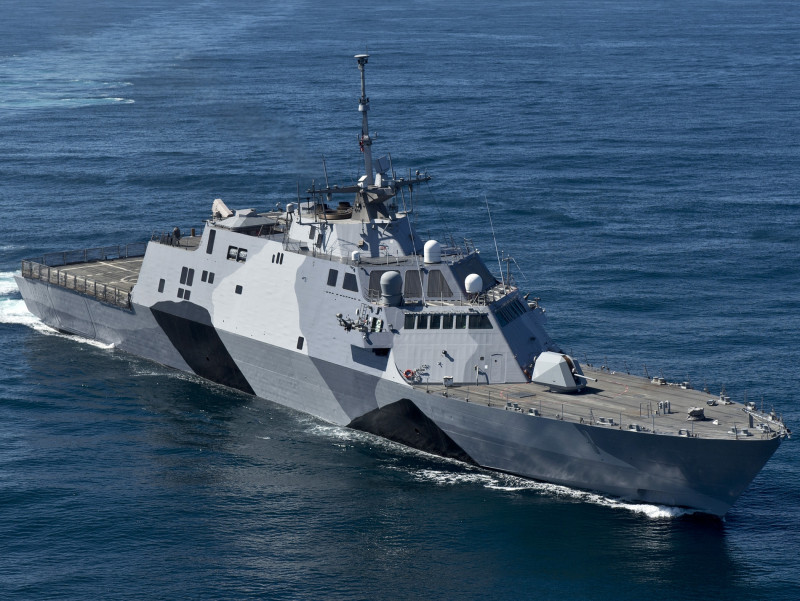
I WELCOME the decision by the prime minister to declassify the Special Investigation Committee on Public Governance, Procurement and Finance (JKSTUPKK) Report on the littoral combat ship (LCS) project.
As I have written previously, the future of the LCS project is also as important as its past. The perpetrators of any wrongdoing must be punished.
But, the project must also be carefully monitored going forward to ensure no more money is wasted and that we get the best LCS possible, as soon as possible.
The Public Accounts Committee (PAC) report has outlined some proposals that the government must carry out to the letter.
This affair should also be a teachable moment on how Malaysia’s defence procurement can be transformed.
I would like to outline some reforms that the unfortunate LCS saga has presented us to implement.
First, the government’s defence industry development policies must be re-examined. Are the assumptions and targets that it has set for itself achievable? Should they be recalibrated?
Perhaps exemptions to the application of the Industrial Collaboration Programme can be considered for projects where failure or delays would jeopardise national security?
No one is against Malaysia building its own indigenous defence industry. But this won’t emerge without good governance or if incompetence and malpractice are ignored. Flexibility is needed; the lack of this arguably facilitated the problems plaguing the LCS.
The internal governance should also be strengthened.
The practice of appointing former public servants, including military personnel, to the boards of government-linked companies (GLC) is nothing new.
But there appears to be no policy or written directives from the Finance Ministry (MoF) on such appointments besides the general provisions of the Companies Act 2016.
Perhaps guidelines will be needed to provide best practices, such as a cooling-off period between when an officer leaves the service and his or her appointment to a GLC. This will help avoid problems like potential conflicts of interest and maintain the independence of the boards.
Also – and it is dismal that this has to be brought up – all companies that are to be selected for projects of high value or strategic national importance must undergo mandatory financial due diligence before anything is signed. Further, there must be better oversight over these companies.
There have been repeated reports that the LCS contractor, BNS, was in a poor financial state. Also, it arguably underperformed in its previous project, the NGPV. And yet it was still entrusted with the LCS project.
More care must be taken in the selection of contractors, and they have to be monitored carefully.
This is no doubt a complex process. MoF will need to come up with a comprehensive and compulsory framework to evaluate bidding companies.
Also, training must be given to all manpower involved in the government procurement process to build institutional memory and capabilities.
The MoF and Attorney-General’s Chambers (AGC) should also draft clauses in procurement contracts with safeguards such as preventing payments from the government to be used for other purposes than the project.
The clauses should also prohibit the creation or involvement of additional entities between the government, contractor and OEMs and disallow contractors from undertaking internal policies that go against good governance.
All of the above were reported anomalies that allegedly impacted on the LCS.
Next, we need a government procurement act.
The current legislation, including the Government Contracts Act 1949, is simply not fit for purpose and Malaysia’s procurement process has many obvious flaws that need not be repeated.
My understanding is that a bill along these lines is now being drafted by the MoF and that it has sought feedback from the state governments as well.
The AGC should likewise expedite the necessary reviews so that the bill can be tabled and passed by Parliament quickly.
Finally, the power relationships governing complex and long-term procurement contracts must be changed.
Probably the most shocking revelation of the LCS saga is that the Royal Malaysian Navy’s requirements and views were ignored or overridden by the government and the contractors, including over the design of vessels.
Why buy ships when even your own Navy has reservations about them?
It has also been alleged that the delays to the project were caused because the defence minister at the time – who is also the present minister, Datuk Seri Hishammuddin Hussein – failed to act on extension of time and variation order requests before the 2018 general election and change of government.
The delay added to the pile-up of costs.
The government may hence have to re-look at the individual prerogatives that ministers have over procurement contracts, especially defence. Certainly, there ought to be a formal requirement for the end users to be consulted before a contractor is selected.
Overall, defence and government procurement in general must be depoliticised, with less top-down interference and greater transparency.
Some politicians have claimed that the status quo must be maintained to protect Malaysia’s defence secrets, including in relation to the LCS.
But this logically cannot apply to the LCS, since much of this project is based on overseas equipment and technology. Secrecy should not be used as an excuse to protect the guilty or delay much-needed improvements to how our government buys military equipment.
The refusal of those in power to be accountable lies at the heart of many of Malaysia’s problems.
There should be no reason for all parties to not accept the reforms outlined above.
It’s admittedly a lot to ask, because future Malaysian governments will, in effect, be made to accept limitations to their authority.
But if we fail to act on this, the LCS and other scandals will simply occur, in different forms, again and again, with the country losing more and more.
More of the same is not an option. – The Vibes, August 11, 2022
Nik Nazmi Nik Ahmad is Setiawangsa MP and PKR vice president