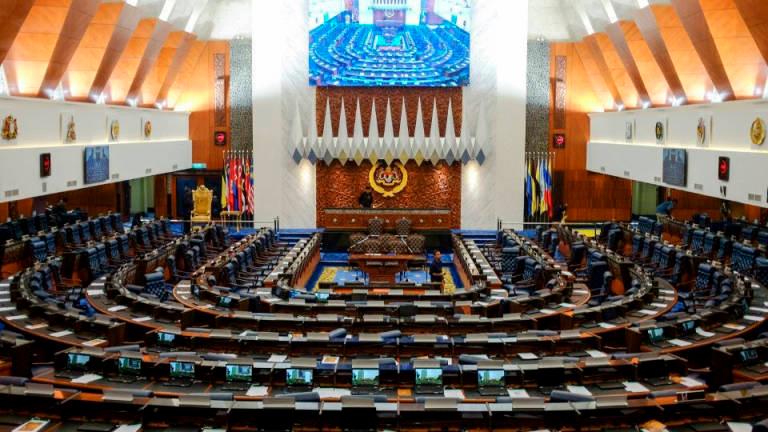
MALAYSIANS are truly being governed in unprecedented and strange times.
The passage of the Supply Bill 2021 by the federal government this week is of crucial importance, considering how Covid-19 has and continues to ravage the lives and livelihoods of Malaysians.
I raised questions on how MPs would approach the Supply Bill in times of Covid-19 not too long ago, and sadly, there are more questions than answers.
Considering recent events and the upcoming vote on the bill, confidence in the prime minister has once again been called into question,
particularly if the bill is defeated. This event is relatively known as a loss of supply.
Loss of supply is typically interpreted as indicating a loss of confidence in the government. This was established in other Commonwealth countries that practised the Westminster system as early as 1975.
For example, in Australia that year, the elected Senate delayed voting on a bill to authorise supply for the government, demanding that prime minister Gough Whitlam call an election for the House of Representatives.
Whitlam was dismissed by the governor-general based on his refusal to either resign or request a dissolution.
Until voting on the Supply Bill takes place, a host of questions remain unanswered, some of which are:
Will the Supply Bill pass into law?
Will the prime minister resign if the Supply Bill does not pass?
If the Supply Bill is defeated, will the prime minister claim that the defeat does not measure confidence, and as such, he need not resign?
With rising Covid-19 infections, will the prime minister and his cabinet make another attempt to declare a state of emergency in Kuala Lumpur, thereby putting an abrupt halt to proceedings in Parliament, effectively culling any confidence or no-confidence motions and voting on the Supply Bill?
How will the federal government meet its expenditure if the Supply Bill is defeated?
If defeated, will Parliament be dissolved to pave the way for elections?
How soon can a new Supply Bill be prepared for the benefit of Malaysians?
The fact that the prime minister and cabinet are responsible to or must answer to Parliament for their actions is a fundamental characteristic of a parliamentary government.
They must also enjoy the support and confidence of a majority of the House to remain in office. This is commonly referred to as the Confidence Convention.
It should now become clear that in the long run, the Confidence Convention will remain part and parcel of politics in Malaysia, just as it is in other Commonwealth countries.
It is for this reason that the UK passed the Fixed-term Parliaments Act 2011 (FTPA). Before the passage of the act, elections were required by law to be held at least once every five years, but could be called earlier if the prime minister advised the monarch to exercise the royal prerogative to do so.
The system in place prior to the FTPA could result in a period of political uncertainty before the possible calling of an early election, if such an election was widely anticipated, and this was one of the catalysts for the passing of the act.
Under the FTPA, confidence votes must be specifically worded to trigger a general election. This means that a government defeat on a budget measure will not necessarily bring down a government, though it is likely it will face a vote of no confidence shortly afterwards, as its ability to command the will of the House would be in question.
Malaysia ought to draw lessons from the FTPA and place her own safeguards against political instability and turmoil. This will encourage good governance and promote a responsible government.
If all our MPs unite and abide by the king’s decree on reminding politicians to stop politicking, then I would humbly submit three feasible steps and urgent proposals to the government (during this parliamentary session) to ensure Malaysia does not endure more political instability and upheavals:
Step 1. Table an Anti-Party Hopping Bill.
Step 2. Proceed to table a following bill to regulate all political parties in a coalition government to include and compel them to enter and register into a written coalition government shared agenda and policy agreements.
Step 3. Seal this with the tabling of a bill somewhat similar to the FTPA.
With so much political uncertainty at the moment, and confidence (and no-confidence) motions unlikely to be voted on, perhaps the only way we can return to political normalcy is to consider returning the mandate to the people by calling for the dissolution of Parliament to pave the way for a general election.
In this regard, I echo the Umno president’s clarion call for all political parties to set aside their differences for the sake of the people, and to stand united on the mandate being returned to the people, because the people’s mandate is sacred.
So far, 13 countries are known to have held a general election during the Covid-19 crisis, among them Singapore. Before the republic called the polls on July 10, the number of infections there ranged between three digits and four digits daily.
However, since late August, the number has been brought down to the single digits and double digits.
Perhaps, only when political equilibrium is restored and the safeguards proposed above are put in place, can politicians shift their focus to what they are expected to do when they come to power, by governing responsibly.
Until then, Malaysia continues to see desperate times, with desperate measures reigning over her. – The Vibes, November 23, 2020
Datuk Seri Azalina Othman Said is Dewan Rakyat deputy speaker and Pengerang MP