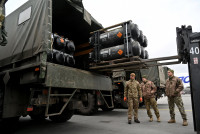
IN December 2020, the New York Centre for Foreign Policy Affairs, a nonprofit think tank, filed a lawsuit in a US district court over a pending United States arms deal to sell F-35s and Reaper drones to the United Arab Emirates. The lawsuit argues the proposed sale should be found invalid because the “administration failed to provide a reasonable explanation” for its approval, placing it “in breach of the Administrative Procedure Act”.
When the new Biden administration decided in 2021 to proceed with the sale, the think tank responded by adding new plaintiffs “directly affected by UAE-sponsored aggression through the use of US-made arms”.
Few expect the lawsuit to succeed, but it demonstrates a new approach by US civil society to change US arms-sales practices.
Non-governmental organisations (NGOs) have used similar strategies against weapons suppliers in France, Italy and the United Kingdom. Such lawsuits may be aimed at arms companies or governments (sometimes both) and tend to cite violations of obligations under national law, as well as EU law and the UN Arms Trade Treaty (ATT) where relevant.
In 2019, a group of NGOs filed a communication with the International Criminal Court to investigate the potential complicity of European arms executives and officials with war crimes in the Yemen conflict.
Although the ATT contains no enforcement mechanisms, cases like these suggest an important role for civil society, and NGOs especially, in creating accountability to humanitarian arms-export standards in national or international law.
Public opinion alone is typically not enough – even in democracies – to prompt governments to practise arms-trade restraint. Except in rare cases, the public does not track the goings-on of the conventional arms trade.
As a result, NGOs with expertise and access to information can be important for raising media attention, mobilising public awareness and lobbying policymakers to engage in more “responsible” arms-export decision-making.
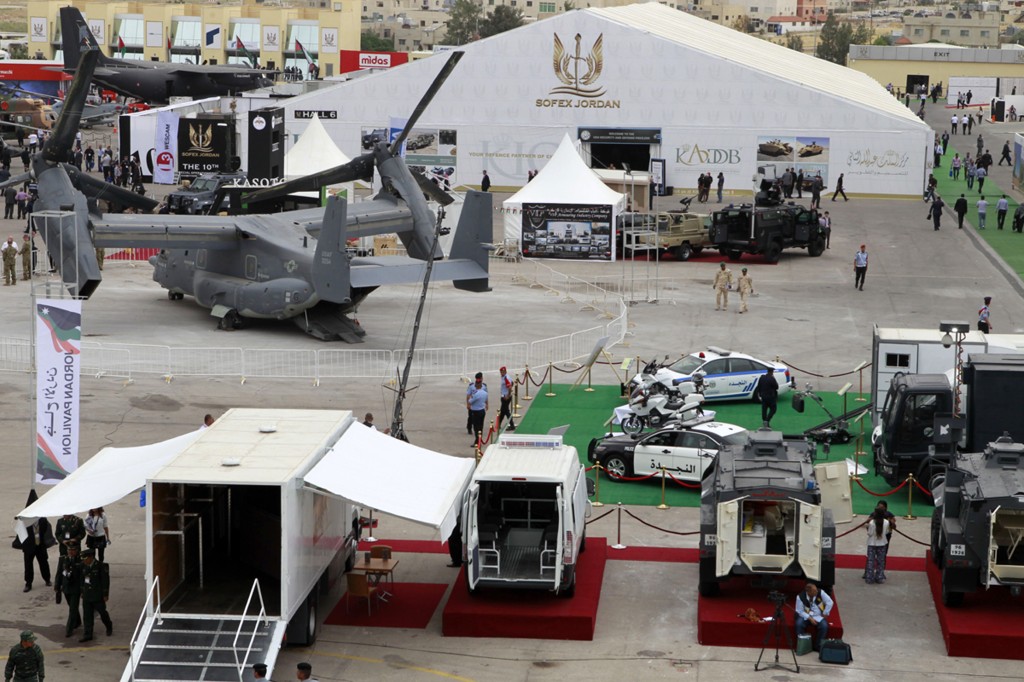
Contentious deals with Saudi Arabia and UAE
A case in point are recent US debates over arms sales to Saudi Arabia and the UAE in light of the ongoing Yemen conflict. US domestic export rules direct the executive branch to take conflict “into account” in making arms-export decisions, but do not prohibit arms sales to conflict zones.
In general, US arms transfers also do not tend to generate public and media attention. But the Yemen conflict and the US role in supplying it have created moments of rare American public outcry against US arms sales. Across party lines, a majority of Americans think “selling weapons to other countries” makes the United States “less safe”, according to a 2019 survey.
Many NGOs and think tanks have been pivotal in building on heightened media attention about the war to sway public and congressional opinion in favour of restraining US arms sales in light of their humanitarian consequences. These efforts reveal both the importance of public pressure and its limitations for arms-trade accountability.
By late 2015, some senators had begun to question US arms sales to Saudi Arabia. In November, the Senate Foreign Relations Committee made its first-ever formal request for a 30-day notification of sales from an administration. Yet other members saw the precision-guided munitions on order as a way to help Saudi Arabia avoid civilian casualties.
A September 2016 joint resolution to block a proposed tank sale to Saudi Arabia failed to pass. Indeed, the need to muster a two-thirds veto-proof majority in both Houses has made Congress structurally incapable of formally stopping or modifying US arms sales approved by the executive branch.
Rather than congressional action, it was reports of a Saudi air strike on a funeral hall in October 2016, killing more than 100 people, that prompted the administration of then president Barack Obama to put on hold the planned precision-guided munitions sale.
The Donald Trump administration decided to proceed with the sale. It was only in June 2019 that Congress succeeded in passing a set of joint resolutions to block a series of arms sales to Saudi Arabia and the UAE. Trump vetoed the resolutions, and the Senate failed to reach the two-thirds majority to override the vetoes.
Congress has never been able to reach the two-thirds voting threshold necessary to override the presidential veto to block or modify a proposed arms sale.
The effects of political opposition to proposed Saudi/UAE deals have been indirect at best. The Obama and Joe Biden administrations have rejected some sales in response to pressure from Congress and the media.
Setting these aside, though, the US generally continues to supply long-term friends and customers with political and economic objectives in mind. US export rules are flexibly written, making decisions for restraint ad hoc and allowing presidential administrations to prioritise their own political considerations.
Challenges faced by NGOs in campaigning against arms trade
It seems unlikely that joining the ATT would substantially alter US practices. The treaty provides criteria for arms-export decision-making (modelled in part on US legislation) but only obliges countries to deny export licences under a small – though important – set of circumstances.
The Yemen conflict presents a “most likely” scenario for NGO advocacy to influence arms-export decision-making. The Saudi/UAE deals have attracted more public attention and congressional pushback than any US arms deals in recent memory.
Public and media attention to humanitarian arms-export controls – and therefore also congressional interest – are usually difficult to rouse. In this way, the Saudi/UAE deals highlight the limitations of civil-society advocacy and public pressure as a source of arms-trade accountability. Even under favourable conditions, US practices remain largely unchanged.
NGOs face specific challenges when it comes to campaigning on the arms-trade issue. Arms-export controls are highly complex and bureaucratic, and apply to a broad category of weapons that serve as basic military tools – often legally owned by private civilians, especially in the United States.
As a result, campaigning for an outright ban on the arms trade is a nonstarter for many NGOs seeking to persuade governments to sign up. Instead, campaigns tend to focus on regulation according to specific humanitarian criteria.
But nuanced regulation will struggle to resonate with the public as easily as a straightforward prohibition such as the Ottawa landmine ban. While NGO campaigning with the public and governments drove the adoption of the Ottawa treaty, the ATT has not received similar groundswells of attention and support.
Creative solutions, such as engaging the courts, may be one way forward for NGOs seeking to raise awareness around arms-trade issues. But perhaps most effective will be efforts to continue to educate the public and legislators, pursue reforms of export rules and monitor government behaviour to bring “irresponsible” practices to light. – The Vibes, August 30, 2022
Jennifer L. Erickson is an associate professor of political science and international studies at Boston College. She researches the conventional arms trade, arms embargoes and economic sanctions, and the laws and norms of war
Portions of this article have been drawn from Jennifer L. Erickson, On the Front Lines: Conflict Zones and US Arms Exports, World Peace Foundation, 2022. The research behind this article was undertaken with the World Peace Foundation’s Defence Industries, Foreign Policy and Armed Conflict programme and funded in part by the Carnegie Corporation of New York
Published under Creative Commons and in partnership with 360info.org