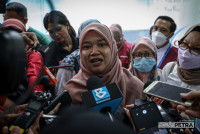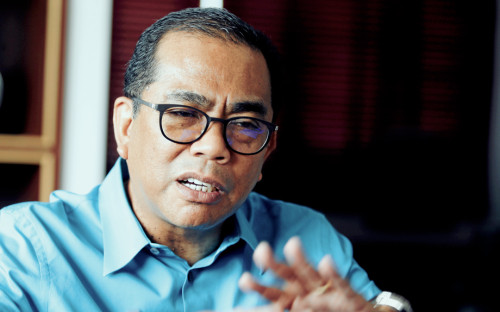
DEAR YB Fadhlina Sidek and YB Lim Hui Ying,
Firstly, many congratulations on your respective appointments as minister and deputy minister of education.
You are co-helming what is arguably one of the most complex and important portfolios across the whole of government. A portfolio for long-term nation-building, for unity, and for human capital development. A critical bridge to the future.
Now that you are getting your feet under your respective desks, you are also – no doubt – beginning to firm up your priorities: deciding whether to go up, down, left, or right. And at what speed.
No doubt, too, you will also be receiving extremely good advice from the ministry, and from wider civil society groups about the priority initiatives that you could consider. So, this letter isn’t about that.
Instead, it contains some humble suggestions about how you might sift and sort those competing priorities and translate them into actions that generate impact.
These suggestions are derived from the things that high-performing education systems have learned about applying the principles of implementation science to their work.
And whilst contexts are always different, I hope that some of these insights might also be of value to you, too.
Thing 1: doing less to achieve more
With the delivery window for the Malaysia Education Blueprint closing fast, thoughts will naturally turn to what comes next. It may be tempting to cram Blueprint 2.0 with yet further ambitious initiatives that are designed to show their success three general elections ahead.
But when we look at the highest-performing systems, this tendency is often held firmly at bay. Those ministers and ministries often commit to doing far less but doing it better – focusing on things that are achievable within a single election cycle.
Their acid test for deciding what to prioritise is to ask: “What’s the worst that could happen if we left this area alone – if we did absolutely nothing?”
They ask this question over and over; and keep interrogating the evidence until they have whittled it down to that handful of cast-iron priorities that matter most.
Thing 2: understanding the root causes
After deciding the priority areas, it can then be tempting to rush straight into programme building. But the best ministries seldom do this. Instead, they spend considerable time diagnosing the root causes of their chosen problem space.
To use a medical analogy, there are many causes of backache and many treatments. The sweet spot is in identifying the actual cause and matching it with the optimal treatment. The same applies to education.
But in education, causation is often complex. It’s rarely a simple case of X causing Y. Instead, more commonly, there are multiple “chains of dominos” all exerting pressure from different directions. Literally hundreds of variables all pushing down on one another with different levels of force to generate that problem space.
However, by carefully mapping those causal chains, strong ministries are better able to identify the specific dominos in their chains to focus on. This means that they can design better programmes that fit local conditions hand in glove, not hand in shoe.
Thing 3: treating improvement as an engineering experiment
Knowing what caused your priority problem is only the start. The next step is to mine the opportunity space to identify potential solutions. Thankfully, we already have excellent global data on “what works best” for student learning – with 2,100+ meta-analyses of 130,000+ studies, involving 300 million+ students – pointing to 400+ different interventions that can improve children’s learning. This is quite a treasure trove.
High-performing education systems flip back and forth between their map of root causes, the global “what works” research, and promising local projects – to identify high-probability bets. The best ministries then use these insights to build multiple programme logic models that each suggest a different way of getting from A, to B, to C, to deep impact.
Logic modelling is like engineering – it’s about carefully laying out a sequence of actions. And, like good engineers, strong ministries carefully stress test their models before implementation.
They check every link in the proposed delivery chain through a range of techniques including pre-mortem, bodystorming, side-effects analysis – so that they can further tighten the programme designs before wider implementation. Or so that they can put them in the bin and go back to the start.
Thing 4: monitoring and evaluating
Most education systems are fairly good at monitoring. They can count whether the school roof was re-tiled, whether the new computers were delivered, and whether the right number of teachers attended the training event.
But the best systems have their eyes firmly on the impact of doing all this stuff. For example, after the training, was there a noticeable change in teacher behaviours?
And, more importantly, did this translate into any impact on the learning lives of students? And was that impact good enough?
The savviest ministries also know that nothing works properly the first time it’s implemented, and they don’t expect it to. Instead, they treat their initiatives as “science experiments” – where they are testing a hypothesis, gathering data, and then carefully reviewing and deciding what to do next. They have regular review gates and the decision is about whether to: continue; iterate; or STOP.
And, yes, lots of things get stopped. Because, through evaluation, it turns out they don’t work. So, the ministries go back to the drawing board and select the next cab off the rank and start over. There is no embarrassment about any of this. It’s simply part of the process of learning.
Thing 5: avoiding temptation
The four things above are dull as dishwater. They are part of a discipline called implementation science that started in healthcare, and which has been transplanted to education – because it’s proving useful. But it’s not easy to explain to voters, or the media, without eyes glazing over.
So, instead, it can be tempting to implement (seemingly) sensible initiatives that everyone understands and can get behind like: improved school infrastructure; more computers; free school meals; reduced class sizes; public-private partnerships; changing the medium of instruction; longer school days; curriculum tweaks; new school governance arrangements; and so on.
For the avoidance of doubt, all these things can be “good”. But only if they address a problem you actually have and only if they respond to the most critical “dominoes” in your map of root causes. And, of course, you still have to check that the thing you are implementing is actually working once you get going.
Malaysia already has all the raw ingredients for educational success: comparatively high levels of funding; near universal literacy; and high student and teacher attendance rates. This is much better than many other systems and a brilliant foundation to build upon.
The next key step? Getting from good to great. And I hope that some of these pointers from implementation science might help with that. – The Vibes, December 20, 2022
Arran Hamilton is group director of education at Cognition Learning Group, which has supported education improvement initiatives in more than 30 countries. Opinions expressed are his own