
HE started off as an unknown but in the end, Volker Knapp left a mark on Malaysian hockey despite the rough journey he had to endure as a national coach.
Upon being hired as Malaysia’s coach, not only did the German achieve his main target of qualifying for the 1998 World Cup in Utrecht, but he did the same for the 1996 Atlanta Olympics.
Before that, Malaysia had failed to qualify for the World Cup in 1986, 1990 and 1994.
All said and done, he delivered on what he was supposed to do despite tremendous pressure from fans and the Press.
A former German national junior player, Knapp was only 31 when he first arrived in Kuala Lumpur in 1994. Prior to that, he was coaching Limburg in the German Feldhockey Bundesliga.
I was only 23 then.
After Terry Walsh's exploits, which ended with Malaysia finishing fourth in the 1993 Asia Cup in Hiroshima, The Malaysian Hockey Federation (now Malaysia Hockey Confederation) decided that European expertise was needed to raise Malaysia’s standard to a new level.
Walsh was also looking for new prospects in his coaching career after guiding Malaysia to the 1992 Barcelona Olympics.
However, Malaysia failed to qualify for the 1994 World Cup in Sydney after the sad episode in the Intercontinental Cup-cum-qualifier a year earlier in Poznan.
Earlier, MHF had intended to hire Paul Lissek but this did not materialise due to his contractual obligations with the German Hockey Federation until 2000.
However, the German guru recommended his prodigy and understudy, Knapp, and MHF agreed.
Compared to Walsh and some Malaysian coaches, Knapp was inexperienced in handling a national team ─ he was a rookie as this was his first time.
At the international level, his arrival stirred huge interest from fans and the Press brigade as he was an unknown. All eyes were on him as to what he could bring to the team from Day One.
We, the players, gave Knapp mutual respect as he made changes to the gameplay, structure and concept.
In trying to get the team to play a more European style that leaned towards the German defensive approach as opposed to Walsh’s Australian-Asian way of playing, we listened and followed what he had to say.
Under Knapp, there was less running with the ball and more of one-two hockey. There was this high discipline in defence.
Even myself, as a forward, had to be in the 25-metre and be involved in defence.
Initially, I was struggling but I got used to it after making suitable adjustments to this playing style.
Knapp might have obtained some tips and fresh ideas from Lissek to improve the team.
However, it must be said that Knapp had to impart what he got from Lissek in Germany to the players in Kuala Lumpur, which was not an uncomplicated task.
In his attempt to improve the team and make everyone happy, the easy-going Knapp knew when to be strict and when to have fun with players.
At times, Knapp, who was still young and fit, would conduct long-distance runs alongside the players. This was one of the things that motivated us to improve.
Things seemed to get better when Malaysia managed to beat Australia 3-2 in the Sultan Azlan Shah Cup in Penang in 1994.
However, the Press began to put a lot of pressure on Knapp when Malaysia got thrashed by South Korea in 1996 at the same tournament in Ipoh.
The fans were naturally upset. The Press criticised and chided the soft-spoken Knapp for this defeat. One newspaper headlined him as a turkey on the Sports page.
However, Knapp took all this in stride. This was evident from the fact that he still spoke to the journalist who wrote the article. They were seen talking about it for a good 15 minutes and even after that, Knapp still entertained the journalist.
This was because Knapp knew the importance of the Press, especially when it came to the promotion of the game. He coped well under pressure and continued to do what he had to do.
Interestingly enough, there was this love-hate relationship between Knapp and the Press.
Anyway, Knapp's immediate task for Malaysia was the 1994 Asian Games in Hiroshima where Malaysia finished fifth.
At the time, there were many youngsters in the squad as Walsh included them for the Asia Cup in Hiroshima in late 1993 where Malaysia finished fourth.
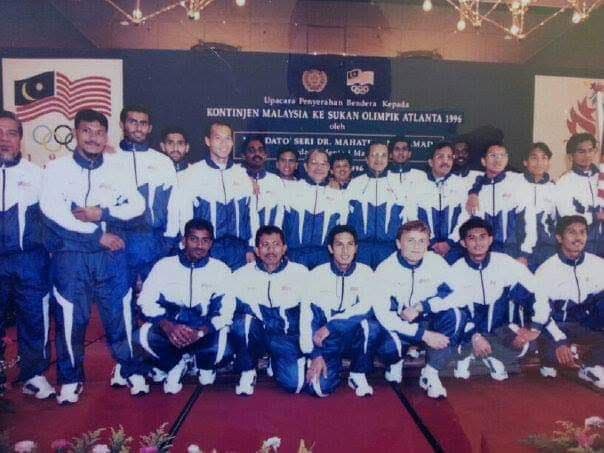
In early January of 1996 in Barcelona, Malaysia qualified for the Atlanta Olympics, which was held the same year. Knapp and his players finished fifth behind Holland, India, Great Britain and Spain.
There was this controversy as well in Barcelona where Canada accused Malaysia of conspiring with India for a 0-0 draw. This resulted in Canadians being knocked out after ending up in the sixth spot by a point.
The thing was that Malaysia did beat Canada 2-1 in an earlier match. There was this bad blood between us and the Canadians because of this accusation and controversy. It ended, though, at the 1998 Commonwealth Games in Kuala Lumpur.
At the Atlanta Games, the Malaysians finished 11th. The squad then was comprised of Nasihin Nubli Ibrahim, Maninderjit Singh, Lailin Abu Hassan, Brian Siva, Lim Chiow Chuan, Charles David, Chairil Anwar Abdul Aziz, Lam Mun Fatt, R. Shankar, Nor Saiful Zaini Nasiruddin, M. Kaliswaran, Aphthar Singh, Calvin Fernandez, S. Kuhan, Hamdan Hamzah and myself.
And it was in Atlanta that Knapp failed to recognise former World Number One women's tennis player Monica Seles while travelling on the same buggy in the Games Village.
Seles was born and raised in Yugoslavia (now Serbia) to an ethnic Hungarian family. She became a naturalised American citizen in 1994 and received Hungarian citizenship in June 2007.
True to his easy-going character, Knapp kept talking to Seles without actually knowing who she was. It was fun.
Knapp's greatest moment with Malaysia came in March of 1997 in the World Cup qualifier at the Bukit Jalil National Stadium. This was when Malaysia earned a spot at the 1998 World Cup in Utrecht by finishing sixth.
All and all, Knapp was pretty happy with the success. His main target had been achieved despite all the hurdles ─ high and low.
The Malaysian squad at Utrecht comprised of Paul Lopez, Lailin Abu Hassan, K. Keevan Raj, S. Kuhan, Nor Azlan Abu Bakar, Chairil Anwar Abdul Aziz, Brian Siva, R. Shankar, Nor Saiful Zaini Nasiruddin, M. Kaliswaran, Aphthar Singh, Calvin Fernandez, A. Arul Selvaraj, Nasihin Nubli Ibrahim and myself. ─ The Vibes, December 25, 2020
P.S. I would like to take this opportunity to wish the staff of The Vibes and all Malaysians who are celebrating a very Merry Christmas.