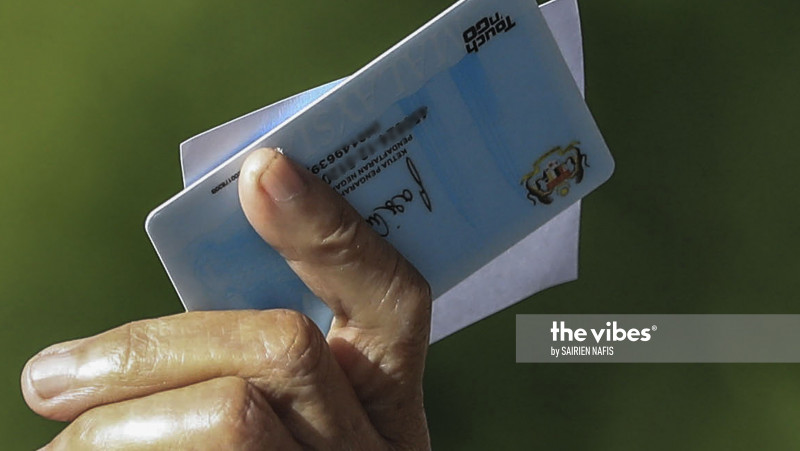
WITH just a single card in hand, Malaysians are now able not only to verify their identity but also to manage nearly all daily tasks—such as paying highway tolls, commuting on public transport and purchasing household goods—with greater efficiency and simplicity.
While current MyKad-integrated services remain limited, many users commend the convenience it offers and express hopes for wider integration in the near future.
"I don’t need to carry multiple cards in my wallet. Just MyKad is enough," Bernama cited 43-year-old trader Roslina Daud, who uses the card for Touch ’n Go (TNG) toll and parking payments saying today.
She urged the government to broaden MyKad’s integration into sectors such as banking, arguing that people increasingly require solutions that streamline their fast-paced lifestyles.
For Maisara Abdul, 25, a private sector employee who commutes daily via public transport, the integration of her My50 travel pass into the MyKad has made journeys easier. "I don’t have to carry multiple travel cards for different transit modes anymore."
Meanwhile, 50-year-old Rohani Abdullah, a recipient of the Sumbangan Asas Rahmah (SARA) aid, appreciated the added security and practicality MyKad provides in managing basic needs. "I don’t need to queue at banks or ATMs. I can go straight to the supermarket, get what I need, and use MyKad," she said.
MyKad: A Two-Decade Evolution
The MyKad, or Government Multipurpose Card, was introduced in 2001 under the Multimedia Super Corridor initiative to modernise identity verification, enhance security, and unify various digital services on a single platform.
Since then, four versions of MyKad have been launched, with the latest introduced in 2012. The National Registration Department (JPN) is currently in the final development phase of a new version with further enhanced security features.
“The first version used basic plastic. It was upgraded to Polikad 2.0, and then to the current version with additional security features like a laser-etched ghost image,” said Director-General of JPN, Badrul Hisham Alias, in an interview with Bernama.
The term "MyKad", he explained, combines "My" for Malaysia and "Kad" for identification card. It is the continuation of Malaysia’s evolving ID system—beginning with paper IDs in 1948, followed by blue plastic IDs (1960–1990), the hibiscus-themed card (1990–2001), and finally, the current smart MyKad.
Although not fully digital, MyKad is designed to support multiple digital government transactions, including driving licence verification, passport and health data, and e-wallet functionality.
"MyKad is widely used in public healthcare, especially for identity verification, vaccination records, and access to government hospitals," Badrul Hisham added. JPN is also working with agencies such as the Inland Revenue Board (LHDN) and the Employees Provident Fund (EPF) to improve the delivery of financial assistance.
Built-In Security and Controlled Access
Addressing public concerns over security, Badrul Hisham clarified that while MyKad does not contain a security chip per se, the chip used is highly secure and readable only by authorised JPN-certified systems.
"The chip is not a general security chip, but it contains safety features and can only be read or modified by systems certified by JPN," he said. “Although similar chips are used in other industries, their use in MyKad is strictly regulated.”
The card includes visible security features such as a laser-etched secondary “ghost image” and a high-capacity smart chip. Even though card readers are widely available, only devices equipped with JPN source code can access or update the card’s data.
"Even if a shop uses a generic card reader, the data on MyKad cannot be read or altered," he noted.
Data shared with other agencies—including the police, Immigration Department, Ministry of Health and Road Transport Department—is done securely under a “Whole of Government” framework. Biometric data such as fingerprints are encrypted and can only be read with matching keys, while updates can only be made at JPN counters.
MyKad is also protected under Regulation 25(1)(e) of the National Registration Regulations 1990, which prohibits it from being used by anyone other than the cardholder. Offenders risk imprisonment of up to three years, a fine of RM20,000, or both.
Aid Distribution and Public Services
MyKad is currently used in the distribution of government aid such as Sumbangan Tunai Rahmah (STR), SARA and eKasih. The SARA programme, for instance, involves 5.4 million recipients who use the card to purchase selected basic goods at designated outlets.
Badrul Hisham clarified that aid is not “loaded” onto the card itself. Rather, when recipients provide their MyKad at participating retailers, their identity is verified and the system reflects their available balance.
"In the RM100 SARA assistance programme announced by Prime Minister Datuk Seri Anwar Ibrahim, recipients just need to present their MyKad for identity verification," he explained. “Redemptions must be made by the cardholder personally and cannot be saved for future use or passed on.”
As the 31 August deadline for the RM100 SARA disbursement nears, JPN has advised MyKad holders to check their chip’s functionality and seek replacements if damaged.
A Decline in Agency Integration
Despite MyKad’s multifunctional capabilities, JPN acknowledged that the card has not achieved its full intended role after more than two decades, with interest among government agencies waning.
"Currently, MyKad is mostly used for basic identity verification—like the RM1 hospital payment or fisheries fuel subsidies. Touch ’n Go remains one of the few systems still actively using it as an e-wallet," Badrul Hisham said.
He revealed that the latest MyKad version can support applications such as banking and digital health records, as the chip now carries up to 128 kilobytes—an upgrade from earlier 84KB capacities. However, agencies such as the Road Transport Department (JPJ) have stopped using MyKad as a platform, making it necessary once again to carry a physical driving licence.
Beyond Physical Identification: Towards a Digital Future
Badrul Hisham emphasised that MyKad remains governed under the National Registration Act 1959 and is unaffected by the implementation of MyDigital ID, a separate digital identity initiative.
He said JPN is committed to making MyKad the secure gateway to Malaysia’s digital ecosystem—linking government, financial, health and social services through a single, efficient and user-controlled platform.
"Even in countries with advanced digital systems, physical ID cards remain relevant," he said. “Our long-term aim is to provide end-to-end services—digitally and securely.” He also confirmed that the department is in the process of amending the National Registration Act to enable digital services via MyKad.
Expert View: MyKad Key in Targeted Subsidy and Aid
According to Dr Umi Hamidaton Mohd Soffian Lee, a senior lecturer at Universiti Sains Islam Malaysia, MyKad remains crucial for targeted aid and subsidy programmes due to its centralised integration of citizen data.
“For targeted petrol subsidies at fuel stations, for example, using MyKad is more efficient and reduces duplication risks,” she said. She recommended improving card durability and chip reliability, especially for rural areas where digital infrastructure may be weaker.
Blockchain Potential for MyKad
Dr Nor Alina Ismail, Head of Data Science and Computing at Universiti Malaysia Kelantan, noted that blockchain could greatly enhance the MyKad’s role as a secure “digital identity wallet”.
Blockchain, she said, offers immutable records, decentralised data access, and cryptographic safeguards that can support secure cross-agency services—from banking to healthcare—while preserving user privacy.
“Each access request could be logged in real-time on the blockchain. Technologies like zero-knowledge proofs can verify age or citizenship without revealing full personal data,” she explained.
She added that the technology supports selective data sharing across government and private agencies. For instance, banks could verify an applicant’s identity and employment status directly from government databases without requiring physical documents.
"With digital signatures and blockchain-based multi-factor authentication, only authorised users can access or transact using their digital identity," she said.
However, she cautioned that full-scale implementation would require legal reform, robust digital infrastructure and strong privacy guarantees.
“Transformation will likely begin with hybrid systems where both physical and digital forms of MyKad coexist, before transitioning fully to a blockchain-based digital identity once the ecosystem is ready,” said Dr Nor Alina. - August 15, 2025