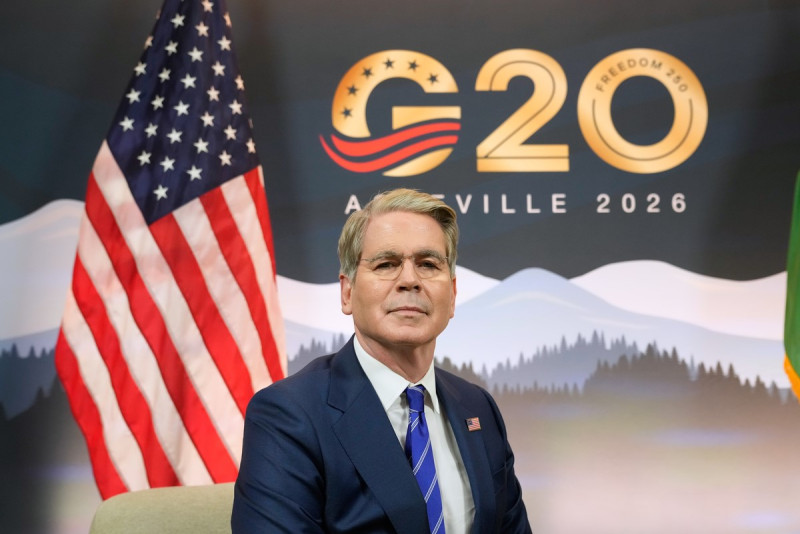
US Treasury Secretary Scott Bessent will urge G20 members to re-examine their trade relations with China and push Beijing to rebalance its economy towards domestic consumption, warning that the country’s export-driven growth is contributing to unsustainable global imbalances.
Speaking ahead of a G20 finance leaders’ meeting, Bessent said the current surge in Chinese exports could not continue, despite an improvement in the United States’ direct trade position with China.
“The world cannot have a China with a $1.2 trillion trade surplus,” Reuters reported Bessent saying.
“In China, the economy is quite weak, and they are trying to export their way out of it, and they need to rebalance their economy.”
Bessent’s call for a coordinated response comes as legal setbacks have forced Washington to rebuild parts of its tariff policy, while restrictions on Chinese imports into the US have contributed to greater flows of Chinese goods into other markets, particularly Europe and Latin America.
The US has sought to shield its economy from a range of Chinese goods through high tariffs and outright bans on some products, including automobiles.
Bessent said he had warned other major industrial economies last year that they would face pressure from the surge in Chinese imports, adding that they now faced difficult choices.
He said other countries would need to provide Beijing with incentives to reduce its reliance on exports and strengthen chronically weak domestic demand.
“The rest of the world is going to have to examine their terms of trade with China,” Bessent said.
The US is also pushing for a joint G20 statement aimed at reducing global trade and current-account imbalances.
Tariffs introduced after President Donald Trump returned to office in 2025 have helped reduce the US trade deficit with China by about one-third in the first six months of 2026 compared with the same period last year, to US$73.9 billion, according to US Census Bureau data.
Bessent rejected suggestions that a coordinated effort to strengthen the yuan would be sufficient to address the imbalance.
He also dismissed calls for a new “Plaza Accord”, referring to the 1985 agreement aimed at strengthening major currencies against the US dollar, arguing that such an approach would avoid addressing what he described as the underlying trade problems.
He pointed instead to excessive Chinese industrial subsidies and weak domestic demand.
US-China Summit
Bessent said it remained unclear whether he would meet Chinese Vice Premier He Lifeng in person ahead of a planned late-September meeting between Trump and Chinese President Xi Jinping.
US and Chinese officials are expected to continue discussions ahead of the summit on possible tariff reductions covering non-strategic goods, as well as safeguards aimed at preventing powerful artificial intelligence models from falling into the hands of non-state actors.
“I think that there probably are $30 billion of non-strategic, non-critical goods on each side that we could take the tariffs off,” Bessent said.
The September summit comes as Washington rebuilds parts of Trump’s tariff regime after the US Supreme Court struck down broad duties imposed under an emergency law, including a 20 per cent tariff on Chinese imports.
The Trump administration imposed a 12.5 per cent tariff on Chinese imports in July under an anti-forced-labour trade investigation and is expected to introduce additional tariffs linked to excess industrial capacity under a separate investigation.
Bessent also said he planned to hold a bilateral meeting with People’s Bank of China Governor Pan Gongsheng during the G20 conference in Asheville, but declined to provide details. - August 31, 2026