KABUL – Women presenters on Afghanistan’s leading news channels went on air today with their faces covered, a day after defying a Taliban order to conceal their appearance on television.
Since seizing power last year, the Taliban have imposed a slew of restrictions on civil society, many focused on reining in the rights of women and girls to comply with the group’s austere brand of Islam.
Earlier this month, Afghanistan’s supreme leader Hibatullah Akhundzada issued a diktat for women to cover up fully in public, including their faces, ideally with the traditional burqa.
The feared Promotion of Virtue and Prevention of Vice Ministry ordered women TV presenters to follow suit from yesterday.
But the presenters defied the order and went on air with their faces visible, only to fall in line with the directive today.
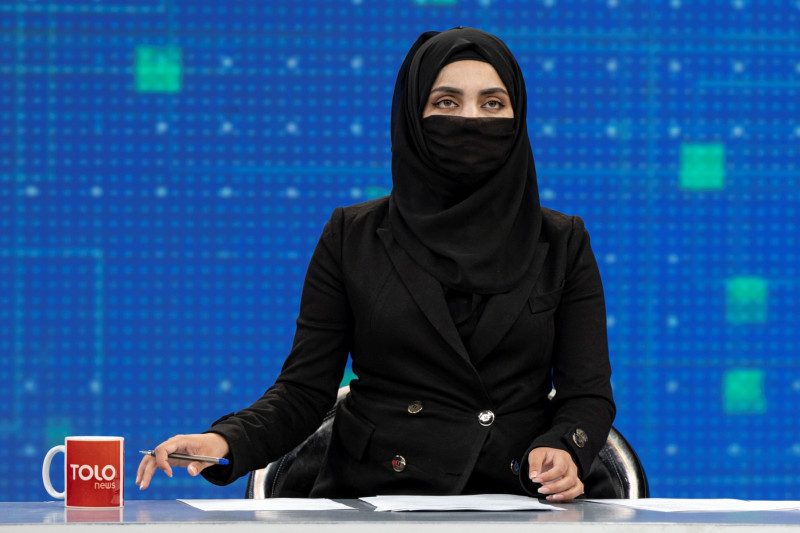
Wearing full hijabs and face-covering veils that left only their eyes in view, women presenters and reporters aired morning news bulletins across leading channels like TOLOnews, Ariana Television, Shamshad TV and 1TV.
“We resisted and were against wearing a mask,” Sonia Niazi, a presenter with TOLOnews, said.
“But TOLOnews was pressured and told that any female presenter who appeared on screen without covering her face must be given some other job or simply removed,” she said.
“TOLOnews was compelled and we were forced to wear it.”
Women presenters were previously only required to wear a headscarf.
TOLOnews director Khpolwak Sapai said the channel was “forced” to make its staff follow the order.
“We were told ‘You are forced to do it. You must do it. There is no other way’,” Sapai said.
“I was called on the telephone yesterday and was told in strict words to do it. So, it is not by choice but by force that we are doing it.”
‘Not against women presenters’
Today, male journalists and employees of TOLOnews wore face masks in the channel’s offices in Kabul in solidarity with women presenters, according to reports.
Other women employees of the channel continued to work with their faces visible.
Ministry spokesman Mohammad Akif Sadeq Mohajir said authorities appreciated that media channels had observed the dress code.
“We are happy with the media channels that they implemented this responsibility in a good manner,” he said.
Mohajir also said that the authorities were not against women presenters working in the channels.
“We have no intention of removing them from the public scene or sidelining them or stripping them of their right to work,” he said.
Akhundzada’s decree orders authorities to fire women government employees if they fail to follow the dress code.
Men working in government also risk suspension if their wives or daughters fail to comply.
Authorities have also said that media managers and guardians of defiant women presenters would be liable for penalties if the diktat was not observed.
During two decades of US-led military intervention in Afghanistan, women and girls made marginal gains in the deeply patriarchal nation.
Soon after resuming control, the Taliban promised a softer version of the harsh Islamist rule that characterised their first stint in power from 1996 to 2001.
Since the takeover, however, women have been banned from travelling alone and teenage girls barred from secondary schools.
In the 20 years after the Taliban were ousted from office in 2001, many women in the conservative countryside continued to wear a burqa.
But most Afghan women, including TV presenters, opted for the Islamic headscarf.
Television channels have already stopped showing dramas and soap operas featuring women on the order of Taliban authorities. – AFP, May 22, 2022