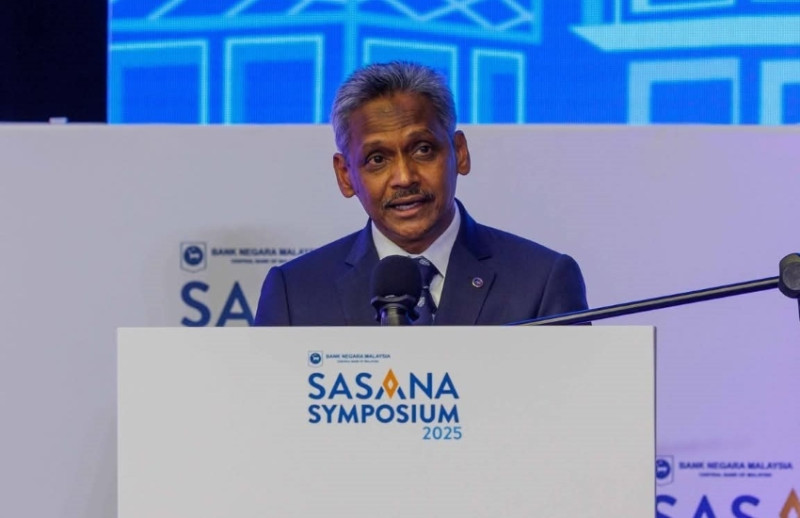
MALAYSIA must accelerate structural reforms to strengthen economic resilience and position itself for the next phase of growth as global uncertainties, technological transformation and climate challenges reshape the economic landscape, Bank Negara Malaysia (BNM) Governor Dato’ Sri Abdul Rasheed Ghaffour said today.
Delivering the keynote address at Sasana Symposium 2026 (SS2026) at Sasana Kijang on Tuesday, Abdul Rasheed said resilience required continuous adaptation and renewal rather than simply preserving existing systems.
“Resilience is not about preserving things exactly as they are. It is about continually renewing our ability to adapt and seize new opportunities as circumstances evolve,” he said.
The two-day symposium, held on 28 and 29 July, brings together policymakers, industry leaders, academics and civil society representatives to examine major issues shaping Malaysia’s economic and financial outlook, including wages, cost of living pressures, investment, energy security, Islamic finance and healthcare costs.
Abdul Rasheed said structural reforms were increasingly important as the global economy entered a period marked by geopolitical fragmentation, artificial intelligence-driven disruption and more frequent climate-related shocks.
While monetary policy remained a key tool in maintaining price stability, he stressed that it could not independently resolve deeper structural challenges affecting productivity and competitiveness.
“This is where structural reforms come in. At their core, structural reforms are an investment in the economy's future. They make the economy more productive, competitive and resilient,” he said.
He said Malaysia’s reform efforts in recent years had centred on two priorities — expanding productive capacity and rebuilding fiscal strength.
Malaysia has approved RM815 billion in investments over the past two years, with a significant share channelled into advanced manufacturing, semiconductors, digital technologies and modern machinery.
According to Abdul Rasheed, these investments were not merely increasing economic capacity but also transforming the structure of the economy by creating pathways towards higher-value industries, stronger incomes and better-quality jobs.
However, he warned that Malaysia’s future competitiveness could not rely on low-cost labour, but must instead be driven by innovation, technology adoption and a more skilled workforce.
“The most direct way for growth to be felt is through better jobs. Jobs that create more value. Jobs that pay more,” he said.
He noted that the proportion of high-skilled employment had risen from 27.5 per cent in 2019 to 30.1 per cent in 2025, while the RM815 billion investment pipeline could potentially create nearly 245,000 jobs if fully realised.
Nevertheless, Abdul Rasheed said workforce transformation remained a major challenge, with more than two-thirds of Malaysians still employed in low- and medium-skilled occupations.
He said continuous upskilling and reskilling would be essential as artificial intelligence and digital technologies reshape industries and alter the nature of work.
“The days of learning a skill once and relying on it for a lifetime are over. Workers will need opportunities to continuously upskill and reskill throughout their careers,” he said.
On fiscal reforms, Abdul Rasheed highlighted Malaysia’s progress in reducing its fiscal deficit from 6.2 per cent of gross domestic product (GDP) in 2020 to 3.7 per cent in 2025.
He said stronger public finances were crucial to ensuring the Government had sufficient capacity to support national priorities, including education, healthcare, infrastructure, climate resilience and social protection.
“These efforts were aimed at strengthening the Government's ability to respond when shocks occur, while ensuring sufficient resources remain available to invest in Malaysia's long-term priorities,” he said.
The Governor said Malaysia’s recent economic performance reflected the benefits of earlier reforms, with the economy expanding by 5.2 per cent last year, inflation remaining manageable and the ringgit emerging as the region’s best-performing currency.
He also pointed to Malaysia’s successful issuance of a US$1.5 billion Global Sukuk as evidence of continued investor confidence, after the offering attracted demand of almost five times the amount issued and achieved record-low spreads.
Looking ahead, Abdul Rasheed said Malaysia’s next phase of development must focus on ensuring economic growth translates into tangible improvements for households through stronger wages, better employment opportunities and improved living standards.
He said Malaysia needed to move from value extraction towards value creation by strengthening domestic capabilities, encouraging innovation and ensuring investments generated long-term benefits.
“The objective is therefore not simply to bring investment into Malaysia. It is to ensure that investment leaves something behind. From deeper capabilities to new technologies. And ultimately, better opportunities for Malaysians,” he said.
On the financial sector, Abdul Rasheed said BNM’s upcoming Financial Sector Blueprint 2027–2030 would be guided by three key aspirations — finance for a more resilient society, finance for a more prosperous society and a future-proof financial system.
He said the financial sector must continue supporting sustainable development, directing capital towards productive investments and enabling Malaysian businesses to innovate, expand and compete globally.
During SS2026, BNM also launched iTEKAD Employment, the latest initiative under its social finance programme to help vulnerable communities secure stable employment and sustainable income.
The programme brings together financial institutions, funding partners, training providers and corporations to provide participants with skills training, financial education, employment placement support and access to financial solutions.
Abdul Rasheed said Malaysia’s future resilience would depend on collaboration among government, businesses, financial institutions and communities.
“The next chapter of Malaysia’s story will not be determined by global events alone. It will be shaped by how we respond to them,” he said. - July 28, 2026