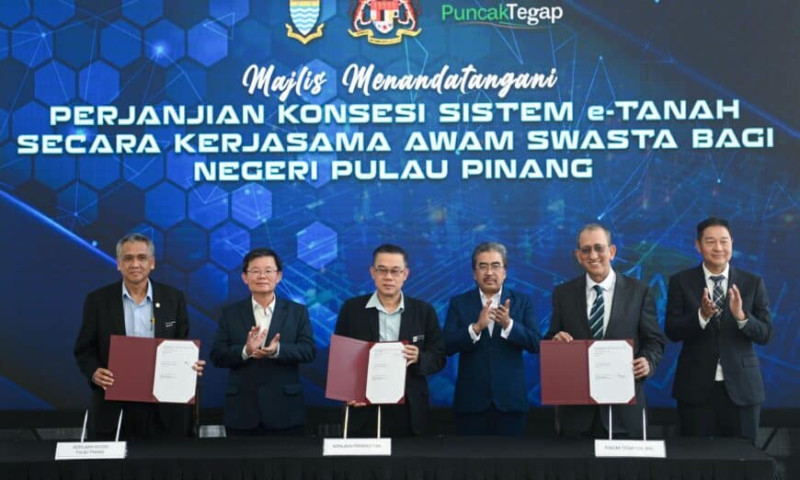

THE edge in embracing digitalisation has seen Penang lead the way in online connectivity after the state signed a public-private partnership (PPP) concession agreement to manage an online land administration system.
Called the e-Tanah system, the land digital eco-system will allow the state to undertake efficiency, transparency, and digital integration transaction for land administration matters, especially with the state embarking on large scale land reclamation projects.
Penang will have an additional landbank of some 1,500ha within the next few years, namely through reclaiming of the Silicon Island, the Gurney Wharf expansion, the Seri Pinang project, a proposed Linear Waterfront project and the controversial Jelutong landfill reclamation and rehabilitation project.
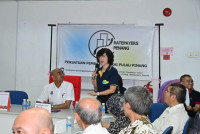
Chief Minister Chow Kon Yeow, who witnessed the signing, described the moment as “a catalyst for Penang’s digital governance ambitions under Penang2030”.
“This agreement is not merely a contract but a turning point in modernising our land administration. We want a system that is efficient, fast, secure and people-centric, fully aligned with our Penang2030 vision,” Chow said.
Penang 2030 is Chow's legacy for Penang; a comprehensive development policy to inject a quality of life, good jobs and the importance of the family institution.
Plantations and Commodities Minister Datuk Seri Johari Abdul Ghani was present to witness the occasion.
Johari is also the Acting Minister of Natural Resources and Environment Sustainability.
Chow expressed appreciation to Johari's ministries, the Department of the Director General of Lands and Mines, the Public-Private Partnership Unit of the Prime Minister’s Department (UKAS), and the Federal Government for enabling the system to proceed under the Private Finance Initiative (PFI).
The concessionaire is Puncak Tegap Sdn Bhd, will be accorded 14 - years to manage the e - Tanah application for all digital matters related to land administration.
Penang has been operating on the first-generation e-Tanah system since 2008, but structural issues during development and execution have long weighed down performance, Chow explained.
Users faced slow processes, limited functionality and persistent inefficiencies despite RM8.3 million spent on maintenance and upgrades.
The need for a next-generation system became urgent as Penang moves into an era of large-scale reclamation projects, including Andaman Island and Silicon Island Phase 1.
These projects, with a combined gross development value exceeding RM100 billion are expected to push land title and strata registrations from 15,000 annually to between 25,000 and 30,000 over the next decade.
“With rising applications for land ownership transfers, leases, strata matters and State Executive Council (Exco) approvals, Penang urgently requires a modern, reliable and integrated digital platform,” Chow said.
He welcomed the introduction of the upgraded eTanah Solution, emphasising that user experience and data accuracy must be at the heart of the system.
Beyond the new e-Tanah platform, Penang is already pushing boundaries in digital governance.
Its PgLAND system, launched in 2023, has digitised key processes such as title transfers, registrations and land searches.
Usage has skyrocketed by 73%, from 103,000 users to 178,860 in 2025, CHow revealed.
“We want PgLAND to become a fully efficient digital platform for land and parcel tax collection. Integration with e-Tanah will strengthen Penang’s overall digital delivery ecosystem,” he said.
He reaffirmed Penang’s commitment to fulfilling all concession obligations and called on all parties to uphold the same spirit of cooperation. - December 2, 2025