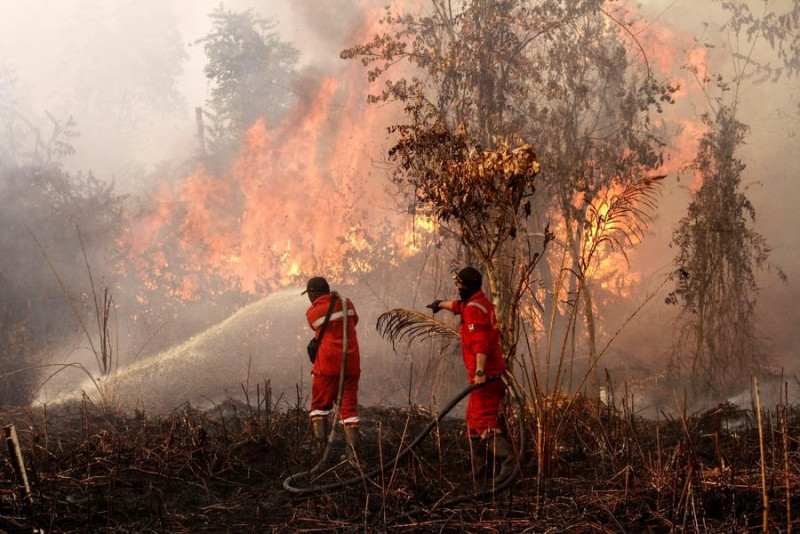
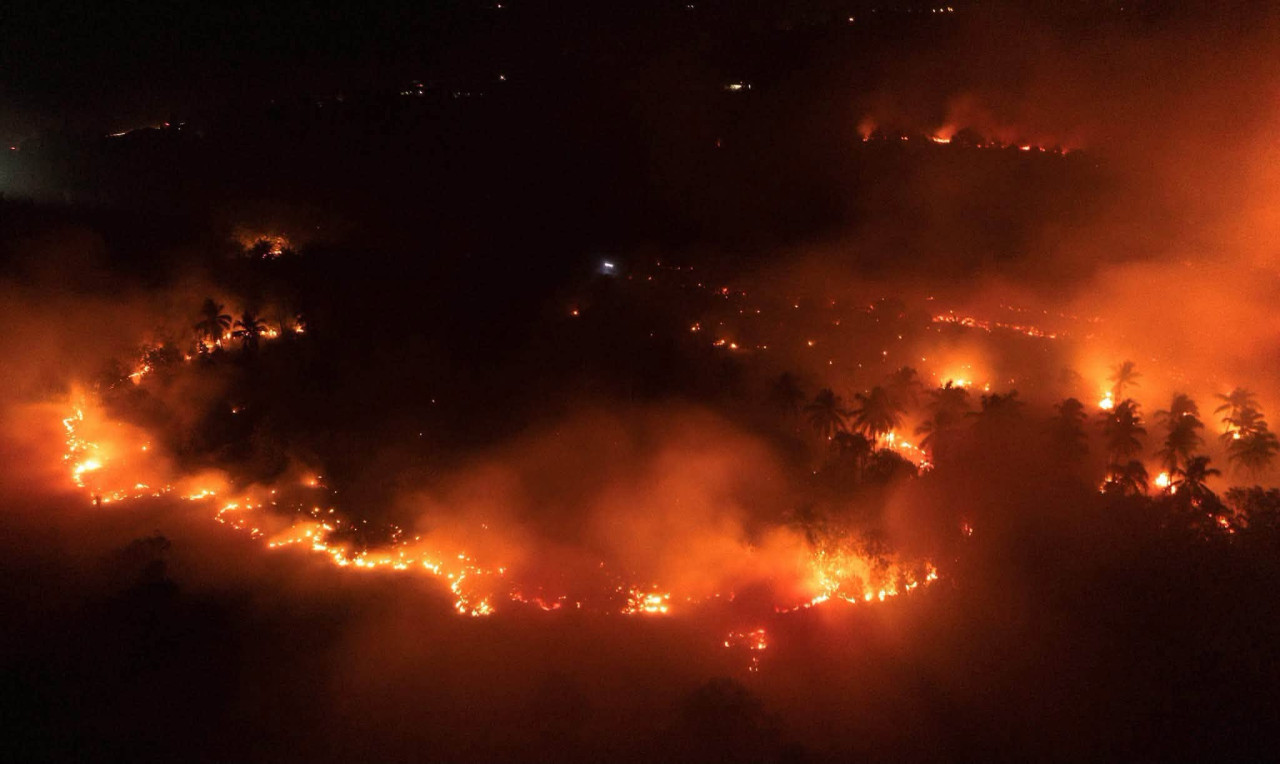
INDONESIA’S return of widespread forest and land fires in 2026 has exposed persistent weaknesses in fire prevention a decade after the country’s worst haze crisis, despite reforms that have helped keep the scale of burning below the levels recorded in 2015 and 2019.
Nearly 900,000 hectares had burned by late August, according to independent forest monitoring platform Nusantara Atlas, while Indonesia’s Health Ministry recorded 113,336 wildfire-related respiratory infections across seven affected provinces as at Sept 9, more than double the 50,891 recorded on Sept 1.
The fires have also sent smoke towards neighbouring Singapore and Malaysia, reviving concerns over a recurrence of the severe regional haze that followed Indonesia’s 2015 fires.
The Straits Times reported on Sunday that the current fire season, however, remains significantly smaller than 2015, when about 2.6 million hectares burned, and 2019, when another 1.65 million hectares were affected.
The reduction reflects measures introduced after 2015, including tougher enforcement, peatland restoration and earlier fire detection.
But the 2026 fires have highlighted areas where those measures remain vulnerable, including the continued economic appeal of land clearing by fire, the return of hotspots in concessions and the loss of a dedicated government agency responsible for peatland restoration and monitoring.
Forestry Minister Raja Juli Antoni said on Sept 16 that the wildfires could continue until early November, with the rainy season expected to arrive later than previously forecast.
Burning Remains Cheaper
In South Kalimantan, clearing land without fire remains considerably more expensive than burning it.
Fitria Khairani, who heads Syamsudin Noor village, said hiring an excavator cost about 1.25 million rupiah (S$90) to 1.5 million rupiah a day, including an operator, and could clear roughly one hectare daily.
“If it is burned (instead), it is indeed fast, especially when the land is dry,” she said.
Some people also believe burning makes soil more fertile, she said, although established farmers in the village generally use excavators or clear land manually.
A World Bank study released in 2021 found a similar cost gap. Small-scale operators in Sumatra, Kalimantan and Papua spent about 3.5 million rupiah per hectare clearing land with fire, compared with 4.6 million rupiah manually, 6.6 million rupiah using semi-mechanical methods and 7.7 million rupiah mechanically.
The study found that higher upfront costs for non-burning methods could be offset by better returns when they were combined with improved agricultural practices.
Authorities have also raised concerns that some fires may be deliberately started for payment.
Indonesia’s National Disaster Management Agency (BNPB) chief Suharyanto said on Sept 7 that a suspected fire-setter caught in Jambi had allegedly been paid 500,000 rupiah to set fire to forest land.
In West Kalimantan, officials found recently burnt land already being prepared for oil palm cultivation while fires were still burning elsewhere, he said.
“There are indeed deliberate efforts in the field to burn,” he added.
President Prabowo Subianto has ordered authorities to investigate who was behind the fires and how quickly burnt land could be converted into plantation land.
Jakarta-based think-tank Center of Economic and Law Studies estimated on Sept 2 that forest and land fires between January and August could cost Indonesia between 39.29 trillion rupiah and 123.1 trillion rupiah in economic and health losses.
Enforcement Improved, But Sanctions Remain Limited
In Syamsudin Noor, community leader Hendri Wibowo said the threat of punishment had changed farmers’ behaviour.
“The farmers do not dare to do it. Even burning now, in conditions this dry, they really do not dare,” he said.
Indonesia’s National Police specific crimes director Mohammad Irhamni said on Sept 17 that police had launched 219 criminal investigations relating to forest and land fires and named 162 suspects. Police were also investigating 95 companies, although it was unclear how many were suspected of criminal offences.
Prabowo has called for tougher penalties and said there would be “no tolerance” for companies responsible for forest and land fires.
“And perhaps we should ask the House of Representatives to stiffen the law, so that we classify this as ‘ecological terrorism’. This is very serious,” he said at a Cabinet meeting on Sept 16.
He also instructed regional governments to immediately revoke regulations allowing land to be cleared by burning and ordered companies found responsible for fires to have their licences revoked and face criminal investigations.
But the most severe sanction — revoking a company’s operating licence — has historically been uncommon.
Environment and Forestry Ministry figures show that three licences were revoked in connection with forest and land fires between 2015 and 2017, all in 2015. Other companies received administrative sanctions including licence suspensions, government orders and warning letters. A consolidated official tally for subsequent years was not publicly available.
Environmental group WALHI said it detected 33 high-confidence hotspots in August within the concession of PT Bumi Mekar Hijau, which had previously been ordered by an appeals court to pay about 78 billion rupiah in compensation over an earlier fire.
A hotspot within a concession does not by itself establish that a company started a fire or is legally responsible for it.
The Forestry Ministry has also imposed sanctions on concession holders this year, including suspending the business permit of PT MPK in August.
Peatland Prevention Under Strain
Peatlands account for less than 10 per cent of Indonesia’s land area but made up about a third of the area burned in 2015.
Once drained, peat can dry out and burn underground, making fires harder to extinguish and generating large amounts of smoke.
After the 2015 crisis, then president Joko Widodo established the Peatland Restoration Agency (BRG), appointing Nazir Foead to lead it in 2016.
Nazir told The Straits Times that the agency mapped vulnerable peatlands and installed hundreds of monitoring stations across seven provinces. Sensors monitored groundwater levels, moisture and temperature, sending data to a central server every hour.
Combined with weather forecasts, the data helped authorities identify areas becoming dangerously dry and determine where patrols or peat rewetting should be prioritised.
Satellite-detected hotspots could then be checked on the ground or with drones, allowing firefighting teams to be deployed before fires penetrated deeper into peat.
Nazir said community patrols also needed equipment, fuel and other resources.
“If we train the community already, but we don’t provide them assistance in resources, it’s difficult for them to move because who would pay? They are full-time farmers,” he said.
The BRG later became the Peatland and Mangrove Restoration Agency (BRGM), whose temporary mandate ended in 2024.
Nazir said the agencies were never intended to exist permanently, with their equipment, software and expertise handed over to other government agencies and local authorities.
“You need to maintain that, and of course you need people and money to maintain it,” he said.
He said the environment and forestry ministries now had broader responsibilities amid budget cuts.
“The priorities of the current government are very different. There are big budget cuts,” he said.
Environmental group Pantau Gambut said in a July study that 70 per cent of canal blocks it observed were damaged, while 52 per cent of intervention sites still had groundwater levels below the safe threshold.
CELIOS has called for an integrated ecosystem-restoration team, saying restoration efforts had not been running optimally since BRGM ended.
BNPB’s disaster-resilience programme was allocated 250 billion rupiah in the 2026 state budget, down from a 1.77 trillion rupiah outlook for the same programme in 2025.
Singapore Institute of International Affairs chairman Simon Tay cautioned against allowing anger over the haze to turn into finger-pointing.
“The anger is real, not only in Malaysia and Singapore, but among Indonesians themselves. That’s very understandable but not the best response,” he said.
“Anger and apportionment of blame can trigger bickering and finger-pointing. Right now, (the focus is) firefighting and prevention – with cooperation between companies and government officials in the provinces and Jakarta, and between governments (in the region),” he added.
Nazir said he did not know how much of the coordination established under BRG and BRGM remained, and did not argue for simply recreating the agencies.
Instead, he said the Government should examine what had failed during the current fire season and ensure someone was clearly responsible for preparations before the next dry season.
That responsibility could sit with existing ministries or a task force, he said, but whoever led it would need sufficient authority to coordinate ministries and governors.
“Someone has to lead from the palace,” he said.
Firefighting Stronger Than Prevention
Indonesia retains substantial capacity to fight fires once they have started.
BNPB said on Aug 21 that 39 air assets were operating across six priority provinces, including patrol helicopters, weather-modification aircraft and water-bombing helicopters.
In South Kalimantan, the contrast between national firefighting resources and local capacity was evident as helicopters dropped water from above while volunteers tackled fires on the ground with basic equipment.
“How are we supposed to extinguish fires if we do not have the equipment? Never mind equipment, some of them do not even have PPE (personal protective equipment), and that could endanger their lives,” Fitria said.
For Hendri, the problem also persists after fires are extinguished. He estimated that almost 40 per cent of his neighbourhood consisted of vacant plots, many owned by people who lived elsewhere. Fires frequently started on such idle land, sometimes, he believed, as a means of clearing vegetation.
The plots were often left untouched after burning, allowing vegetation to grow back and recreate the same fire risk during the following dry season.
Before farmers began cultivating some of the vacant plots, Hendri said fires could spread through them “right up behind people’s houses, up to their kitchens”.
Farmers’ groups have since begun cultivating some previously idle land, which he said had helped because cultivated land “breaks the path of the fire”.
“As long as these vacant, idle plots are not maintained, this will definitely happen again every year,” he said. - September 20, 2026