
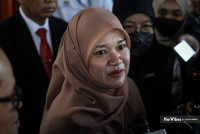
KUALA LUMPUR – The issue of stateless children not being allowed to attend school continues to plague the present government, claims Kulai MP Teo Nie Ching.
Teo, who is former deputy Education minister, said Senior Education Minister Radzi Jidin had promised to provide an answer in writing to this issue on December 8 but she has yet to receive it.
Citing a present case where a child was adopted by Malaysian parents but was unable to be registered for school, Teo questioned whether the Perikatan Nasional (PN) administration had reversed the policy for non-citizen children.
“The child was born in 2014, and adopted by parents, both Malaysians, in 2017. The parents have obtained the adoption certificate issued by the National Registration Department (NRD).
“For next year, he (the child) has applied to enter Standard 1 at a government school. But a letter sent out from Johor Education Department had requested him to go to the Immigration Department to apply for a student pass.
“For the child to obtain a pass, the parents must apply to the Immigration Department and present his passport.
“How is the boy going to present his passport? Although he has made an application for citizenship in 2017, his application has yet to be approved,” she told reporters at the Dewan Rakyat here today.
Teo said until the boy is awarded citizenship from the Home Ministry, he has no passport and is considered a non-citizen.
“We cannot say that the adoptive parents are lazy, they have done all they can for their child. Also, not every parent can afford private education.
“How will this 7-year-old child get his education?" she asked.
Teo pointed out that during the Pakatan Harapan (PH) administration, non-citizen children with parents who are citizens can apply to join a school with either one of the following documents – adoption certification from NRD, a court order on guardianship or a letter confirming the adoption from the Welfare Department.
“During the PH reign, this child would not have faced such issues. But now, it is sad to see that this boy is being asked to obtain a student pass,” she said.
Stressing that access to education is the right for all children, Teo expressed hope that the Education Ministry will look into this matter.
On December 2018, PH had announced that all stateless and undocumented children would be able to go to school from 2019 onwards, provided their parents or guardians are able to present the relevant documents.
The move was part of the Education Ministry’s initiative to simplify the registration process for children without citizenship into government schools.
Parents need only present relevant documents and pay a small fee when registering, using the First Schedule P.U.A (275), at State Education Departments or District Education Offices.
Children without citizenship can still register with government schools or government-assisted schools despite provisions in the Education Act 1996 or Act 550, which require that every pupil must be a citizen.
As of 2018, there are currently 29,960 stateless children who have registered and have been accepted into government and government-assisted schools.
However, these children will not be eligible to receive aid, such as the Textbook Loan Scheme, Supplementary Food Programme and other special assistance. – The Vibes, December 16, 2020



.jpg)





.jpeg)