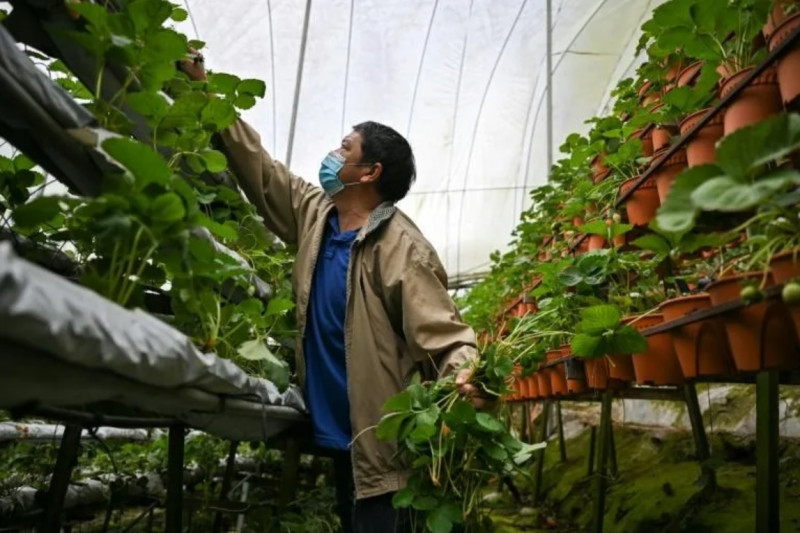
FARMERS may consider raising the price of their vegetables by 10% to 15% in the coming months if they do not get diesel subsidies to sustain their operations.
Malaysian Federation of Vegetable Farmers Association president Lim Ser Kwee said they have requested for diesel subsidies, but many did not get it because they are smallholders who do not fulfil the requirements for diesel subsidies.
He said currently they have about 6,000 members nationwide including in Sabah and Sarawak.
“In the coming months we can expect to see about 10% to 15% of the farmers closing shop. So far, in the first half of this year about 6% have shut down their operations.
“If farmers are burdened and do not see any profit, then they will give up," Lim said.
He said the removal of diesel subsidies has increased the operational burden for all smallholders.
“Although the government has introduced diesel subsidies for commercial and transport vehicles, 90% of agricultural machinery, including water pumps, are used for crop irrigation purposes.
“This does not fulfill the requirement for the diesel subsidy," Lim said.
According to the Budi Madani Subsidy Aid Programme (Budi) farmers or smallholders whose companies are registered with the relevant agencies will receive the subsidies.
They must also be active commodity smallholders with an annual turnover of between RM50,000 and RM300,000 from farming or commodity production.
The Finance Ministry (MOF) had said all eligible recipients will receive RM200 monthly in financial aid as part of the targeted subsidy programme for diesel.
Lim said they are also facing the issue of vegetables from Thailand, Indonesia, Vietnam and other neighbouring countries flooding the local market that are sold cheaply.
Another factor affecting the farmers are prices that are set by the wholesalers.
“Most farmers sell their produce to wholesalers who determine the prices. So, this makes it difficult for farmers to determine the selling price.
“Also, the implementation of e-invoicing will increase the burden on small farmers. This is because there are differences in the level of their education and ability to use technology for each individual smallholder," Lim said.
He also said another issue is the increase in the price of fertiliser which is adding to the burden of all smallholders.
“Under pressure with these various challenges, many smallholders are expected to stop growing vegetables and switch to other crops as the burden of maintenance costs increases.
Lim said they sent a letter to the Finance Ministry last month, suggesting that with an estimated vegetable production of 1 million metric tons per year the government should reintroduce vegetable production incentives.
“For the production of each metric ton of vegetables, an incentive of at least RM120 per ton should be given to smallholders.
“With this amount we can cover diesel costs, fertiliser, workers' salary, operation costs and others.
“We hope this proposal will be considered seriously by the government. We need help to ensure the survival and development of the vegetable farming industry in Malaysia as well as the well-being of farmers," Lim added. – July 23, 2024.










_Datuk_Rusdi_Mohd_Isa._Facebook_pic..png)