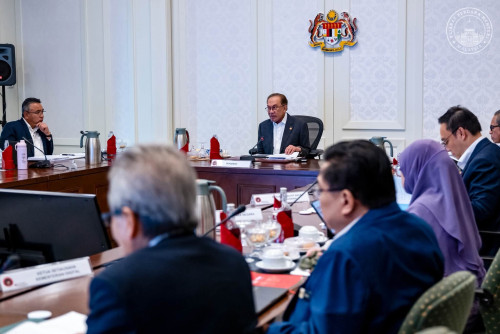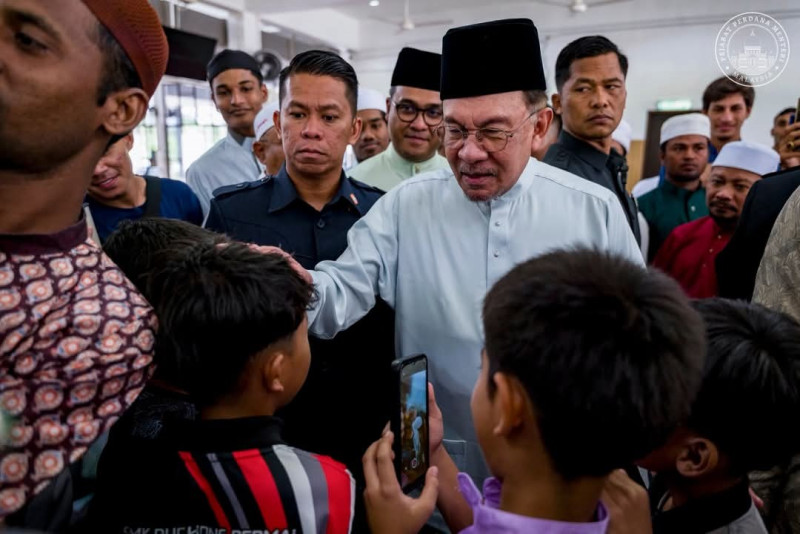
PRIME MINISTER Datuk Seri Anwar Ibrahim has urged corporate leaders and sponsors of the MADANI Adopted School initiative to actively engage with their adopted schools, stressing that personal visits can inspire students and reinforce the value of education.
Launching the initiative in Kuala Lumpur, Anwar — who also serves as Minister of Finance — said corporate involvement must go beyond financial contributions, and include mentoring and direct interaction with students.
“I want to emphasise that it is important that companies and corporate figures share their experience and successes with students... then the children will be attracted to emulate them,” he said.
“If you don’t have time, once a month, once every two or three months or at least twice a year, go down to the school yourself. Give the children a little tea and explain what education means and how education can change in terms of social mobility.”
Anwar underlined that the programme was more than a typical corporate social responsibility (CSR) exercise.
“It is beyond CSR. We are talking about compassion when they take responsibility to build this nation together, ensuring that no one is left behind. There is no point talking about purely impressive growth figures, investment figures, if we do choose to neglect the poor and the marginalised.”
He noted that the private sector’s participation was helping to alleviate pressure on government resources, particularly in terms of educational infrastructure.
“When we ask for cooperation, no one refuses. At least two schools will be given \[support], some big companies will be given 30 schools. So I ask the Ministry of Education to give full cooperation \[to the companies involved], at all levels.”
Companies involved in the programme include Sime Darby Foundation, Petronas Foundation, UEM Foundation, and TM Foundation. Launched in April, the initiative is jointly overseen by the Ministry of Education (MOE) and the Ministry of Finance.
Nearly 1,000 schools have been adopted under the scheme, with backing from around 117 private firms. The aim is to close the education gap between rural and urban areas.
Education Minister Fadhlina Sidek said the programme reflects the government’s belief that ensuring quality education is a collective responsibility.
“By combining the expertise of the government and private sectors, this programme aims to ensure that no student is left behind,” she said.
“Initially, we only targeted 500 schools, but we see the commitment and feel it would be unfair if we do not invite the bodies \[companies] that have long focused on our schools.”
Fadhlina explained that the adopted schools would benefit across five key areas: infrastructure and facility upgrades; academic enrichment and guidance; teacher training and professional development; financial support and scholarships; and student character and skills development.
“Therefore, the focus is not only on one segment but more broadly, while the overall development of the school not only includes infrastructure development but also human development is given attention.”
According to the MOE, the initiative has drawn support from 32 private firms, 29 government-linked companies (GLCs), 29 government agencies, 29 government-linked investment companies (GLICs), and 27 firms under the Minister of Finance (Incorporated).
Each sponsoring organisation is matched with a school according to the latter’s needs and the former’s capacity, in order to build long-term, meaningful partnerships that incorporate skills training, mentoring and capacity building alongside financial aid.
The first phase of the programme is set to conclude on 31 December, with the potential for an extension depending on its outcomes. - June 20, 2025